


US Forces Board a Sanctioned, Venezuela-Linked Tanker in the Indian Ocean
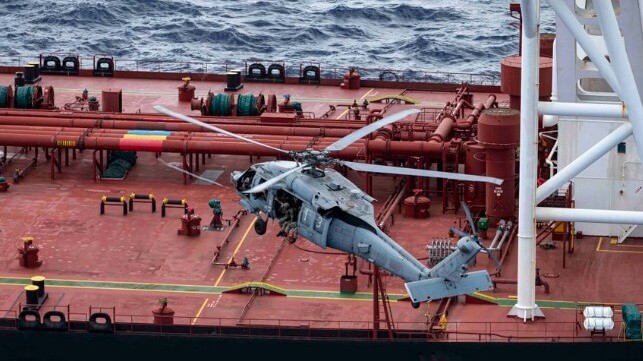
Overnight Saturday, U.S. forces carried out a boarding of the sanctioned tanker Veronica III, the ninth vessel affected by a U.S. military flag verification boarding and/or seizure since the partial blockade of Venezuelan oil shipments began in December.
The boarding occurred at an undisclosed location in the Indian Ocean, and video from the scene shows that the helicopter boarding teams were accompanied by an Arleigh Burke-class destroyer. The daylight operation occurred without incident, the Pentagon said in a statement.
"The vessel tried to defy President Trump’s quarantine - hoping to slip away. We tracked it from the Caribbean to the Indian Ocean, closed the distance, and shut it down. No other nation has the reach, endurance, or will to do this," the Pentagon said in a statement. "International waters are not sanctuary. . . . The Department of War will deny illicit actors and their proxies freedom of movement in the maritime domain."
We defend the Homeland forward. Distance does not protect you.
— Department of War ???????? (@DeptofWar) February 15, 2026
Overnight, U.S. forces conducted a right-of-visit, maritime interdiction and boarding of the Veronica III without incident in the INDOPACOM area of responsibility.
The vessel tried to defy President Trump’s… pic.twitter.com/Tran3cLR9g
Veronica III is under way in laden condition, and the military did not specify what would happen to the vessel or her cargo. On Sunday, the tanker resumed AIS transmission after a long period running dark; as of Monday morning local time, she was making six knots on a northeasterly course near the Cocos Islands, headed slowly towards the Sunda Strait.
In previous interdictions near Venezuela, captured tankers were diverted to Galveston or to neutral Caribbean islands for offloading and confiscation, or handed back for continued work in Venezuelan trades. The distances involved in overseas boardings would make these options more resource-intensive, as each ship requires a prize crew with law enforcement oversight for the voyage to its new home.
Veronica III is a stateless VLCC of 300,000 dwt. Built in 2006, she is operated by the entity Shanghai Future Ship Management Co., which is sanctioned by the U.S. Treasury for past involvement in Iran's oil trade. Like many shadow fleet tankers, she has served multiple "sensitive" crude trades over the years, including trade in Russian and Venezuelan oil.
Veronica III is one of 16 tankers identified by the New York Times' Visual Investigations desk for attempting to evade the U.S. "blockade" on Venezuelan oil exports. These ships departed in a wave shortly after the capture and exfiltration of former Venezuelan dictator Nicolas Maduro, potentially hoping to capitalize on the U.S. government's new focus on events on land.
The Pentagon has made clear that it maintains a blockade enforcement policy of track-and-board, regardless of distance. However, only one of the 16 fugitive vessels remains under way and seizable, according to TankerTrackers.com: Bertha (IMO 9292163), also known as Ekta.
Boarding without pay

that matters most
Get the latest maritime news delivered to your inbox daily.
Saturday's boarding occurred on the first day of a lapse in funding for the Department of Homeland Security, including its U.S. Coast Guard division. The lapse will likely result in a delay in pay for coastguardsmen, including pay for members of the service's highly trained counterterror security teams; these unique assets are reportedly in short supply relative to the demand for tanker interdictions, and officials have previously said that their availability is a limiting factor for the pace of boarding and seizure.
The U.S. Coast Guard recently announced that it is reorganizing these "deployable specialized forces" personnel under the newly-formed USCG Special Missions Command, to be helmed by a rear admiral.
