

Upsizing Continues with Cruise Ship Deliveries for Contemporary Segment
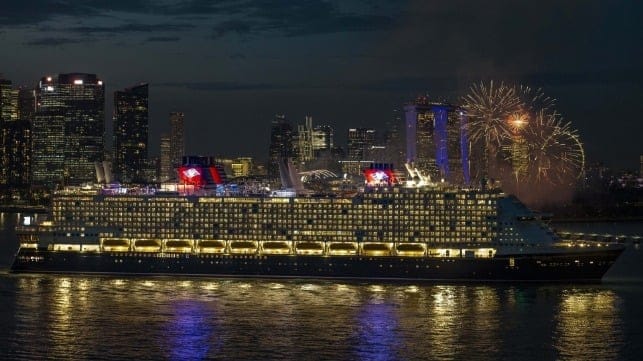
The contemporary segment of the cruise industry, which targets the broadest market, continues to focus on ultra-large ships as seen in the recent deliveries. Royal Caribbean International and TUI’s Mein Schiff each took delivery of large ships this month as the ultra-large segment dominates the cruise ship construction orderbook.
Driven by economies of scale and market expansion, the industry grew the size of cruise ships but largely plateaued for more than a decade in the range of 150,000 to 180,000 gross tons and a passenger capacity of 5,000 to 6,000 people. Long-time CEO of Royal Caribbean, Richard Fain, had said that the ships were getting larger to accommodate all the amusements that they sought to pack onto the ships.
For more than a decade, Royal Caribbean was the only line that surpassed the 200,000 gross ton mark, but that is quickly changing. On June 10, Royal Caribbean took delivery of the third sister in the Icon class, Legend of the Seas, which at 248,663 gross tons is the third ship claiming the title of the world’s largest cruise ship. It has a double occupancy of 5,610 passengers, a total capacity of around 7,600 passengers, and an additional 2,350 crew.
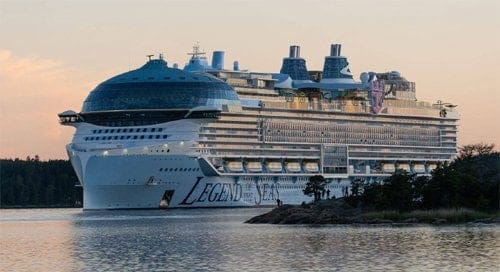
Legend of the Seas departing Finland on June 18 (Meyer Turku)
Whereas Royal Caribbean had long been the only one to exceed the 200,000 gross ton mark, MSC Cruises became the second with MSC World Europa (215,863 gross tons) delivered in October 2022. Disney Cruise Line joined this exclusive club in December 2025 with the delivery of Disney Adventure (208,108 gross tons), which entered service on March 10, 2026, sailing year-round from Singapore.
The bigger platform gives the cruise lines space to create more experiences. Disney Adventure features seven immersive themed areas, including the attention-getting San Fransokyo Street, where passengers stroll a “street” inspired by the Disney film Big Hero 6, or the Imagination Garden, which has a courtyard and stage for Disney storytelling. Royal Caribbean highlights additions to the Icon platform, saying Legend of the Seas continues the evolution of the class, increasing the dining options to 28, including a new supper club and a new food hall. Similarly, MSC will introduce its third World Class sister, MSC World Asia, in November with new entertainment, dining, and family experiences. It will have more than 40 bars and restaurants and feature the longest dry slide at sea.
The new ships are also getting more technologically advanced. Fincantieri delivered the second InTUItion class cruise ship to TUI on June 12. Mein Schiff Flow (157,651 gross tons) is at the smaller end of the ultra-large segment, but is 40 percent larger than the line’s prior ships. TUI highlights its added open space and an innovative design that increases proximity to the sea for the passengers. Below decks, it is dual-fuel, primarily using LNG, and this summer will bunker exclusively with bio-LNG in Barcelona, while the class is also capable of e-LNG in the future. It also has improved catalytic converters and shore power connections so that it will operate with almost zero emissions while berthed, which is about 40 percent of its operating time.
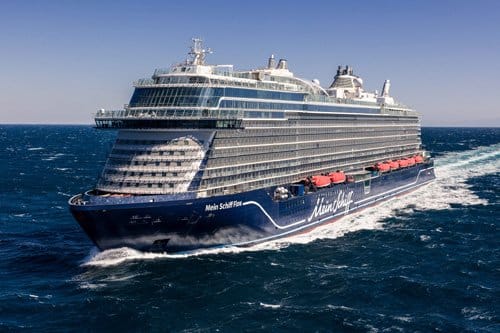
Mein Schiff Flow was christened on June 20 to start her maiden voyage (Fincantieri)
The broad market segment’s fixation on ultra-large ships has reshaped the orderbook. Fully 40 percent of the cruise ships on order will be ultra-large (165,000 gross tons or larger), and in the next decade, they will account for nearly three-quarters of the capacity additions. There are currently 19 cruise ships ordered (or optioned) that will be above 200,000 gross tons, and they account for nearly half the additional capacity for cruising.
Royal Caribbean has become focused on ultra-large ships, with orders and options for four additional Icon class ships for delivery by 2030, and on June 12, the first block for its seventh Oasis class ship (approximately 235,000 gross tons) was placed into the assembly dry dock at Chantiers de l’Atlantique, and is scheduled for delivery in 2028. The ships come with a giant price tag. Royal Caribbean told investors in April it completed €2.2 billion in financing, representing 80 percent of the construction contract for the fifth Icon. Due from Meyer Turku in 2028, the shipyard is already staging components while number four, Hero of the Seas, is still in the assembly dry dock.
Meyer Turku highlights that the series construction has enabled it to develop “production processes in a systematic way.” Royal Caribbean Group has booked shipbuilding capacity at the Finnish shipyard through 2036, with construction starting earlier this month on the components for the sixth Icon.
The next milestone is reportedly approaching as Fincantieri is expected to soon start steel cutting for Carnival Cruise Line’s Project Ace, which is projected at 230,000 gross tons and will carry almost 8,000 passengers. Carnival will become the next line in the exclusive club, with the first of three giants scheduled for delivery in 2029, followed by 2031 and 2033.
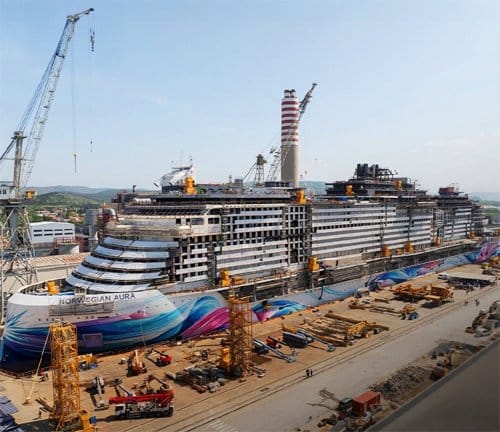
Norwegian Aura ready to be floated out in April (Fincantieri)
Norwegian Cruise Line is scheduled to introduce in 2027 its largest yet cruise ship, Norwegian Aura (approximately 170,000 gross tons). It was floated in April at Fincantieri’s Monfalcone shipyard, but it will be a stepping stone in the fleet. Norwegian has ordered five cruise ships, each at approximately 227,000 gross tons, which will start delivery in 2030, with deliveries approximately every two years and a fifth hull in 2037.

that matters most
Get the latest maritime news delivered to your inbox daily.
All the segments of cruising are upsizing their newbuilds. In the luxury segment the lines are now ordering ships between 75,000 and 85,000 gross tons, equal to the size of the largest Atlantic liners built in the era of steamship travel. For years, Royal Caribbean discussed plans for its future generation of ships that would be more versatile and replace existing smaller ships in the fleet. The order was finally revealed in January 2026 for two ships due in 2029 and 2032, and four options. The size of the ships was not announced, but a corporate filing report states that they will have a double occupancy capacity of approximately 4,300 berths, leading to speculation that these ships will be in the 150,000 to 160,000 gross ton range.
While there is speculation that the industry is reaching a new plateau in the maximum size of cruise ships, the discussion centers on how large the cruise ships can become and remain practical for the current ports and infrastructure.