


UK Appoints Salvage Company to Remove Masts from Famous WWII Wreck
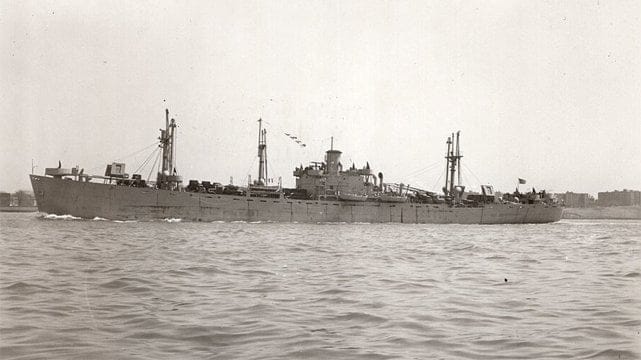
After six years of planning and annual surveys of the wreck site, the UK confirmed that it has selected a salvage company to remove the masts of the SS Richard Montgomery, a World War II Liberty ship that wrecked in the Thames Estuary in 1944. The wreck site became a popular tourist attraction, although all that is visible are the tops of three masts, but because the ship is still laden with explosives, people are warned to keep their distance.
The UK’s Department for Transport (DfT) officially has oversight of the wreck and confirmed to the BBC that it has appointed a leading salvage company to undertake the delicate job. The Telegraph newspaper reports that Resolve Salvage was selected, and the DfT confirmed that it expects to finalize the contract soon. The Telegraph says the work is expected to run for nearly a year until March 2027.
The Richard Montgomery was one of more than 2,700 WWII-built Liberty ships, a standardized design that the U.S. created at the start of the war and mass-produced to meet the needs for cargo and troops. The 10,000 dwt vessels were approximately 440 feet in length (135 meters), and, while known as a maritime workhorse, also earned some more dubious reputations due to their rapid construction. The average build time was brought down to just over 40 days, and in a 1942 publicity effort, one was built in under five days. At its peak, U.S. shipyards were turning out more than three Liberty ships a week.
The Richard Montgomery was commissioned in 1943. Her fateful voyage began in August 1944 when she was loaded with nearly 7,000 tons of munitions. Upon her arrival in the UK, she was assigned an anchorage in the shallow Thames Estuary near the Sheerness Middle Sands. She was waiting for a convoy to proceed to Cherbourg, but on August 20, 1944, during a storm, she dragged anchor and grounded.
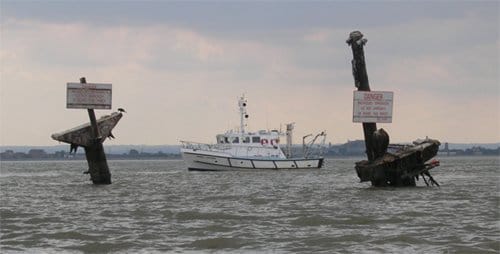
The masts are above the water level regardless of the tide (MCA)
A salvage effort ensued, and by most estimates, at least half of the munitions were salvaged by September 25, 1944. However, the ship broke her back, and as the water rose, the efforts had to be abandoned. The recent UK surveys have estimated that there are approximately 1,400 tons of explosives contained within the forward holds.
The ship is sitting on the bottom in two pieces. Two of three forward masts protrude from the water, attached to the ship near the holds containing the munitions. They are visible at all tide conditions, and long-ago warning signs were posted to stay away. The wreck, however, is just about 1.5 miles off the coast.
The DfT had started an effort in 2020 to remove the masts, but it had stalled out. Surveys, however, raise a concern as the hull continues to deteriorate, the masts are increasingly in danger of toppling over. One concern is that they could displace or even cause an explosion of some of the munitions still onboard. More sensationalist media reports also speculate that terrorists could attempt to explode the mutations.
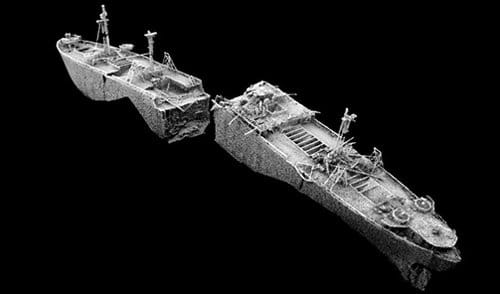
Rendering of the wreck based on multibeam and laser data from the 2013 survey report (MCA)
The BBC is now reporting that the removal has become a local sensation and political issue, with a petition being raised demanding that the masts be placed on permanent display in the local area near the wreck site. The DfT told the BBC it was aware of the calls to preserve the masts but said it was too early to determine what would happen to them once they were removed from the wreck.

that matters most
Get the latest maritime news delivered to your inbox daily.
The UK continues its monitoring and annual surveys of the wreck. Overall, they report it is stable. The condition, however, is too decayed to consider removing more of the ship, especially because of the concern about the munitions that remain onboard.
