


U.S. Suspends Licenses for Five Under Construction Offshore Wind Farms
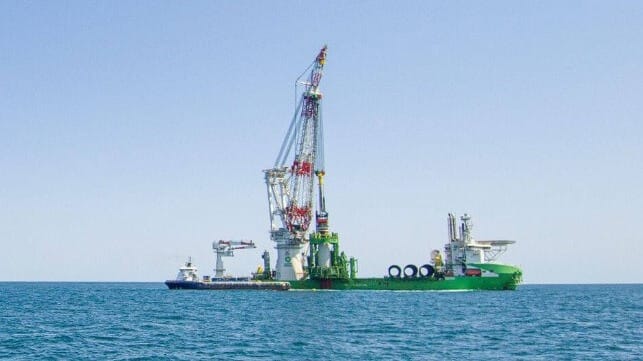
In its latest moves to stop the development of offshore wind energy projects, the Trump administration on Monday, December 22, announced it is suspending all the licenses for under-construction offshore wind farms. It impacts five projects, many of which are nearing completion, with a generating capacity for 5.8 GW of energy, and sent shock waves through the industry.
In a statement from the Department of the Interior, the administration says the pause is due to “national security risks identified by the Department of War in recently completed classified reports.” It said that the pause would give the Department of the Interior, Department of War, and other relevant agencies “time to work with leaseholders and state partners to assess the possibility of mitigating the national security risks posed by these projects.”
The non-profit Oceantic Network, which lobbies in support of the industry, quickly issued a statement calling the move “another veiled attempt to hide the fact that the President doesn’t like offshore wind.”
Trump, immediately after returning to the office, issued an Executive Order pausing the leasing and approvals and ordering a review of the industry. Since then, it has been reported that he directed all government agencies to work together to stop the development of wind farms, and the administration has gone to court to challenge the approvals of several projects. It also attempted to stop construction work on both the Empire Wind project in New York and Revolution Wind off the coast of Rhode Island.
The five projects impacted by today’s actions are Vineyard Wind 1, Revolution Wind, Coastal Virginia Offshore Wind, Sunrise Wind, and Empire Wind 1. Many of the projects are nearing completion, and in the case of Vineyard, are already generating power, or are due to begin delivering power in 2026.
“Today’s action addresses emerging national security risks, including the rapid evolution of the relevant adversary technologies, and the vulnerabilities created by large-scale offshore wind projects with proximity near our east coast population centers,” said Secretary of the Interior Doug Burgum.
According to the Department of the Interior, unclassified reports from the government have “long found that the movement of massive turbine blades and the highly reflective towers create radar interference called ‘clutter.’ The clutter caused by offshore wind projects obscures legitimate moving targets and generates false targets in the vicinity of the wind projects.”
They continue by saying the Department of Energy in 2024 stated that a radar’s threshold for false alarm detection can be increased to reduce some clutter. They assert that those steps could cause radar to miss actual targets.
“The U.S. offshore wind industry has continuously worked with the Department of Defense to address national security concerns, and its own Clearinghouse has signed off on every offshore wind lease ahead of construction,” noted Liz Burdock, CEO of Oceantic Network. “This newest claim contradicts years of rigorous, interagency reviews, as these projects have already passed explicit clearances from the Department of Defense and the Pentagon before construction began.”
This action comes just two weeks after a U.S. District Court found that the presidential executive order suspending the industry was unlawful because it violates the Administrative Procedures Act that governs how agencies administer programs. In the opinion, the court wrote that the order was “arbitrary and capricious.” It was the result of a lawsuit filed by 17 states and the District of Columbia challenging the executive order. The order has been used as the basis for many of the actions to challenge projects in 2025.

that matters most
Get the latest maritime news delivered to your inbox daily.
Federal courts have permitted the administration to proceed with its review of the approval process for projects off the New England coast and Maryland. However, another district court issued an injunction when the administration issued a stop work order for the Revolution Wind project. The dispute, just as offshore work was due to start for the Empire Wind project, was settled with an agreement between the federal government and New York State.
Experts are predicting that today’s action will be quickly challenged in the courts.
