


U.S. Navy Commissions its Very Last Littoral Combat Ship
The Independence-class finished delivering last year, and with the commissioning of Freedom-class USS Cleveland, the procurement program is complete
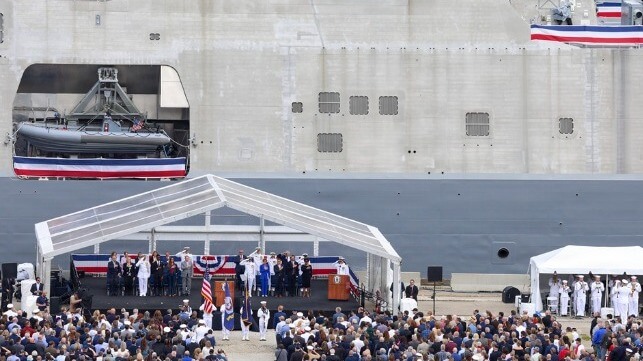
After 18 years, the U.S. Navy has commissioned the last Freedom-class Littoral Combat Ship, a lightweight, high-speed surface combatant designed by a prominent aerospace contractor during the Global War on Terror.
In discussing the twin LCS classes, Navy officials have focused not on their capabilities or problems, but on celebrating the tireless efforts of crewmembers to make their ships as effective as possible. That emphasis was present at Cleveland's commissioning ceremony as well. "Today we celebrate the sailors who breathe life into this ship," said acting Navy Secretary Hung Cao, who spoke at the commissioning ceremony in Cleveland. "To the officers and crew of USS Cleveland, today is your day."
"You are not simply serving aboard this ship. You are writing the first chapter of her history. You are forging a legacy that will endure long after all of us have left these decks," emphasized CO Cmdr. Bruce Hallett.
Cleveland is the 16th and last hull in the series. Along the way, the Freedom-class has encountered many issues - an absent sonar capability, high contractor maintenance costs, high crew workload, and a class-wide propulsion vulnerability. These issues culminated in a request from then-CNO Adm. Mike Gilday to decommission the first nine hulls in 2022; at the time, the youngest on the list was just three years old. Five early examples were ultimately taken out of commission, but the Navy continued to take deliveries of additional new hulls for the next four years. With Cleveland's commissioning on Saturday, her builder is ready to move on to future projects.
The Freedom-class was designed for high speeds and shallow draft, allowing for swift counterinsurgency and SOF operations near shore. An unusually high speed requirement meant engineering tradeoffs for armor and armament, and the ships were not designed to Navy standards for resistance to shock. As early as 2016, official concerns were raised about whether they could survive in high-end combat.

that matters most
Get the latest maritime news delivered to your inbox daily.
In service, the Freedom-class developed a reputation for mechanical issues, particularly a faulty gearbox design in the propulsion system (later resolved with a retrofit solution). Even when all systems were functioning, the Freedom-class vessels were "noisy as an aircraft carrier," and that created challenges for their core anti-submarine warfare mission, according to then-CNO Adm. Mike Gilday. The sonar system (part of the ASW "mission package" ) failed to mature, and the Navy canceled it in 2021, leaving the Freedom-class without a designated mission set. They have seen success in recent years as host platforms for U.S. Coast Guard law enforcement detachments, operating in coordination with the Coast Guard's cutters in the Eastern Pacific and Caribbean.
The other LCS "variant," the aluminum trimaran Independence-class, completed its final delivery last year; it has begun to deploy with a mine countermeasures mission package. Some of the first operationally-ready hulls with that capability are now in the Central Command area of operations, part of the fleet tasked with resolving the Strait of Hormuz dilemma.
