


Interview: Sanmar's Ali Gürün on 50 Years of Tug Innovation
Specialty shipyards have to bring a unique set of capabilities to the table in order to compete - a mix of innovation, adaptability, and finely-honed expertise in their niche. Sanmar Shipyard has succeeded in the workboat business for 50 years because it has developed world-leading capabilities in high-end tug construction, helped by strong relationships with the naval architects at Robert Allan Ltd. and with the top global towage operators. To learn more about what it takes to succeed in this segment, TME spoke with Ali Gürün, Vice Chairman & CEO of Sanmar Shipyard.
Over the course of 50 years in operation, what has Sanmar learned about what it takes to compete and thrive as a commercial shipyard?
This year marks Sanmar's 50th anniversary, representing five decades of specialization, innovation, and continuous evolution in the tugboat industry.
Over the years, we have learned that long-term success in shipbuilding comes from combining engineering capability, operational understanding, and the willingness to continuously innovate. While designing and building advanced vessels for operators worldwide, Sanmar has always maintained a practical and operator-focused perspective.
Our milestone achievements include constructing Türkiye's first privately owned tugboat, Europe's first tugboat designed by Robert Allan Ltd., the world's first dual-fuel LNG tugboats, and the world's first remotely operated commercial vessel. Building on this legacy, Sanmar has further strengthened its position in alternative fuels by building the world's first purpose-built dual-fuel methanol escort tugs for Kotug Canada.
This culture of innovation has been one of the key drivers behind our growth. However, innovation alone is not enough. Competing globally also requires strong engineering infrastructure, reliable supply chain management, production efficiency, digitalization, and long-term partnerships with clients, designers, suppliers, and classification societies.
Another important lesson has been the value of specialization. By focusing entirely on tugboats, Sanmar has developed deep technical expertise across a wide range of operations and vessel types. Today, with more than 350 tugboats built to Robert Allan Ltd. designs, we continue to combine experience, technology, and engineering expertise to deliver high-performance, future-ready tugboats for operators around the world.
Sanmar is known for sustainable solutions for marine towage. Can you tell us about the efforts you've put into developing a "green" portfolio, and the experience your team brings to designing and building these high-end vessels?
Sustainability is now the cornerstone of Sanmar's strategy. Over the past several years, we have made significant investments in developing low- and zero-emission tugboats.
To date, Sanmar has built and delivered 14 fully electric tugboats, making us one of the global leaders in this segment. These vessels are operating across Europe, North America, and Latin America, representing important industry milestones. Key deliveries include Europe's first fully electric tug, BB ElectRA for Buksér og Berging; Denmark's first fully electric tug, Svitzer Ingrid; and Latin America's first, Trapananda, for SAAM Towage.
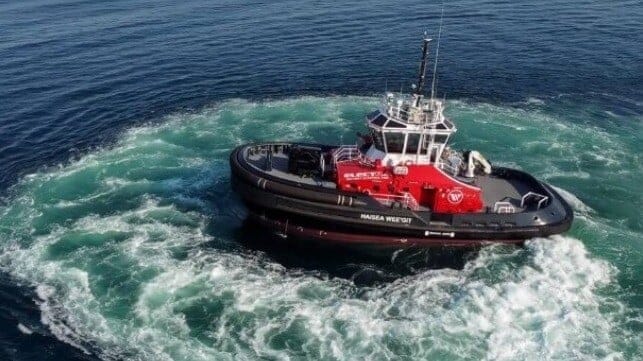
A standout achievement in our portfolio is the complete fleet transition for HaiSea Marine in Canada. Operating in the environmentally sensitive British Columbia region, this fleet, comprising three fully electric and two dual-fuel LNG tugboats, is widely recognized as one of the most environmentally responsible tugboat fleets in the world.
Furthermore, we recently delivered four ElectRA 2500SX tugboats to BOTAS, Türkiye's state-owned energy company. These vessels, BOTAS Hilal, Bayrak, Ay and Yildiz, are among the most powerful fully electric harbor tugs worldwide, featuring 5,085 kWh of battery capacity and 70 tonnes of bollard pull.
Designing these advanced vessels requires extensive expertise in battery integration, energy management, and alternative-fuel systems. Our teams have developed substantial know-how in integrating these technologies while maintaining the operational reliability and maneuverability expected from modern tugboats.
Do you see increasing demand from your clients for "green" vessels? What kinds of energy sources are they leaning toward, and what is motivating their investments?
Yes, we are witnessing a substantial and steady increase in demand for environmentally responsible tugboats across global markets.
Today, operators are under growing pressure to support decarbonization targets from regulators, ports, and cargo owners. Many now view sustainability as a long-term business advantage rather than simply a compliance requirement.
Fully electric tugboats are attracting significant interest for harbor operations because they offer zero-emission capability, reduced noise, and lower operational costs. At the same time, LNG and methanol are emerging as vital alternative fuels for applications requiring higher power and longer operational flexibility. While LNG is a proven lower-emission solution, methanol is gaining momentum due to its strong decarbonization potential and practical handling advantages.
Sanmar's latest projects include a series of dual-fuel methanol tugs for Kotug Canada, the first of their kind in the world. What are the challenges in building a methanol-fueled vessel, and what are the fuel's advantages for the operator?
The dual-fuel methanol escort tugs currently under construction for Kotug Canada represent another major milestone.
These vessels, SD Aisemaht and SD Qwii-aan'c Sarah, are the world's first large, purpose-built dual-fuel methanol escort tugs, built for operation on the Trans Mountain Expansion Project. Designed for demanding escort operations, they deliver 120 tonnes of bollard pull while significantly reducing emissions and underwater noise.

that matters most
Get the latest maritime news delivered to your inbox daily.
Building methanol-fueled vessels presents unique engineering challenges, such as designing dedicated fuel storage, specialized piping, and advanced safety systems. Because this is an emerging segment, close collaboration with classification societies and equipment manufacturers is essential.
Despite these challenges, methanol offers significant advantages. It can substantially reduce CO2, NOx, SOx, and particulate emissions. Unlike cryogenic fuels, methanol remains liquid at ambient temperatures, making bunkering and onboard storage simpler and more practical. We see methanol as one of the most promising pathways for reducing emissions in high-power tug operations while maintaining operational capability and flexibility.
