


Survival of Chagos Sovereignty Deal Hinges on U.S. Review
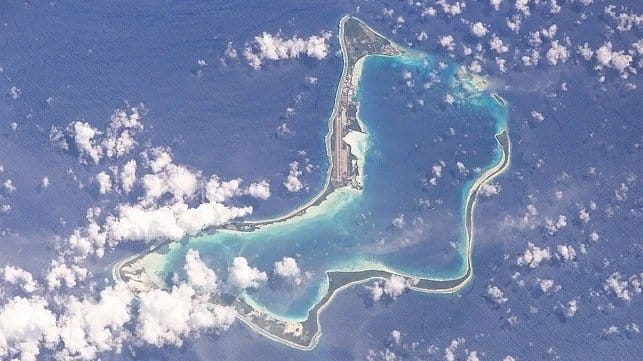
The survival of the deal the UK has agreed with the government of Mauritius, involving the UK’s surrender of sovereignty and a lease-back arrangement to provide for continued American use of the Naval Support facility on Diego Garcia, now appears to depend on a U.S. review of its initial support for the arrangement.
The progress of the enabling legislation through the British Houses of Parliament encountered stormy waters on January 20, when the House of Lords passed a number of amendments to the bill, the most difficult of which was that the Chagos islanders should be consulted on whether or not they wished to lose British citizenship and be transferred to Mauritius instead. These amendments were rejected by the UK Government, but the bill still has to return to the House of Lords to be voted on.
At the same time, the UK Government acknowledged that the Chagos bill cannot make progress until the United States has given formal approval for the necessary amendments to be made to the 1965 Treaty, which guarantees U.S. use of the base. Such approval has not been obtained as yet, which is a problem since President Trump is now describing the handover to Mauritius as an act of “GREAT STUPIDITY.” In the meantime, the UK government has withdrawn the Chagos bill from further parliamentary scrutiny, and opposition is growing to the handover, even from the government’s own members of parliament.
From a U.S. perspective, there are three major difficulties with the deal as currently tabled.
Once sovereignty of the Chagos Archipelago is transferred to Mauritius, there is no mechanism for recovering sovereignty and rights should Mauritius renege on aspects of the agreement at some time in the future. As the UK discovered in Hong Kong, even when safeguards are codified in an international treaty, the sovereign power can, in effect, do what it wants. In this regard, Mauritius’ close relationship with China poses a real threat, so there is a substantive risk that Mauritius could grant another nation basing rights on one of the other islands of the Archipelago, rendering the utility of the base on Diego Garcia much reduced.
Secondly, even without bad faith on the part of the Mauritian government, it is unlikely to be able to effectively police the 58 islands and 250,000 square miles of territorial waters making up the Chagos Archipelago, when it has no navy and lies more than 1,300 miles from Mauritius. While the British Indian Ocean Territory remains in being, this is a responsibility shouldered effectively by British vessels and Royal Marines.

that matters most
Get the latest maritime news delivered to your inbox daily.
Thirdly, Mauritian government sources have said that once sovereignty is transferred, they will impose the 1996 Pelindaba Treaty on Diego Garcia, which bans nuclear weapons from the African continent.
The UK government has based its negotiations with Mauritius on the need to follow international law, even though international bodies have only issued advice rather than any ruling on the matter. But conversely, to not obtain U.S. consent for the switch in sovereignty would be a material breach of international law, which the UK government has been so keen to observe. Even if U.S. consent is forthcoming, however, opposition to the transfer of sovereignty is now so strong domestically that the legislation is unlikely to progress. Moreover, should the present agreement with Mauritius collapse, there are alternative arrangements that could well satisfy all parties.
In the meantime, observers are keeping a careful watch on the apron of the airfield on Diego Garcia itself, to see if strike aircraft are arriving from the United States, as they did during the run-up to American attacks on Iran last year. At present, there are no additional aircraft to be seen, albeit U.S. aircraft have arrived at other U.S. bases in the Middle East. The USS Abraham Lincoln (CVN-72) and its carrier support group have now been reinforced by U.S. Central Command and may have need of the facilities on Diego Garcia should their deployment to the region be prolonged.
