


Sanctions on Shamkhani Network Deal a Major Blow to the Dark Fleet
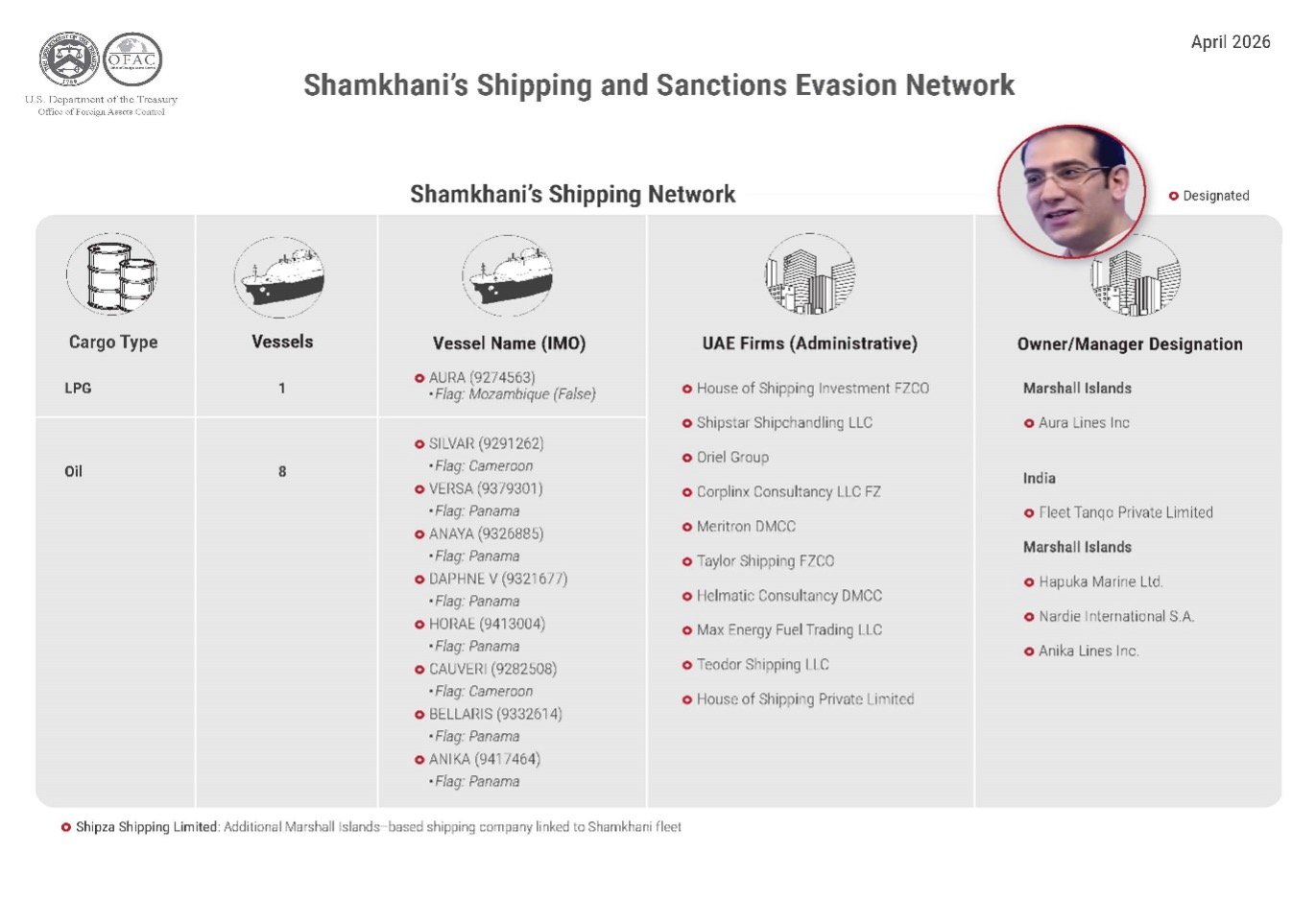
On April 15, the US Treasury announce a wide-ranging series of sanctions on the business empire of Mohammad Hossein Shamkhani, son of the recently-deceased one-time National Security Advisor and close confidant of the late Iranian Supreme Leader Ali Khamenei.
The US Treasury sanctioned eight crude and one LNG tanker, and ten ship management and trading companies associated with Shamkhani operating in the United Arab Emirates. The US Treasury described the Shamkhani network as a "multi-billion dollar Iranian and Russian petroleum sales empire that enriches a family connected to the highest echelons of the Iranian regime and served both Iranian and Russian interests."
The action against the Hossein Shamkhani network follows similar action taken against Babak Morteza Zanjani by the US Treasury on January 30. Babak Zanjani was arrested for corruption in 2013, when he estimated his own net worth as $13.5 billion, but rarely checked into the jail. Nevertheless he was sentenced to death in 2021, accused of spreading corruption on earth, but more particularly for purloining $2.7 billion owed to the Ministry of Petroleum for oil exports conducted through his business empire. By order of the Supreme Leader, his sentence was commuted in 2024, and he went back to work.
Zanjani's Sorinet Group is based in the UAE, and trades in cosmetics, finance and banking, hospitality, commercial aviation, infrastructure, building material, information technology and international real estate development, a business empire through which dark fleet oil revenues have been laundered. Zanjani has been heavily linked to the ship-to-ship oil transfer activity off Malaysia's east coast, and while enriching himself, has been a key conduit for collecting Iranian government oil revenues.
For ordinary Iranians, the extraordinary wealth of both Hossein Shamkhani and Babak Zanjani, derived from corrupt dealings and close family connections to the ruling elite - mirroring similar kleptocratic arrangements in Russia - undermines the religious credentials of Velayat-e Fakih rule, which was supposed to be purer than the pre-revolutionary era under the Shah. Their enduring activities are a major source of discontent and disillusionment within Iran. One estimate of the handling cut the Shamkhani and Zanjani operations were taking amounted to about 40% of the revenues owed to the Ministry of Petroleum.
A recent Reuters investigation has identified the cryptocurrency firm Nobitex as having a critical role in helping the IRGC move funds and circumvent sanctions: this firm too, taking commissions for moving government funds, has also made billions for its founders, Ali and Mohammed Kharrazi, whose family is intermarried with those of the late Ayatollah Khomenei, his successor the late Ali Khamenei, and now Mojtaba Khamenei.
The Shamkhani and Zanjani operations were able to endure for so long because their huge financial resources enabled them to pay off and ingratiate themselves with anyone who might threaten them, wherever they operated. Large numbers of employees, sub-contractors, real estate agents, drug dealers, gold traders and bankers, and probably many others, have benefited from their business activities, either directly or indirectly. These operations contributed to the Grey Listing of the UAE by the Financial Action Task Force in 2022, but this pressure was lifted when the Grey Listing was mysteriously lifted in 2024 after FATF noted there had been "significant improvements" to money laundering controls. These improvements did not however close down the Shamkhani and Zanjani operations.

that matters most
Get the latest maritime news delivered to your inbox daily.
But now, as the war continues, the UAE has acted decisively, the crackdown affecting both the networks supporting Iranian and Russian dark fleet operations, but also a number of trans-national criminal and drug-dealing operations. Having initially resisted external pressure to act in the name of sovereign autonomy, the UAE is now keen to be seen as an active member supporting US efforts.
A clampdown on Iranian front operations in the UAE will have wider impact across the Gulf region. Ship owners and managers in neighboring countries could comply with Central Bank controls by not making payments or having financial relationships with Iranian entities – because they could make and receive payments through "clean" Iranian front entities registered in the UAE instead. These avoidance schemes facilitating money laundering are also now under pressure, all building up the stress which both the Iranian and Russian regimes are facing.
