


Exercise Balikatan Concludes Amidst South China Sea Tensions
This year’s Exercise Balikatan, which concluded last week, was the biggest ever such annual exercise mounted jointly by the Philippines and the United States. 17,000 troops took part, along with naval vessels and participation from Australia, Canada, France, New Zealand and the United Kingdom.
Save for individual hold-outs hiding out in the jungle who missed the surrender in 1945, this was the first time that Japan had deployed troops to the Philippines since the Second World War, and follows a defense reciprocal access agreement signed by the two countries last year. Japan deployed the Hyuga Class helicopter destroyer JS Ise (DDH-182), the Osumi Class Amphibious Landing Ship JS Shimokita (LST-4002), and the Murasame Class destroyer JS Ikazuchi (DD-107). More than 1,000 troops from the Japan Ground Self-Defense Force’s Amphibious Rapid Deployment Brigade conducted a beach landing alongside Filipino marines on the north coast of Luzon, opposite Taiwan across from the Balintang Channel.
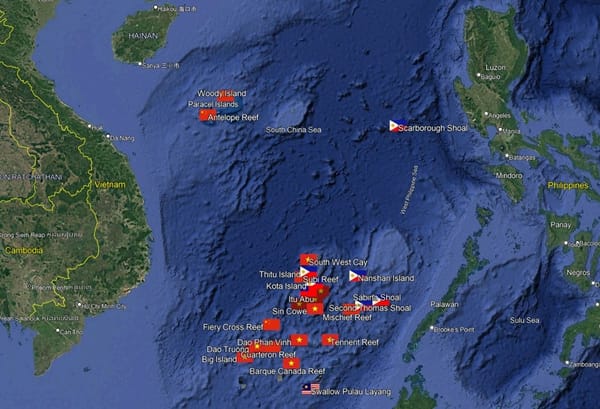
Occupied islands and competing claims in the South China Sea (Google Earth/Copernicus/CJRC)
Much of the exercise activity took place on or off the coast of Palawan, which is the nearest Filipino mainland to the concentrated cluster of islands in the South China Sea, where China disputes possession of islands with the Philippines, Vietnam, Taiwan and Malaysia. After claiming construction work on small islands and low-lying rocks was for civilian purposes, China in effect took possession of a number of disputed islands, consolidating its position by building airfields and defensive fortifications. After something of a lull in this activity in recent years, tension flared last year between China and the Philippines over fishing rights in the Scarborough Shoal, which the Philippines defended vigorously and successfully.
The tension has continued with an upsurge of Chinese island-building activities in the South China Sea, with an estimated 15km2 of land reclaimed recently on the atolls of Antelope Reef, which is contested by the Philippines but in particular by Vietnam. This upsurge has been interpreted as a move to take advantage of the US Navy’s switch of assets recently to the Middle East. Two weeks ago, Taiwanese minister Kuan Bi-ling made a rare and hence politically-significant trip to the Taiwanese garrison on Itu Abu, to witness a military exercise to recapture a ship seized at sea.

that matters most
Get the latest maritime news delivered to your inbox daily.
Aside from the first time Japanese troops had been deployed and worked alongside allies, Japanese and Filipino air defense units worked closely with US Army and Marine air defense units, practicing techniques to counter drones and to provide littoral air defense support to ships at sea.
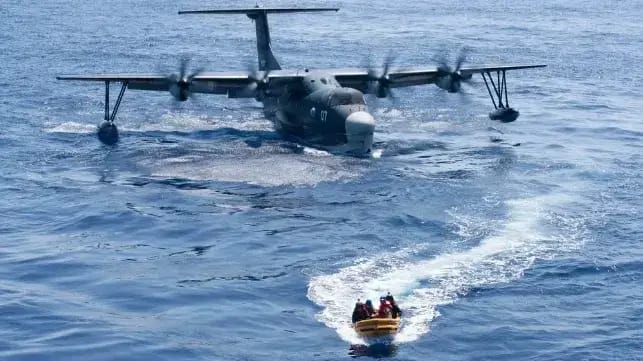
The exercise also saw the deployment of a Japanese ShinMaywa US-2 amphibious aircraft (top), which rehearsed air-sea rescue medical procedures alongside the Whidbey Island Class dock landing ship USS Ashland (LSD-48). American forces have no comparable counterpart to the US-2, and it has been proposed as a potential off-the-shelf asset for long range ocean rescues and medevacs - missions which are currently fulfilled by U.S. Air Force parachutists.
