
Sails Set for Wider Uptake as IMO Defines Wind Propulsion Work Plan
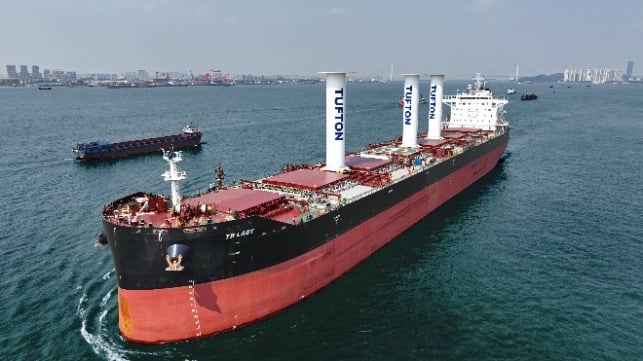
IMO’s new work on safety for decarbonization technologies will reinforce wind-assisted propulsion’s value as an early win on the route to net-zero emissions, writes Anemoi Marine Technologies technical director Luke McEwen.
After years of negotiations over targets and incentives, the IMO has turned its attention to what matters most to ship operators planning their path to net-zero emissions—how to get there safely. A new workplan aims to accelerate regulatory oversight for three technology groups: lithium-ion batteries, wind and wind-assisted propulsion systems (WAPS), and nuclear power.
The workplan was agreed at the IMO’s Sub-Committee on Ship Design and Construction in January and is expected to be considered for approval by the Maritime Safety Committee (MSC) in May. It sets out a multi-year pathway for developing new or updated safety provisions, with regulatory deliverables for each technology.
SOLAS amendments enabling the safe use of lithium-ion batteries as main power and essential ship functions are scheduled to be adopted by MSC 111 in 2028. Interim safety guidelines for the use of WAPS will follow by MSC 116 in 2029. And revisions to IMO’s Nuclear Code (and related changes to SOLAS) will be delivered in 2030 or later.
At first glance, the mix of technologies may seem surprising. All technologies have been deployed on ships for decades (if not centuries in the case of wind) and have few similarities. The common thread is the attempt to define safety expectations for technology applications that currently lack unified, up-to-date global maritime standards.
The workplan matters to both technology providers and ship operators, and for the same reason. Safety regulations are what make wider rollout of decarbonization investments possible beyond the relatively high cost of pilot trials and first-mover projects. Investors, flag states and class societies will be more ready to finance, accept and assure new technologies, accelerating their scale up, if regulations are aligned to work with the technology. The new workplan is therefore a crucial counterweight to the uncertainty and commercial risk that decarbonisation targets have so far placed on ship operators.
Three solutions, three pathways
The three different deliverables highlight that each technology sits at its own level of maturity and risk. Lithium-ion batteries and nuclear power are at different stages and provide different challenges, hence a different approach, so we will focus on wind-assisted propulsion in this article.
Undoubtedly, wind-assisted propulsion introduces technical risks to be managed. However, these considerations sit largely within the established scope of ship design and operational procedures. Today, these are approved on a project-by-project, risk assessment approach drawing on varying class rules and varying flag state interpretations of IMO and SOLAS regulations.
This approach delivers wind-assisted vessels that meet their operators’ expectations, finding solutions that are equivalent to the existing requirements or can safely be exempted by flag states. IMO interim guidelines will hopefully streamline those processes further, supporting repeatable approval pathways in anticipation of wider adoption. Although the guidelines are under development, IMO’s work will likely focus on standardising expectations around:
- Stability and wind heeling moment assessment
- Structural integration, load cases and fatigue design
- Bridge visibility, sensor interference and navigation risk controls
- Operational procedures, automation, and emergency functions
- Documentation and training expectations
Of these, the biggest benefits may come from updating the regulations on obstructions to bridge visibility, radar and navigation lights, key areas of uncertainty where the existing regulations were not designed to work with WAPS. At present, significant time and effort can be needed to agree a safe arrangement with class and flag for these factors. Such agreement can always be reached in our experience, but having a degree of uncertainty at the start of each project hinders rapid scaleup.
Operationally, rotor sails also have simple safety characteristics. When switched off they stop generating thrust and therefore, unlike some other wind-assist technologies, they do not require folding or stowing in extreme weather conditions and it is safest for rotor sails to remain in their upright position and switched off.
A ‘no-regret’ first step
Wind-assisted propulsion is already growing strongly, having surpassed the psychologically meaningful milestone of one hundred installations in 2025. That means that wind-assisted propulsion is now a long way through the transition from early projects to scaling for wider uptake. The reasons for that growing acceptance are already clear.
Wind assist aligns strongly with the commercial reality of maritime decarbonization. The bulk of the existing world fleet will still be trading through the 2030s, and owners are seeking emission reduction measures that can be installed during scheduled dockings, with predictable downtime and manageable costs. WAPS can be added without rebuilding the ship’s propulsion train. And retrofits can be staged to align with a vessel’s scheduled dry dock.
WAPS are fuel agnostic – they use the renewable power of wind to reduce fuel use and greenhouse emissions whether a ship is operating on VLSFO today, biofuels tomorrow, and green methanol or ammonia—or even batteries for short sea crossings. Because wind assist reduces propulsion demand rather than replacing the ship’s primary power source, it can complement both conventional and emerging fuel pathways. The battery case is interesting because WAPS can make the biggest difference in strong winds, when high sea states add heavily to the vessel’s propulsion energy needs and battery capacity may be insufficient.
That flexibility to work with all fuels is valuable at a time when fuel uncertainty remains one of the largest strategic risks for shipowners. Combined with the relative ease of installation and large savings compared to many propulsion modifications, more and more operators are coming to the conclusion that wind assist is a ‘no-regrets’ step.

that matters most
Get the latest maritime news delivered to your inbox daily.
WAPS reduce emissions and fuel cost now, improve compliance margins under carbon pricing and fuel intensity rules, and do so while keeping a ship’s primary power source options open. With further harmonization of safety practices under IMO’s guidelines, accessing those advantages will soon become even easier for ship owners and operators.
Luke McEwen is Anemoi Marine Technologies' technical director.
The opinions expressed herein are the author's and not necessarily those of The Maritime Executive.