


Rock Strike Caused Near-Fatal Grounding of Tourist Vessel in New Zealand
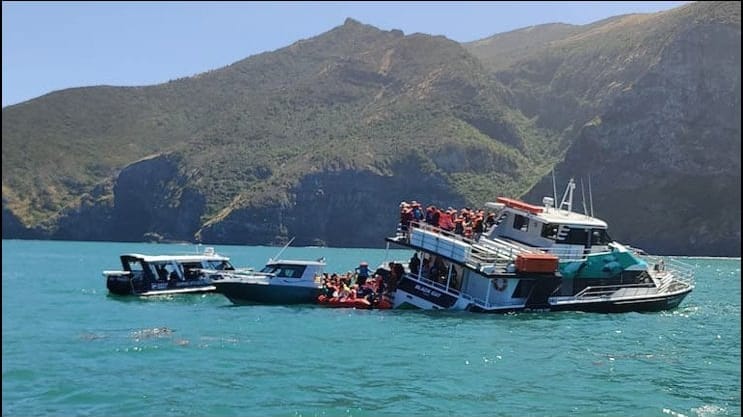
The near-fatal grounding and loss of a tourist catamaran in New Zealand waters early this year was caused by the vessel coming into contact with a known hazard after the master approached it from an “unusual direction.” That was the finding detailed in an interim report from New Zealand’s transportation authority.
The Transport Accident Investigation Commission (TAIC) released its interim report detailing the grounding and subsequent total loss of the Black Cat catamaran on the morning of January 31, 2026. The report shows the vessel was breached after coming into contact with the Archway Rock, a documented submerged rock. Investigations so far indicate the master had approached the known hazard from an unusual direction.
Built in 1994, the Black Cat was a 17-meter catamaran owned by Black Cat Cruises and operated out of Akaroa, offering sightseeing tours from the South Island. On the fateful day, the vessel was conducting a regular two-hour wildlife and scenic cruise with 38 passengers and three crewmembers aboard. The vessel departed her berth at Akaroa Harbor at 1045 and visited various locations. The weather was calm, prompting the master to decide to navigate outside Akaroa Harbor and visit Scenery Nook on the south coast, where they arrived around 1152.
The report shows that upon approaching Scenery Nook, the master moved to the starboard bridge wing helm station to maneuver the vessel close to known rocks. He then decided to visit Archway Rock on the way back to Akaroa. At about 1207, the Black Cat left Scenery Nook, and the master moved back to the central bridge helm station so they could look at the chart plotter regarding their intended route. The master then moved to the port bridge wing helm station and navigated toward Archway Rock.
About this time, one of the crewmembers noticed the vessel was approaching Archway Rock from an unusual direction. Minutes later, the vessel struck the rock, causing a rupture to its hull and flooding, including in the engine. The crew failed to activate the bilge pumping system because they were not confident in how to operate the system correctly.
Unable to pump the water, the master navigated the vessel into Akaroa Harbor to facilitate a safe evacuation. The report shows that while in the harbor, the vessel’s steering and starboard engine had stopped operating and the emergency steering was not responding. The vessel had developed a significant starboard list.

that matters most
Get the latest maritime news delivered to your inbox daily.
Nearby vessels helped in evacuating the passengers while a Coastguard vessel that was exercising just outside Akaroa Harbor attempted to dewater the Black Cat using a portable petrol-powered water pump. The efforts were unsuccessful, and the master tried to save the vessel by attempting to maneuver her towards the beach when it ran aground. A salvage operation the following day failed to refloat and recover the vessel, which broke up in heavy weather conditions.
TAIC highlights that while the interim report presents facts that have been established so far, it intends to publish its final report on the incident upon completion of the investigations. The final report will present analysis, discuss safety issues, and make recommendations.
