


Port of Baltimore Celebrates Recovery of its Container Business
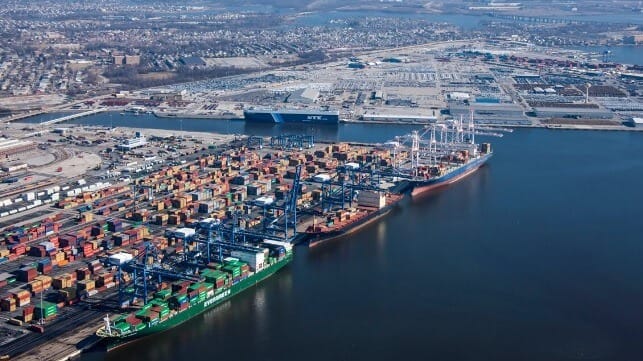
The Port of Baltimore is witnessing a remarkable recovery after the devastating effects of the Francis Scott Key Bridge collapse in March 2024, with container throughput returning to 2023 levels.
Having witnessed its containerized business take a 41 percent nosedive in 2024 to roughly 740,000 TEU due to the Francis Scott Key Bridge disaster, Baltimore is seeing a recovery. Its piers handled 1.1 million TEU in 2025. The throughput exceeded the 2023 record by more than 5,000 TEU and came in a year that was characterized by uncertainty and volatility due to tariffs.
During the year, the port recorded 2,223 cargo vessel visits, surpassing the previous record of 2,137 ships set in 2023, representing a 21 percent increase over 2024. Another notable achievement in 2025 was the arrival of the second-largest ship to ever call at Baltimore. This came in November when the 366-meter Ever Model with a capacity of more than 15,000 containers called at the facility.
Baltimore attributed the arrival of the ship to ongoing business growth efforts centered on the port’s modernization of its infrastructures, among them the reopening of the 50-foot-deep, 400-foot-wide channel, and supersized cranes at the Seagirt Marine Terminal.
Though Baltimore has released the performance of the container business, final cargo volumes and data on roro units handled are still being finalized, though the port is optimistic the numbers will exceed those recorded in 2024.
“We are grateful to the workers whose unwavering commitment and resilience made this progress possible. Our administration will continue to promote our port’s infrastructure to strengthen our supply chains, drive economic growth in our state, and create better-paying jobs for our people,” said Maryland Gov. Wes Moore.
Baltimore is highlighting that with container volumes hitting the 2023 levels, the port is upbeat about significant growth this year driven by the completion of the CSX Howard Street Tunnel project, a $518 million initiative to modernize a 130-year-old freight tunnel in Baltimore. The new freight tunnel will allow the port to accommodate double-stacked container trains, increasing its capacity by 160,000 containers annually and generating nearly 14,000 jobs.

that matters most
Get the latest maritime news delivered to your inbox daily.
“The commitments we’re making now and in future years will continue to advance our multimodal freight network and further accelerate the port’s growth and generate additional jobs,” said Katie Thomson, Maryland Acting Secretary of Transportation.
The Port of Baltimore remains a cornerstone of Maryland’s economy and one of the most important ports in the U.S., particularly in ro/ro, construction machinery, imported forest products, and imported gypsum. The port generates about 20,300 direct jobs, with more than 273,000 jobs overall in the state linked to the port, and it has an annual economic impact of more than $70 billion.
