
Poetry in Motion
The choreography of lifting and moving huge pieces of equipment is something to behold.
(Article originally published in Nov/Dec 2024 edition.)
Shipyards are key pieces of the global maritime infrastructure. From newbuilds to refits to scheduled maintenance, every single ship on the sea needs to return home periodically for a little rest and recovery – not to mention needed repairs, realignment, a fresh coat of paint and so on. Shipyards come in all sizes and shapes and can be found anywhere that the land meets the sea. But no matter the size, location or specialty, there's one constant you'll find at every single yard on earth: Cranes.
Nothing gets done without cranes. Equipment needs transferring; supplies need loading, and sometimes even ships themselves need lifting. Besides dock space, the next most flaunted feature that shipyards tout is their crane capacity. They're the single most important tool needed to get the job done. Crane technology has steadily advanced over the years with better operating systems, environmentally friendly designs and innovative solutions. Here are a few of my favorites.
FROM SKYSCRAPERS TO SHIPYARDS
Tower cranes are a familiar sight in the city. You see them at every construction site. They're quickly installed at the side of the road during highway construction, on bridges, and high in the sky on top of skyscrapers. But they haven't been a fixture widely seen in shipyards – until now. Founded in Spain in 1962, Comansa tower cranes have worked on all kinds of projects around the world: bridges, skyscrapers and high-rise buildings, dams, ports, stadiums and power plants, to name a few.
The company has been operating in North America since 2002 from offices in Pineville, North Carolina. Its specialty is producing large-scale tower cranes for big civil projects. This skillset is also a great option for shipyards needing assist cranes. Tower cranes don't require a road network, take up very little space and have an impressive working capacity, hook height and swing radius that are perfectly suited to shipyard work – all at a reasonable cost.
The company recently provided Vigor Shipyard in Seattle, Washington with two of its LCL-560 luffing jib-tower cranes. These are fitted with Comansa's level luffing system, which maintains load height during boom luffing (raising and lowering), and the EFFI Plus system that controls the electrically driven motors. This slows the hoisting speed when bearing a load but increases wire speed when unloaded on the downcycle. The overall cycle time is the same as traditional large motors but saves on power consumption.
Another innovation is Comansa's Crane Mate system. This digital platform allows crane monitoring, tele-diagnosis and fleet management in support of the preventive maintenance program. Thanks to this cutting-edge communications technology, clients can receive in real time technical information, location, alerts and data related to the productivity and maintenance of the crane. Tower cranes require minimal space versus crawler or mobile cranes. Pair this with the cost savings and all-electric motors for limited maintenance, and the advantage to shipyards becomes clear.
LIFT AND TRAVEL
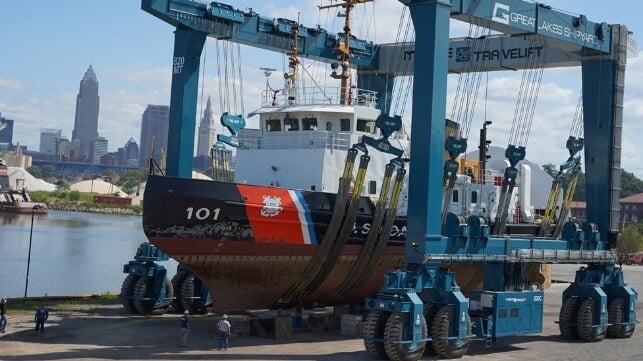
Space is often at a premium in shipyards – especially those that primarily service the pleasure boat market. Since its inception in 1954, Marine Travelift has been known for its innovative boat-handling equipment, designing the very first mobile boat hoist in Sturgeon Bay, Wisconsin back in the 1940s.
Not long after, in the 1950s, Marine Travelift was officially established and has remained an industry leader for the past 70+ years. The company has had many firsts along the way including the first open-end boat lift design for faster handling of sailboats' masts, marina forklifts and breaking the record for largest capacity boat hoist multiple times. In 2022, it introduced a revolutionary variable-width option, available on both the BFMII and C-Series Mobile Boat Hoist machines. The variable-width option helps shipyards save space by stowing vessels more tightly together, enabling them to work on more vessels at the same time. The hydraulically actuated system allows the travel lift's uprights to better conform to the width of the boat being moved rather than requiring a one-size-fits-all approach.
The first Marine Travelift model with the variable width option was a 75BFMII with a 75-metric ton lifting capacity. Delivered to the Marine Group Boat Works in San Jose del Cabo, California, this model offers nine feet of width variability and can seamlessly expand and retract under full load in 60 seconds. "The variable-width option provides the ability to handle a wider variety of hulls and without any major infrastructure changes," explains Kurt Minten, Executive Vice President. "With the ability to vary the boat hoist's width, you can not only lift wide vessels such as catamarans but narrower mono-hulls as well without exceeding recommended sling angles."
A second exciting development was the introduction of a fully electric series of lifts. Fitting a 700-volt, battery-powered system on the 50BFMII boat hoist, which carries a 50-metric ton lift capacity, the power consumption was optimized to ensure the Electric Series meets or exceeds the performance of the standard engine machine. A full charge can be delivered in eight hours with the recommended 30kW high-speed smart charger, and yards can expect to lift anywhere from 10 to 14 vessels a day on a full charge. The Electric Series option is available in all capacity hoists offered. Where possible, going to a boat hoist rather than a drydock allows providers to work on more vessels at once and doesn't create the same delays a drydock might when waiting on parts needed for repairs. This gives yard and marina owners more versatility and allows them to more efficiently move vessels in and out of work areas.
MOVING MORE THAN SHIPS
If you've ever seen an impossibly large structure on top of a platform fitted with dozens of rubber wheels being moved over land, chances are you've seen Cimolai in action. Cimolai Heavy Lift provides the design and execution for the transport and lifting of "exceptional structures in weight and size." This is accomplished by using self-propelled modular transporters or SPMTs.
These hydraulically operated SPMTs are essentially a steel platform fitted with a number of double wheels riding on top of a hydraulic suspension system and powered by a hydraulic power pack on the end. The wheels are able to rotate, which allows the trailer to crab-walk, spin in circles and quickly adjust in any direction. When a weight is loaded on top, the hydraulic suspension serves to keep the platform level, even as the trailer moves across uneven ground. This keeps the load stable, which is critical when moving huge and heavy structures.
The real magic, however, is when you link multiple SPMTs together. The size of the structure to be moved is only limited by the size of the platform available to place it on and the weight-bearing capacity of the wheels. More SPMTs means more wheels and a bigger working surface. When linked, both length-wise and width-wise, all of the wheels respond to the same single operator's inputs. The result is a single unit customized to exactly meet the space requirements of the lift, providing a load capacity of up to 9,500 tons. (Note that the author has participated in many SPMT-powered operations, and they never fail to impress.)
SPACE-SAVING SOLUTIONS

that matters most
Get the latest maritime news delivered to your inbox daily.
In a world that demands increased efficiencies, space and agility are core considerations, and the need for equipment that is powerful, precise and space-conscious continues to increase. Cranes and heavy-lift technologies are no longer just about brute strength. They're about efficiency, flexibility and sustainability. Whether through the towering reach of Comansa cranes, the adaptability of Marine Travelift hoists or the modular versatility of Cimolai SPMTs, modern solutions are enabling shipyards to handle more complex projects in tighter spaces with reduced environmental impact. The future of shipyard operations will depend on adopting these innovations to remain competitive and deliver the reliability the maritime industry requires.
SEAN HOGUE is Executive Vice President of Baker Marine Solutions.
The opinions expressed herein are the author's and not necessarily those of The Maritime Executive.