

Oman Evacuates Tanker Crew as Iran Claims Spate of New Attacks
Tensions remain high in the Persian Gulf, with Iran claiming multiple unverified attacks and the first report of a limpet mine attack in seven years. Data, however, has become unreliable on the actual number of attacks because more vessels continue to delay or not report incidents to UK Maritime Trade Operations or other monitors.
The Omani Navy, however, reported it had gone to the assistance of one tanker today, October 30, evacuating 25 crewmembers. It did not provide details but said the vessel had been targeted and set ablaze.
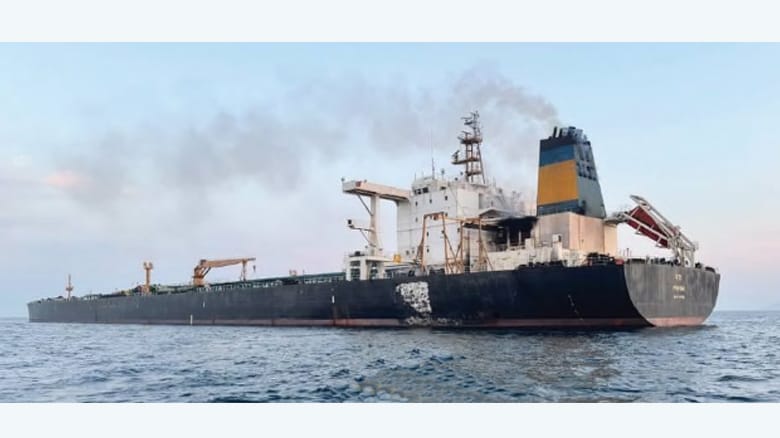
Multiple reports identify the tanker as the Riti (166,729 dwt), operating under the Panama flag and managed from Hong Kong. The image shows a laden tanker. Orbital Risk Intelligence says the vessel was outbound near Oman when it was struck by an Iranian missile.
Attention, however, was focused on a second attack that took place about 25 nautical miles northeast of Oman. An outbound tanker, now identified as the Panama-flagged Suezmax Louise 1, in a now-confirmed incident, reported that it was approached by a small boat that attached two limpet mines to the hull above the waterline. The explosion caused a fire, which the crew was able to extinguish. The tanker, while apparently damaged, was able to proceed under its own power.
Built in 2004, the tanker is operating now under Indian management. It is 159,000 dwt and 274 meters (899 feet) in length. It was previously sanctioned by Ukraine for its involvement in the Russian oil trade.
”This is not a one-off,” writes Martin Kelly, Founder and CEO of Orbital Risk Intelligence. “It is the latest step in a deliberate evolution of Iran’s campaign at sea.” He notes the last recorded limpet attacks came in May 2019.
Kelly says while it represents an evolution of tactics, it matters most for the ships waiting transit. He notes that while a vessel is at anchor, the mines can be attached below the waterline and that can cause significant damage and water ingress, versus when a vessel is underway, when the mines can only be attached above the waterline.
It is unclear if this was one of the four attacks claimed by Iran today. The IRGC Navy issued a series of statements on Friday saying that two tankers had been attacked near each side of the Strait of Hormuz and a third in the Strait. It also said one vessel was attacked at another location outside the Strait.
It claimed that the vessels ignored multiple radio warnings and, in the case of the two vessels, said they were making transits as part of the U.S. efforts. It said the vessels had been ”halted” and also claimed fires. One tanker, it said, was loaded with two million barrels of crude.
Today’s claims followed separate reports on Thursday in which the IRGC said four tankers had been stopped. The IRGC claimed that multiple vessels struck mines. No details were provided to back up the claims.
“It is known now that companies are not reporting attacks to UKMTO/NCAGS as frequently as before, so attack volumes aren’t accurate,” writes Kelly.
U.S. Central Command again moved to dispute the Iranian claims, repeating its assertions that the internationally recognized primary transit routes through the Strait of Hormuz have been cleared of mines. It also denied a separate claim by the Iranians that they had destroyed a U.S. sea drone in the Strait.

that matters most
Get the latest maritime news delivered to your inbox daily.
Oil markets, however, have become increasingly concerned. The benchmark price of Brent crude touched as high as $118 on Friday, ending the day at $117.70. Texas crude is also up well over $100 a barrel.
Fears continue to rise of pending U.S. attacks. Donald Trump has said that the U.S. would not act before the midterm elections on Tuesday.