


Kawasaki Heavy Industries Unveils Climb-Capable Shipyard Robot
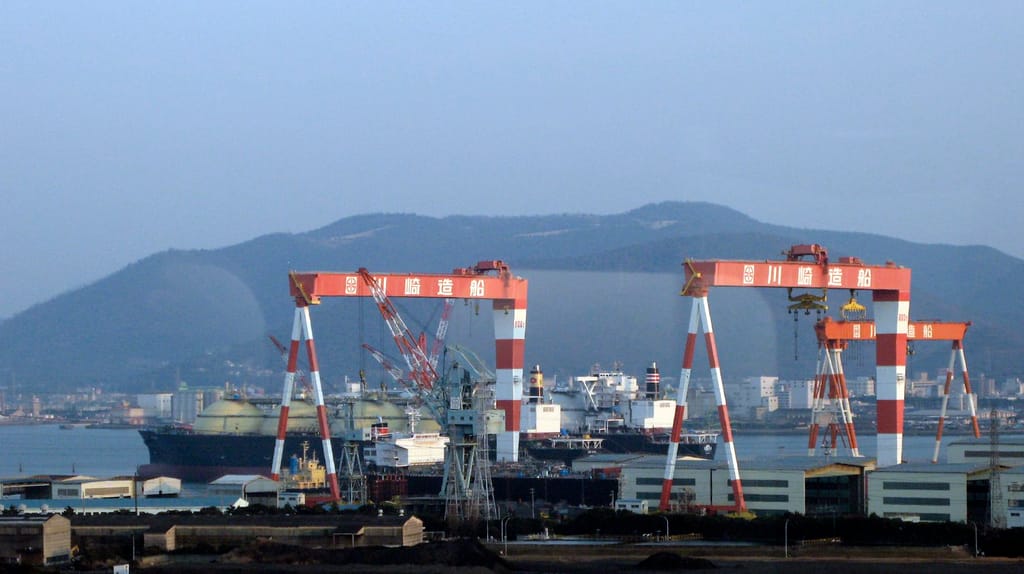
Japanese conglomerate Kawasaki Heavy Industries is among the country's largest shipbuilders, and it also happens to have rare access to its own internal robotics division. It is putting a long legacy of robotics expertise to the test with a new emphasis on "physical AI" in every domain, including out in the yard. On Tuesday, it released an initial look at an AI-enabled, magnet-footed drone robot that can climb bulkheads and navigate small spaces.
The prototype model is small, just two feet long, but the objective is to field a fully-developed version that can weld or perform weld inspections on vertical surfaces, without need for high-reach equipment or human workers. A robot that could work aloft on contoured surfaces would have substantial advantages in a drydock, removing the need for access equipment and staging for human workers.
Japanese shipyards have a strong business need to increase their efficiency: The labor supply in Japan is restricted by an aging, steadily declining population. Guest-worker programs have helped to plug the gap, but the national government is instituting ever-tighter restrictions on work visas. In this environment, a front-line labor position replaced with technology is a job filled rather than a job lost. South Korean yards face similar constraints and have taken a leading role in developing robotic welding robots for block construction.
More broadly, Kawasaki wants to accelerate its efforts with the introduction of AI in day-to-day operations. That includes robotics and "physical AI," a fusion of hardware and AI that creates systems that interact with the physical environment. It plans to invest $3.5 billion on the upgrade effort across all its manufacturing divisions over the next four years, including early testing at the Sakaide shipyard in Kagawa Prefecture.
"Physical AI . . . reaches out from the screen into the real, physical world. Think of self-driving cars, or robots — physical AI can recognize what's happening around it, make decisions, and move things in the real world. As it spreads, we can expect the machines around us to move more flexibly, making our daily lives more convenient," said Jun Yamaguchi, lead co-creation manager at Kawasaki's new physical AI R&D lab in San Jose, California.

that matters most
Get the latest maritime news delivered to your inbox daily.
By 2030, Kawasaki Heavy Industries wants to have an AI-enabled humanoid robot in general service, bringing the advantages of robotics to a broad range of human tasks.
Top image: Kawasaki's Sakaide Plant (Tayorinai eye / CC BY 2.0)

