


Iranian Submarine Force Consigned to History
While the effect had already been almost completely achieved, the U.S. Navy attack on the submarine maintenance facility in the Bandar Abbas Naval Harbor on July 12 was the final blow for the Iranian Navy (Nedaja or Artesh Navy) submarine service.
At the beginning of the war on February 28, two Kilo Class submarines were in dry dock within the Naval Harbor, where they had both been under deep refit since 2021. The only semi-operational Nedaja Kilo Class submarine IRINS Taregh (S901) was confirmed sunk at its home pier by the U.S. Navy at the beginning of March. While the three Kilo Class boats should have been the Nedaja’s premier threat capability, the age, unreliability, and noisiness of the boats rendered them more of a liability than an asset.
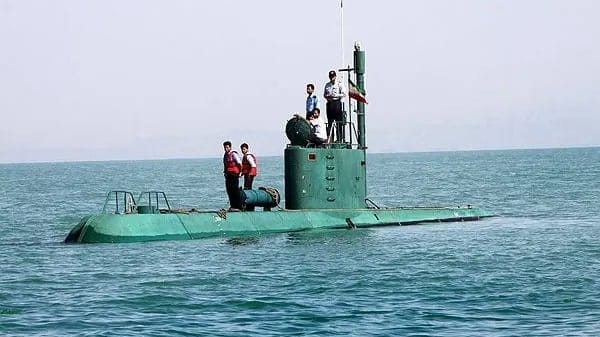
This then left the U.S. Navy with the problem of the Nedaja’s flotilla of about 20 Ghadir Class 125- ton midget submarines, each with a crew of seven. Although these submarines are of only short range and could launch only two torpedoes apiece, they have been seen launching Jask-2 anti-ship cruise missiles whilst at least semi-submerged.
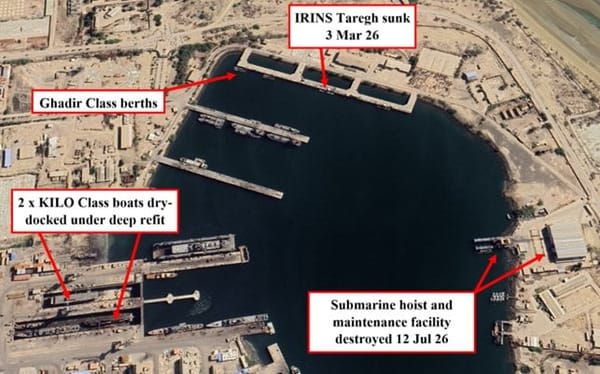
Bandar Abbas Naval Harbor (2025 imagery) showing Nedaja Southern Fleet submarine flotilla locations (Google Earth/CJRC)
This somewhat crude capability was demonstrated during Exercise Velayat-97, in March 2017, when a Ghadir test-launched a canister from a conventional torpedo tube, with a cruise missile rocket motor firing up some 30 seconds later once the canister was stable on the surface. The Jask-2 missile is believed to be an evolution of the Chinese C-704 anti-ship missile and has a range of approximately 20nm. Whether firing conventional torpedoes and a Jask-2, or laying mines, the Ghadirs represented a nuisance and ambush threat. Nonetheless, this could be a dangerous threat if one or more Ghadir could sit, small enough to be difficult to detect, on the bottom, waiting for prime targets to come into range.

that matters most
Get the latest maritime news delivered to your inbox daily.
The attack by three U.S. Navy Saronic Corsair unmanned sea drones on July 12 destroyed the means by which the Nedaja could have repaired any Ghadir boats that might have survived attacks on operational boats moored at the submarine berthing pontoons in the Bandar Abbas Naval Harbor. The attack destroyed the hoist mechanism for lifting such submarines out of the water, along with one Ghadir submarine, which was in the hoist at the time of the attack. In the video of the attack, it could also be clearly seen that the covered maintenance facility, into which the hoist mechanism moved submarines, had previously been heavily damaged.
It is possible that a Ghadir submarine somewhere has escaped detection and destruction, and the Nedaja may still have some trained submariners. But the only way the Nedaja can regenerate a submarine capability which is more than a transient threat will be to buy-in new or second-hand boats from abroad.
