


Improperly Secured Lithium-ion Battery Cargo Caused Cargo Ship Fire
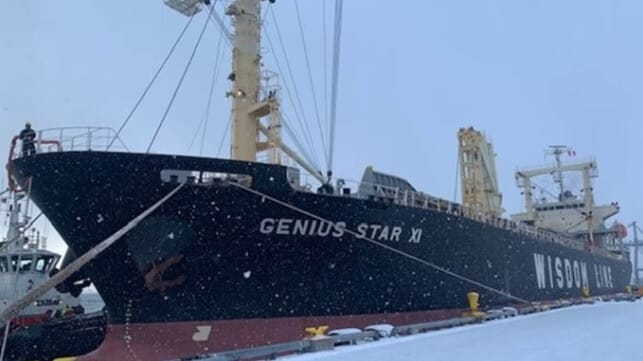
Two years after a cargo ship crossing the northern Pacific experienced two cargo hold fires, the National Transportation Safety Board issued a report finding that when the vessel encountered heavy weather, improperly secured cargo caused the fires in each hold of the ship. They warn about the unique challenges of handling lithium-ion batteries and the need to properly secure cargo following the manuals and instructions.
The fires began on December 25, 2023, aboard the Genius Star XI, while the vessel was south of Alaska. The 13,600 dwt vessel registered in Panama had 19 crewmembers aboard and was about 370 miles southwest of the Aleutian Islands, bound for Long Beach, California. The vessel was 410 feet in length with two main cargo holds.
At the beginning of December, the vessel had loaded cargo in Hai Phong, Vietnam, consisting of 192 lithium-ion battery energy storage systems and 35 heat exchanges. Each of the storage units contained 28 lithium-ion battery packs, each in turn made up of three battery modules with ten lithium-ion battery cells.
The units were stacked between the lower deck and tween deck of each of the two holds. While the vessel’s cargo securing manual recommended utilizing wire rope, chains, or materials with equivalent strength, the cargo owner requested the use of polyester lashing belts to avoid scratching the units. The vessel got underway on December 10, making a bunkering stop in Busan, South Korea, and starting the Pacific crossing on December 18.
Starting on December 24, it began encountering heavy weather, which after midnight became a full gale. Winds were at 26 knots, gusting to 31, waves at 19 feet, and swells at 13 feet. During the heavy weather, seawater was reported to have washed over the vessel’s cargo hatches.
The crew had been doing daily inspections to ensure the cargo was secure, and on the morning of December 25, entering Hold 2, they discovered cargo on the tween deck had shifted. At around the same time, the chief officer observed black smoke coming from a manhole cover that had been opened for access to Hold 1.
The vessel deployed its CO2 system, and later reports indicate the temperature in Hold 1 was declining. The master ordered the crew to re-lash the cargo in Hold 2. However, because they had exhausted the onboard CO2, the vessel requested and received permission from the U.S. Coast Guard to divert to Dutch Harbor, Alaska.
On December 28, while they were still heading for Alaska, the Genius Star XI again encountered heavy weather. The winds were back to 26 knots, gusting to 31, and the seas were at 22 feet with 13-foot swells. At 0215, the fire alarm for Hold 2 triggered, and smoke was seen coming from the ventilation ducts. Without CO2 available, the crew was forced to fight the fire using water to cool the exterior of the hold. By the time the vessel reached Alaska, the hold temperature was decreasing, indicating the fire was extinguished.
The vessel spent nearly six weeks in Alaska while the Coast Guard and private experts familiar with handling lithium-ion batteries were brought in to secure the situation. The CO2 supply was also replenished. The vessel finally reached San Diego, California, at the end of February. The NTSB estimates the damage cost at $3.8 million.
The NTSB reports that three of the power units on the tween deck of Hold 1 and another on the tween deck of Hold 2 had dislodged and experienced fires. In total, 43 of the 160 units stored on the tween decks were damaged. The survey showed that 41 of the 43 units had broken from their lashings and shifted.
Two of the units that broke loose in Hold 1 had experienced an internal fire. Twenty units broke loose but did not experience a fire. One unit broke free in Hold 2 and experienced the second fire days later. While the fires were caused by the same circumstances, the two fires were unrelated.
The report points to equipment failure in securing the cargo. Investigators found that numerous lashing belt hooks had fractured. They found a mismatch between the D-ring and the hooks. Further, numerous brackets securing the D-rings that had been welded and were found to have separated.
Wisdom Marine Group, which operated the vessel, NTSB reports, acknowledged that the cargo lashing procedures were not implemented properly. Further, it said the crew did not have sufficient knowledge to check the lashing conditions within the loading port.

that matters most
Get the latest maritime news delivered to your inbox daily.
The vessel was operating under a time charter to Norden. It pointed out that the stowage plan was similar to one used on five previous voyages. Norden, however, modified the stowage plan by increasing the breaking load of the lashing belts. For subsequent voyages, Norden also instructed masters to take a more southerly route across the Pacific.
The NTSB concludes that the entire incident came down to the stowage of the cargo. Its recommendations focus on properly securing and inspecting cargo arrangements. It says proper inspection and verification are critical to preventing cargo movement.
