


Finland’s Plans to Replace World’s Oldest Operating Icebreaker
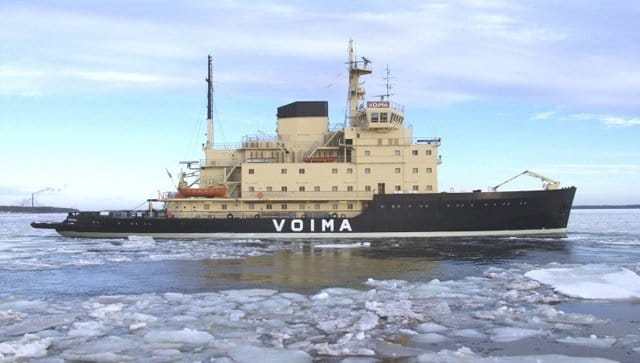
Finland is making progress on a project to replace the world’s oldest working icebreaker. They announced the progress, reporting that the project has settled on the design concept for a new vessel that can operate in the typical ice and open water conditions of the Bothnian Sea and the Gulf of Finland.
The Finnish Transport Infrastructure Agency (FTIA) has settled on the design for the new icebreaker that will replace the 70-year-old Voima, which was built in 1954 and holds the distinction of being the world’s oldest icebreaker that is still in operation. The ship remains a vital part of the fleet, with operator Arctia reporting at the end of December that Voima had set off from Katajanokka, Helsinki, as its first icebreaker for this winter, heading to the Bothnian Bay to assist merchant ship traffic in the Tornio, Kemi, and Oulu areas.
The icebreaker is largely credited with propelling the Finnish shipbuilding industry to world leadership in icebreaker designs and construction and for being the first in the world to be equipped with two bow propellers. At an overall length of 83.5 meters (274 feet), the B-class Voima was once the longest and widest icebreaker ever built in Finland. In 1978–1979, she underwent an extensive refit that allowed her to remain in operation for decades.
Finland has embarked on a project to replace Voima with a new icebreaker that shares some attributes with her (Voima) but also one that incorporates the latest technologies that meet the needs for modern-day icebreaking capabilities.
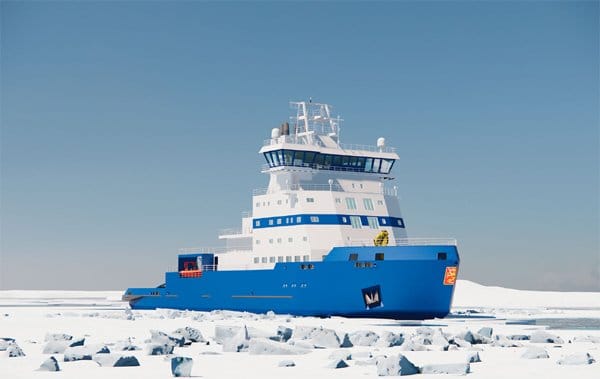
Finland has selected a design for the new icebreaker (FTIA)
Having awarded the design contract to Finnish firm Aker Arctic Technology, FTIA is stating that the new B+ icebreaker will be around 96 meters (315 feet) long and with 10.5 MW of engine power, the same power as the Voima. However, the new vessel will be much wider at 24 meters (79 feet) compared to the Voima's 19 meters (62 feet), with the increased beam and the modern hull and propulsion solution expected to significantly improve the vessel's open water characteristics and performance in icy conditions.
FTIA is highlighting that the propulsion solution for the vessel was a key factor in the final design. The agency contends that the propulsion solution chosen is the first of its kind and is based on traditional straight shaft lines and rudders, complemented by a bow-mounted reversible rudder propeller. The combination substantially improves the vessel's maneuverability and ice-handling capabilities compared to rudders alone, while maintaining a technically clear and well-managed entity over its lifetime.
The design is also said to have considered alternatives where the thrust of the vessel would be distributed over several rotating units, in effect increasing the agility of the vessel. Also of critical importance is the fact that the icebreaker will be capable of making a channel of about 25 meters in width, equivalent to the width of existing A-class icebreakers, and will efficiently serve traffic requiring assistance. While the vessel will operate in open water conditions, its main areas of deployment will be icebreaking in the Bothnian Sea and the Gulf of Finland.

that matters most
Get the latest maritime news delivered to your inbox daily.
“The propulsion solution clearly ensures adequate performance for the vessel’s functions in ice and open water. It is agile and reliable without being technically oversized,” said Lauri Kuuliala, shipping expert.
Having settled on the design, FTIA will move to the tendering stage to bring on board the shipyard to build the icebreaker, whose construction is scheduled to start in 2027 and delivery is slated for September 2029. The new vessel is being built as part of the WINMOS IV (Winter Navigation Motorways of the Sea) project, which has secured $49.4 million in Connecting Europe Facility funding.
