


European Strait of Hormuz Force Inches Forward
The Memorandum of Understanding (MoU) signed by President Trump in Evian, France, on June 17, commits Iran and the United States to clear the Strait of Hormuz of mines and obstacles within 30 days, and to providing free passage for the full 60 days of the negotiating period – which can be extended by mutual consent. The enduring navigation regime for the Strait is to be determined during the 60 day negotiating period, with the agreement of both Oman and Iran though whose territorial waters the inward and outward channels must pass.
The Anglo-French monitoring operation, in which more than 40 nations are engaged to lesser or greater degree, is designed to monitor free movement in the Strait once a sustained ceasefire is in place. Now, therefore, is the time that such a force should be making preparations to deploy. The G7 conference in Evian on June 17 endorsed the Anglo-French plan, which implies therefore that it has American, but not necessarily Iranian support.
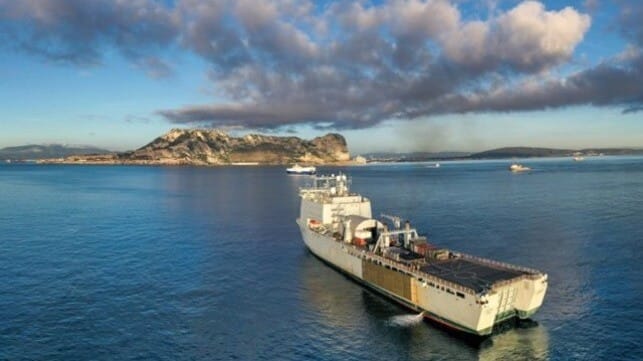
Slated participants of the force are now exercising a greater degree operational security controls on divulging their whereabouts. But already plotted, the FS Charles de Gaulle Carrier Strike Group is in the Arabian Sea. German Defense Minister Boris Pistorius announced on June 17 that the minesweeper FGS Fulda (M1058) and the Elbe Class replenishment ship FGS Mosel (A512) had begun their transit south through the Suez Canal. The Royal Navy air defense destroyer HMS Dragon (D35) is already with the Charles de Gaulle CSG, to be joined by the RFA Lyme Bay (L3007) which is currently carrying out pre-deployment Flag Officer Sea Training. RFA Lyme Bay is preparing to act as a mothership for the operations of autonomous mine clearance drones, which will monitor the navigation channels, looking for mines that may have been missed by Iran’s own initial mine clearance effort.
The Italian Navy’s ITS Crotone (M 5558) and ITS Rimini (M 5561), supported by the patrol vessel ITS Montecuccoli (P455) which all left Italy for the Gulf in mid-May, have now transited the Suez Canal and are in Djibouti.
A number of other navies are still in the planning stage. The Dutch minesweeper HNLMS Willemstad (M864) was in Gibraltar on June 6. The Hellenic Navy is considering reassigning its MEKO 200 Class frigate HS Psara (F454) from EU NAVFOR Aspides already in the Gulf of Aden and reinforcing it with the support vessel HS Prometheus (A374). Many other navies have expressed an interest in joining the force.
Three issues remain hanging over the activation of the force however. It is not clear what the role of the force would be if the two warring parties have agreed a ceasefire; neither Iran nor the United States would necessarily welcome a force monitoring their activities, and it is not clear what recourse the force would have should a breach of the ceasefire – for example, the laying of a sea mine – be observed.

that matters most
Get the latest maritime news delivered to your inbox daily.
Secondly, the force still needs the permission of Iran and Oman before it can deploy into the Strait of Hormuz area. Such a lingering deployment could not be described as UNCLOS innocent passage, so would normally need diplomatic clearance from the two nations in whose territorial waters the force would operate. Inviting a foreign force to operate in your own territorial waters has significant sovereignty implications. Clearance and support for the activities of the force from Oman would in particular be needed, largely because it would have difficulties sustaining itself from Djibouti, and would in all likelihood need to use the fleet support facilities in Duqm.
Finally, the Memorandum of Understanding makes it clear that the final transit arrangements through the Strait post the initial 60-day period are still to be determined. The Anglo-French force may be given a role as a consequence of the negotiations, the results of which are to be endorsed by the UN Security Council. But on balance both Iran and Oman would probably prefer not to have outside parties involved, even with a UN Security Council imprimatur. Indeed, it has long been an Iranian strategic objective to reduce foreign presences in the Region. Hence the Anglo-French led force may either not make it to an initial deployment, might have to withdraw shortly thereafter, or could possibly morph into a UN peacekeeping mission.
