


Construction Starts on Bangladesh Terminal to Double Ship Size and Capacity
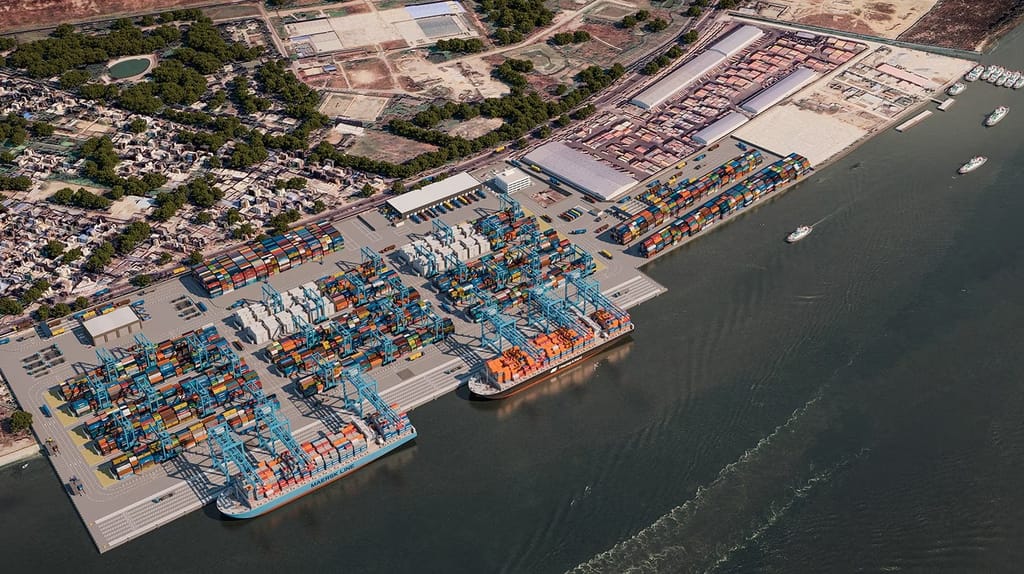
A groundbreaking ceremony was held in Chattogram, Bangladesh, for a new container terminal that is one of the largest public-private partnership investments in the history of the country and that will dramatically enhance its trade capabilities. Being developed by Maersk’s APM Terminals, it will increase the size of vessels that can reach the port and Chittagong’s container capabilities.
Government officials highlight that approximately 93 percent of the country’s import-export trade is conducted through the port at Chattogram. However, the port depends mostly on feeder vessels from hubs including Sri Lanka’s Colombo and Singapore. Currently, the largest vessels that can be handled in the port have a capacity of just 2,800 TEU.
“Chittagong Port is the lifeblood of Bangladesh’s economy,” says Minister of Finance and Planning Amir Khasru Mahmud Chowdhury. He said it is critical to increase the capacity of the port to meet the growing demand for foreign trade.
Planning for the new deep-water terminal dates back to a 2021 memorandum between the governments of Denmark and Bangladesh and a 2025 investment agreement with APM Terminals. Under a unique structure for the agreement, APM, in partnership with the Chittagong Port Authority and local partner QNS Container Services, will lead the project, which calls for an investment of $550 million. APM Terminals Laldia will be fully designed, financed, built, and operated by APM Terminals and its partners, but the port asset remains with Bangladesh. APM will have a 30-year operating agreement with an option to extend for an additional 15 years.
Designed with a deeper draft and an extended quay, APM Terminals Laldia will enable the Port of Chattogram to handle container vessels of up to 6,000 TEU, which is more than double the current limit of around 2,800 TEU. When completed in 2030, it will add 800,000 TEU of new capacity for the port.
The Ministry of Shipping said it is essential to make trade faster, more efficient, and more international-compliant. They noted that Laldia will be the country’s first green port with solar power and shore-power-ready infrastructure.
The terminal will be equipped with seven ship-to-shore gantry cranes, 32 electric rubber-tire gantry cranes, and 41 electric tractors. The terminal complex will encompass more than 49 acres and be able to handle ships with a draft of approximately 10.5 meters (34.5 feet).

that matters most
Get the latest maritime news delivered to your inbox daily.
“The ongoing modernization of Chittagong Port will not end within the Laldia Container Terminal alone. It is a continuous process,” said Minister of Road Transport and Highways, Sheikh Robiul Alam. “There is interest from various international organizations in the development of several other terminals and infrastructure in Chittagong Port. The government is working sincerely to bring this to the attention of international investors, giving top priority to the country's interest, economy, and commercial potential.”
During the ceremony, they noted that APM was the best partner for the project. The company currently handles almost 30 percent of all the containers moving in and out of Bangladesh. Maersk is reported to be looking to further grow its investments in the developing country.
