


CMB.TECH Putting First Ammonia-Powered Bulkers into Service with Fortescue
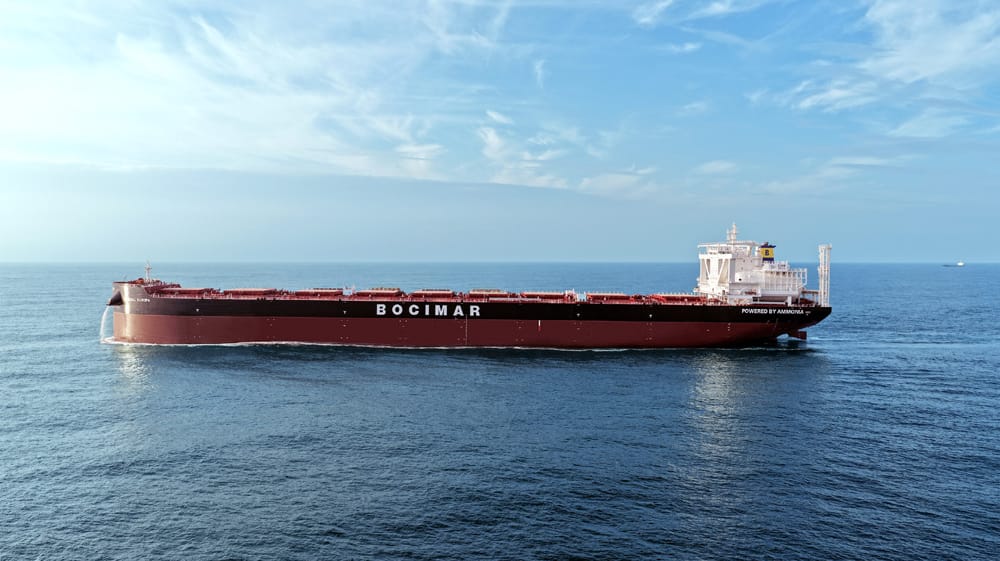
Belgium’s CMB.TECH is highlighting that its nearly decade-long effort to develop and launch large ammonia-fueled ships is coming to fruition. It is highlighting that Mineral Europa (210,000 dwt) is entering service as one of 12 vessels it is chartering to Fortescue and as part of a larger fleet of 21 ammonia-powered ships due to enter service by 2029.
The Saverys family and CMB.TECH have been at the forefront of advocacy for the development of ammonia as a marine fuel to achieve decarbonization of shipping. Alexander Saverys, CEO of CMB.TECH, is calling the vessels the beginning of the “propulsion revolution.” As Mineral Europa embarks on its maiden voyage to Australia, Saverys says it “proves that large ocean-going ships can be powered by ammonia.”
Built by CSSC Qingdao Beihai Shipbuilding Co., the vessel is equipped with a dual-fuel engine capable of using ammonia or conventional marine fuel. The engine was developed in a partnership with WinGD. The ship is 300 meters (984 feet) in length with a reported speed of 14 knots. It will operate under charter to Fortescue, transporting iron ore from Western Australia’s Pilbara region to China and other international markets. The vessel is being managed by Anglo-Eastern and owned by Bocimar, the dry bulk line within CMB.TECH.
The ammonia is stored in liquid form in independent tanks that are located on the deck of the vessel, at a safe distance from the sides of the ship, reports CMB.TECH. Safety protocols were established, and all the crew must undergo training before boarding the vessel.
CMB.TECH highlights that it is building a new fuel ecosystem needed to support the transition to clean shipping. It says the vessel will operate on “green ammonia,” which combines renewable power, water, and air to produce the fuel. It did not comment on the current availability of the fuel for the vessels.
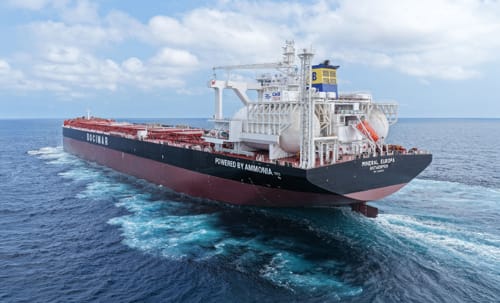
Ammonia is stored in liquid form in the large tanks on deck (CMB.TECH)
Mineral Europa joins Mineral Latvia, with the ships registered in Belgium. CMB.TECH reported in June 2026 that Fortescue would charter 12 Newcastlemax vessels, wth up to three being delivered with dual-fuel ammonia engines and due to enter service in 2026. It said the other nine would be built ammonia-ready and could be converted to operate on ammonia.
Japan’s Mitsui O.S.K. Lines and MOL Chemical Tankers also entered into a deal with CMB.TECH in March 2025, calling for nine ammonia-powered vessels. MOL and CMB.TECH will jointly own three 210,000 dwt Newcastlemax vessels being built at Qingdao Beihai Shipyard and operating under 12-year charters to MOL. They are due for delivery in 2026 and 2027.
In addition, CMB.TECH is building two ammonia-fitted and four ammonia-ready chemical tankers at China Merchants Jinling Shipyard (Yangzhou). Expected to join the fleet in 2028 and 2029, they will be on charters ranging from seven to 10 years with MOL Chemical Tankers.

that matters most
Get the latest maritime news delivered to your inbox daily.
CMB.TECH says in the coming nine months most of the ammonia vessels will be delivered. By the end of 2029, it will have built a fleet of 18 dry bulk vessels, one containership, and two chemical tankers, all powered by ammonia.
The dry bulk carriers join a small but growing segment of ammonia-fueled vessels. In June, Exmar took delivery of its two ammonia-powered gas carriers as the first large vessels in the ammonia class. DNV highlights that there are only five ammonia-fueled vessels in service, the two gas carriers, two tugboats, and Fortescue’s demonstration OSV. Four dry bulk vessels, including CMB.TECH’s were in testing in DNV’s data, with 41 ammonia-fueled vessels on order for delivery by 2030.
