


China Sends its First Maritime Message After the Japanese Election
On February 8, Japan held a parliamentary election and returned the sitting prime minister Sanae Takaichi and her Liberal Democratic Party with a two-thirds super majority, winning outright with 316 of the 465 seats in Parliament. Takaichi overtook the previous governing party record of 308 seats won by the Democratic Party in 2009.
With a majority of this size and a strong personal mandate, Prime Minister Takaichi will have a clear path to implementing her election manifesto, which include immediately increasing defense spending, strengthening the defense partnership with the United States and building alliances in the Indo-Pacific region. She will have the seats in Parliament to amend the Article 9 ‘Peace Clause’ in the constitution which imposes limitation on Japan’s Self Defense Forces.
Of even greater concern to China, before the election Prime Minister Takaichi clearly stated she would abandon the policy of strategic ambiguity over Taiwan. Under a new Taiwan Contingency doctrine, her administration would regard Chinese intervention on Taiwan as a direct attack on Japanese maritime, economic and security interests.
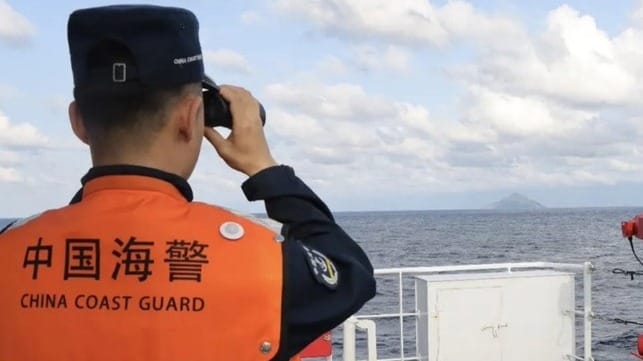
Two days after the election, and with the results in, China decided to show defiance in the face of the projected, more steadfast Japanese military posture. The China Coast Guard mounted another incursion into the territorial waters of the Japanese-administered Senaku Islands, which lie between Okinawa and the northern tip of Taiwan, as does the inhabited Japanese island of Yonaguni, where Japanese defenses are being built up.

that matters most
Get the latest maritime news delivered to your inbox daily.
China claims sovereignty over the Senakus. Similar such incursions are a regular occurrence, usually mounted in response to Japanese political statements on defense matters. The United States acknowledges that the islands are covered by the US–Japan security treaty.
The incursion was mounted by Chinese Coast Guard Formation 2503. From the single picture of the incursion published on the official China Military Bugle site, only a single Chinese Coast Guard vessel was involved, and it did not come in close to the shoreline of the islands. There was no Japanese presence in the area which could respond, so the gesture was largely symbolic – but a warning that this is a live maritime sovereignty dispute which has the potential to escalate.
