


China and Russia Plan to Hold a Naval Exercise With Iran in February
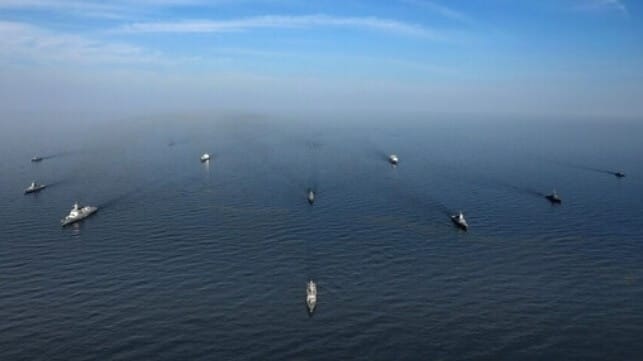
The commander of the regular Iranian navy (Nedaja) Rear Admiral Shahram Irani has announced that Iran will once again host Chinese and Russian naval vessels in Exercise Maritime Security Belt 2026, to be held in the northern Indian Ocean in late February. There have been no confirmatory announcements as yet from the Chinese and Russians, but the Iranians will be anxious to secure their participation again in this annual exercise, needing the reassurance of having allies alongside at a time of high tension.
The Chinese participants can be expected to be drawn from the People’s Liberation Army Navy (PLAN)’s Djibouti-based 48th Flotilla, made up of the Type 052DL guided-missile destroyer Tangshan (D122), the Type 054A guided-missile frigate Daqing (F576) and the Type 903A replenishment ship Taihu (K889).
The Russian contingent is likely to consist of the Russian Udaloy Class frigate RFS Marshal Shaposhnikov (F543), still in the region having participated in the DIMDEX 2026 defense exhibition held January 19-20 in Port Hamad, Qatar. The Marshal Shaposhnikov is being supported by the Boris Chilikin Class oiler Boris Butoma (IMO 8842557). Potentially, the Steregushchiy Class corvette Stoykiy (F545) could either supplement or replace these vessels, as it too is still in the region, having participated in Exercise Will for Peace 2026 off Cape Town.
Rear Admiral Irani also has announced that the 103rd Flotilla, also fresh from Will for Peace 2026, is to exercise with an undisclosed partner before returning to Bandar Abbas. The 103rd Flotilla consists of the Bayandor Class corvette IRINS Naghdi (F82) and the Nedaja’s forward base ship IRINS Makran (K441), supported by the IRGC Navy’s converted oil tanker, IRIS Shahid Mahdavi (L110-3).
While elements of the Nedaja are away from home, the business of confronting President Trump’s armada appears to rest with the IRGC Navy. On January 30, the US Central Command warned the IRGC Navy not to use a naval exercise due to start on January 31 as an excuse to overfly, point weapons or maintain collision courses with US Navy vessels.
US naval forces in the region are made up principally of the USS Abraham Lincoln (CVN-72), with its Arleigh Burke Class guided-missile destroyers USS Spruance (DDG-111), USS Michael Murphy (DDG-112) and USS Frank E. Petersen Jr. (DDG-121), with logistics support from USNS Carl Brashear (T-AKE-7). This carrier strike group (CSG) is supplementing the Bahrain-based Arleigh Burke Class guided-missile destroyers USS Mitscher (DDG-57) and USS McFaul (DDG-74), and three Independence Class littoral combat ships optimized for mine countermeasure missions, namely USS Tulsa (LCS-16), USS Canberra (LCS-30) and USS Santa Barbara (LCS-32), with logistic support from USNS Henry J Kaiser (T-AO-187).
This force has recently been supplemented by a further Arleigh Burke Class guided-missile destroyer, USS Delbert D. Black (DDG-119), which is believed to be in the northern Red Sea. Thick cloud has covered the US Naval Support Facility at Diego Garcia in recent days, so it is not possible to ascertain if air reinforcements have arrived in theater.
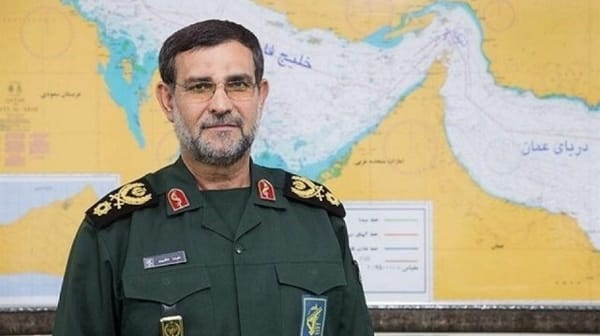
The IRGC Navy issued a statement on January 31 via Tasnim that its commander, Commodore Alireza Tangsiri, had not been killed in an unexplained blast at a residential flat in Bandar Abbas. The statement implied that the blast had been caused by a gas explosion, although local residents have said that the area is not served with natural gas connections.

that matters most
Get the latest maritime news delivered to your inbox daily.
IRGC Navy commander Commodore Alireza Tangsiri (Iranian Defence / Tasnim)
