
British Troops Use Civilian Ferry to Travel to NATO Exercise
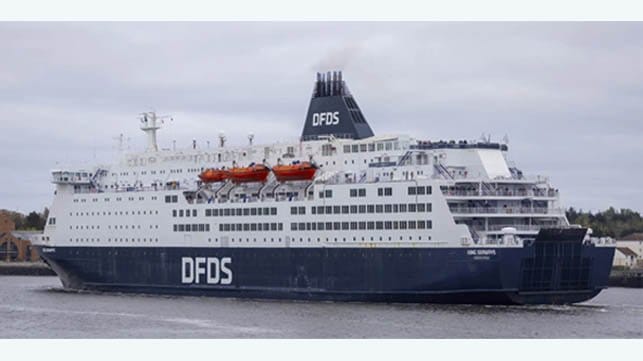
The British Army, for the first time in more than 20 years, has chartered a civilian ferry to transport its forces. It is putting a good light on the operation by saying it is helping the army to practice how to use civilian transport alongside military vehicles and aircraft as it participates in a major military exercise with NATO in Germany.
Over 1,400 army troops boarded a DFDS ferry in the Port of Tyne, Newcastle, for a 16-hour North Sea crossing from the UK to the Netherlands en route to Germany to participate in the Exercise Rhino Storm. After arriving in the Netherlands, the troops continued their trip to Germany by rail, where they met up with French soldiers from the Foreign Legion for the exercise.
The troops sailed aboard the King Seaways, one of the two vessels that DFDS operates on the Newcastle-Amsterdam route. Built in 1987 and acquired by DFD in 2006, the ferry is 31,788 gross tons and 163 meters (5228 feet) in length. It has 522 passenger cabins, giving the ferry a capacity of 1,325 passengers in berths, or 2,280 passengers in total, as well as 600 cars. It features a range of restaurants, shops, bars, cafés, two cinemas, a casino, and children’s entertainment.
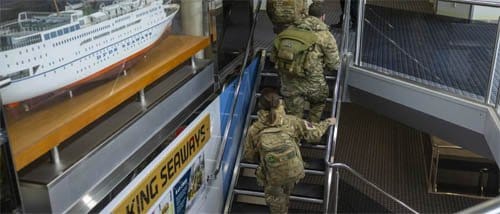
Troops boarding the DFDS ferry for the trip across the Channel (British Army)
According to the army, using a chartered civilian ferry to transport the soldiers was critical in demonstrating readiness and ability to mobilize a large contingent in record time. It said moving a similar-sized unit would have required at least seven RAF Voyager planes had it opted for air transport for the 1,400 troops, plus extra flights for equipment. It contends that using the ferry was a demonstration that it was possible to move large numbers of personnel more efficiently and flexibly.
The soldiers from the 7th Light Mechanized Brigade, known as The Desert Rats, are joining hundreds of French soldiers from the 13th Demi Brigade of the Foreign Legion for Exercise Rhino Storm. The British Army brigade is deploying more than 3,000 soldiers and 900 military vehicles to the exercise, which is not only designed to test rapid deployment but also live-firing skills.
“This exercise is about moving a brigade quickly and efficiently, just as we would in real operations. It sends a clear message that the British Army can project force rapidly and work closely with our NATO allies,” said Brigadier Andrew Watson, Officer Commanding, 7th Light Mechanized Brigade.
that matters most
Get the latest maritime news delivered to your inbox daily.
Though the British Army has not used civilian vessels for more than two decades, the use of civilian vessels for military transport is not unique. During both World War I and World War II, British ocean liners and passenger ships were deployed, and Britain famously used civilian ships to rescue troops at Dunkirk during the 1940 evacuation and to support the D-Day landings. Civilian ferries have also been used in conflicts such as the Falklands War, Bosnia, Kosovo, and the Iraq War in 2003.
