


Blue Water Uses a Damen Design to Speed Up Unmanned-Vessel Program
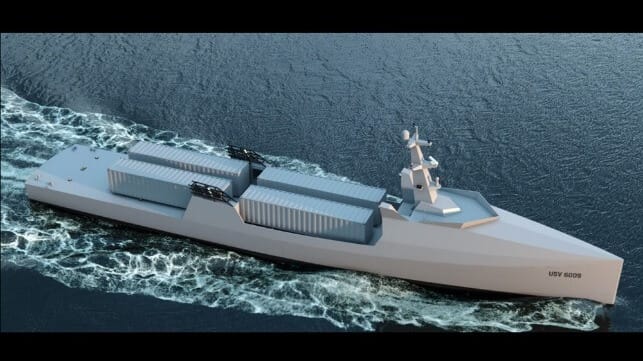
The American autonomous-vessel company Blue Water Autonomy has released the first renderings of its new contender for the U.S. Navy's oceangoing unmanned surface vessel procurement program, which was recently restructured and renamed "Modular Attack Surface Craft" (MASC).
The new "Liberty-class" design - a nod to the mass-produced Liberty ships of World War II - is a 190-foot steel-hulled autonomous vessel, capable of carrying four 40-foot containerized systems for flexible loadout. The hull is based on a Damen Axe Bow patrol boat, the Stan Patrol 6009, which is designed for wave-piercing and reduced ship motion.
Blue Water's objective was to stay with a known and proven hull form in order to lower technical risk, but the company's engineers fully redesigned the interior and ship's systems for unmanned operation. All systems are designed to be fault-tolerant and highly automated, with the goal of building a boat that can go for months with little attention from human operators. The target operational range is 10,000 nautical miles.
Blue Water's design is set to begin construction at Conrad Shipyard next month, and will be ready before the end of the year, the company said. Conrad builds in volume - about 30 vessels of various sizes and types per year - and it has scale and experience for series production.

that matters most
Get the latest maritime news delivered to your inbox daily.
Blue Water says that it has been able to develop the Liberty-class design with private capital only, thanks to partnerships with companies like Conrad and Damen. After delivering the first hull, it wants to ramp up quickly to deliver 10-plus ships per year out of the Conrad yard complex in Louisiana.
The company's speed to market aligns with current Pentagon leadership's goals - leveraging private innovation, prioritizing autonomous systems, and building at scale. The design's manufacturability and intended use cases - including missile, sensor, and logistics payloads - make it a fit for the Navy MASC program, and specifically the four-FEU "High Capacity MASC" container-carrying vessel category. The High Capacity MASC solicitation requires enough room for four 40-foot containers, each weighing up to 36 tonnes and consuming up to 50 kW of power each. Minimum time to production, producibility at large numbers of shipyards, and "non-exquisite" design are key to the solicitation, so a proven steel hull aligns with requirements.
