Alaska's First Ocean-Going Electric Vessel
The U.S. Coast Guard has approved the structural design for the nation’s first ocean-going pure electric vessel.
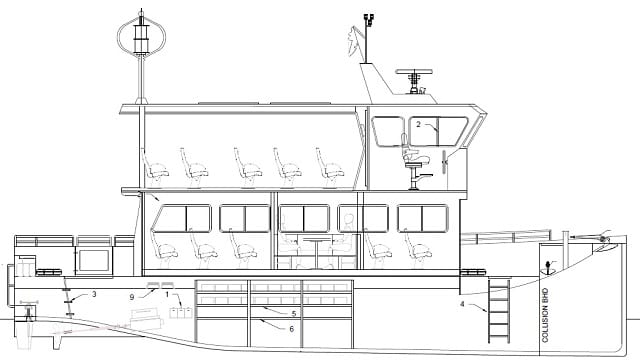
The Tongass Rain, a 50-foot, 47-passenger catamaran, is scheduled to be launched next year in Juneau, Alaska. The vessel has been designed by Tongass Rain Electric Cruise LLC (TREC) of Juneau, Alaska, and Jutson Marine of Vancouver, British Columbia It will be built at Armstrong Marine in Washington.
Scott Jutson and Bob Varness are working through the propulsion and electrical systems with the U.S. Coast Guard now, and anticipate having approval soon.
Tongass Rain will be purely electric vessel with 88 lithium ion phosphate batteries charged daily from the local commercial power hydro-electric power system (which is ultimately sourced from “rain”).
On board, the vessel will have two industrial electric marine motors.
“Our goal is to travel 50 nautical miles at 7-8 knots while maintaining 30 percent reserve capacity, says Bob Varness, president of TREC. “We will be able to recharge using commercial hydroelectricity at dockside, with two 208 volt 50 amp services in 7-8 hours. Wind generators and solar panels will maintain electrical charge on the house batteries.”
Safety
Varness says proper installation and light preventative maintenance will be necessary for safe operations. “TREC will be inspecting and documenting performance on every trip. The lithium batteries are maintenance free, and will be visually inspected daily, and continually monitored in real time while underway using BMS (Battery Management Systems) diagnostic software.
“We’re aiming to get 12-15 years of service from them. The industrial marine motor manufacture recommends scheduled maintenance every 50,000 hours of operation, and chargers will be proactively replaced every 4-5 years. The motors have only one moving part, further increasing reliability factors.”
There is no fossil fuel emergency power backup, so this is a pure electric zero carbon emission vessel. “Our battery string configurations ensure reliability, and in the event a battery string is disabled, we can continue operations to our planned destination. We will have full redundancy of all propulsion systems to ensure reliability and safety.”
Fishing Vessels
The Tongass Rain is designed for creating a silent eco-cruising experience, renewable energy education and whale watching tours, but Varness has his eye on the fishing vessel market for future electric vessels too. So far, Torqeedo and Elco motors have been used for private vessels, but not commercial fishing, says Varness, who believes electric propulsion and on demand hydraulic technologies will be suitable for vessels such as salmon trolling, drift and gillnetters, who have access to commercial power.
“If you have any vessel that operates at a relatively slow speed for a known distance on a routine basis and has access to electrical power, you should be looking at electric or electric/diesel hybrid options,” says Varness. “Globally, we have a huge opportunity to break from the norm, reduce operating expense and carbon emissions. The cost of MV Tongass Rain construction compared to twin diesel is about 10 percent higher, but annual operating expense is predicted to be, 70-75 percent lower.”
More Passenger Vessels
Tongass Rain will be the first of potentially five vessels for TREC. “We have opportunities to grow in the small passenger ferry market in Southeast Alaska. We’re planning on three ferries and two eco marine vessels in Juneau. Jutson Marine has worked with us on three designs from 40-foot 20 passenger vessels with electric outboard motors to 50-foot 48 passenger ferries.
“The Tongass Rain design and look is scalable for vessels from 28-70 feet in length through Jutson Marine. Jutson and Armstrong Marine have been excellent to work with and I’m really looking forward to get U.S. Coast Guard approvals so I can take on investors and get construction underway this fall,” Varness said.

that matters most
Get the latest maritime news delivered to your inbox daily.
TREC is also an authorized Torqeedo dealer and has performed gas to electric conversions on small boats using Torqeedo batteries, chargers and motors. “We’re going to provide the hard data needed for mariners to make intelligent decisions when considering new power or re-power,” says Varness.