


Ill Wind or Tailwind? AI is Sweeping the Maritime World
(Article originally published in July/Aug 2026 edition.)
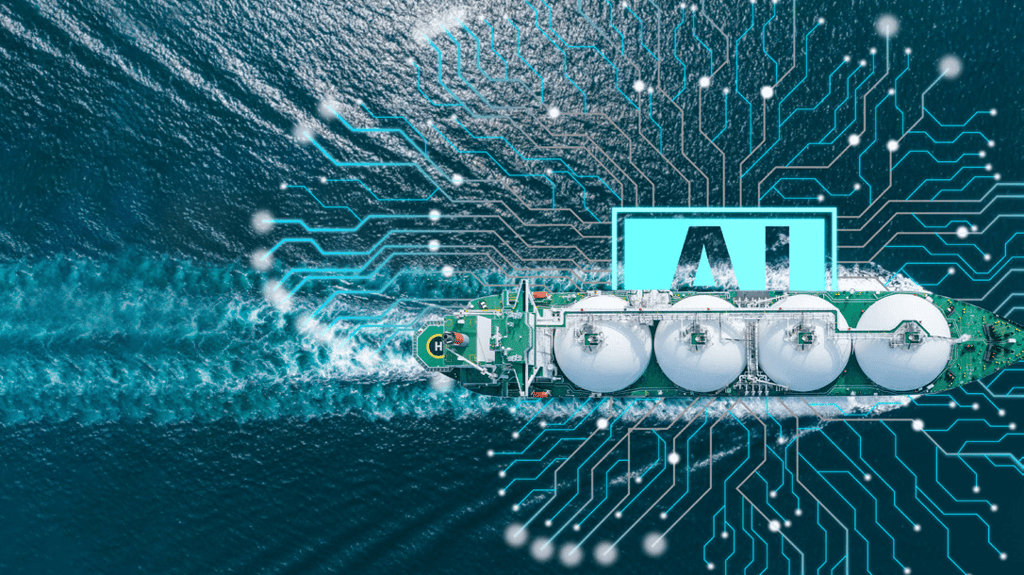
The winds of the digital age and artificial intelligence seem like a tempest for the marine industry.
For those who are prepared and understand how to properly apply the various types of AI, it's like a magnificent tailwind pushing their fleet ahead and outpacing the competition in ways not previously seen. On the other hand, there will be owners and operators unwilling to shift sails in time to catch the benefits of digitalization and AI. Then it becomes an ill wind.
While it's necessary to maintain a healthy amount of skepticism and not go all-in for every new untested application, the consequences of being the last to properly use AI and the consequent loss of business are too great to risk.
The winds of digitalization and AI are blowing. The old way of operating is now obsolete.
TEAMING UP
Shipowners who have already caught the winds of digitalization and AI have likely teamed up with a partner who can embed AI into their day-to-day operational workflows – like Dubai-based Marcura, whose client list reads like a who's-who of the global maritime business.
Marcura's software solutions keep shipowners and operators ahead of the expected pace of maritime logistics by utilizing AI inside functions like chartering, voyage documentation, port calls and payment workflows. Why comb through contracts by hand looking for certain clauses or provisions – a process that can take hours – when a Marcura solution can find it in seconds by typing in a key phrase?
"In one case a dry bulk operator avoided potential losses of more than $120,000 when the system caught four critical clauses omitted from a draft agreement," states Janani Yagnamurthy, Senior Vice President for Product & Strategic Growth. "Our AI reads the same document in seconds and flags what's missing or risky with citations showing exactly where the problem sits. The same approach runs through operations. That includes automating the conversion of Bills of Lading into Letters of Indemnity, saving the equivalent of three month of operator time a year."
AI agents trained on the industry's largest datasets empower Marcura clients when making critical financial and operational decisions. Tough decisions are always easier to make when backed by solid quantifiable analytics. Marcura products such as CP Optimiser equip junior charterers with the quantifiable analytics needed to make the decisive call with the same level of confidence and efficiency as experienced charterers.
Marcura addresses the use of AI through three principles: applicability, explainability and auditability.
Applicability means ensuring AI is deployed for the right use and within the proper operational context rather than being applied indiscriminately.
Explainability is about ensuring users understand why AI has made a recommendation and the rationale behind it.
Auditability ensures the data is in the proper context and can be vetted in a way that can be easily interpreted by users. With Marcura products, every AI run can be traced and reviewed, giving users the ability to defend their decision.
FORCE MULTIPLIER
Another giant in the field is ABS Consulting.
"At ABS Consulting, we view AI as a force multiplier for technical expertise," explains Olivia Northrop, AI Solution Architect. "Ultimately, AI is a tool, and it's only valuable if it can fix the problems it's tasked with solving."
It's a very similar philosophy to that of Marcura.
"That's why our focus is on applied AI – using it to solve real operational problems by helping to improve productivity and turning large volumes of data and documents into actionable insights," she adds.
A subsidiary of the American Bureau of Shipping, ABS Consulting was founded over five decades ago to provide risk management services to clients in the maritime and offshore energy sectors. Today, it's helping clients harness the AI wind by developing tools that deliver real-world results.
In-house AI capabilities have already transformed ABS Consulting's own internal processes in ways that show measurable improvements in efficiency and better decision-making. ABS is using AI to automate workflows that are repetitive, document-heavy and predicated on data extraction and standardization.
Tasks that in the past necessitated hours of time, AI can do quickly, consistently and accurately, freeing up experts to focus on the needs of customers, not the minutia of the process. Organizations that team up with ABS Consulting benefit from more consistency in output, optimized use of data, scalable digital solutions and faster turnaround times.
Northrop warns that the biggest risk with AI is treating it as fully self-sufficient and not subject to data authentication, sound governance and human review. "Treat AI as a new colleague rather than unchecked automation," she advises. "It needs to be trained and supervised to perform in a trusted and reliable way."
THE LEGEND OF JOHN HENRY
There will be holdouts.
Some AI skeptics are reminiscent of the American folk hero John Henry. The legend of John Henry says he lived in the late 19th century and was unequalled when it came to swinging a hammer. He was the fastest human alive when it came to driving steel through mountains or spikes into railroad tracks. The legend recounts how the owner of a steam-powered drill challenged John Henry in a race to see who could carve a tunnel through a mountain fastest so that railroad tracks could be laid. As John Henry carved out the final piece of the tunnel to win the race, he died of exhaustion, proving that one person can win a battle against progress and technology, but in the end technology moves forward.
Industries and organizations must adapt. They must harness the winds of change.
The Association of Diving Contractors International (ADCI) is one such organization. Founded in 1968, it's a nonprofit association that promotes safety, sets standards and issues certifications for the commercial diving industry. As a commercial diver myself, I know it well.
It's the world's largest trade organization of its kind and has taken a defining stance by digitalizing the diver certification process. As of 2026, the ADCI has teamed up with maritime and dive safety subject matter experts at Skill N Depth to streamline the process of verifying diver credentials. Based in Switzerland, Skill N Depth is a blockchain-enabled, purpose-built platform for the commercial diving and marine contracting industry.
The Skill N Depth digital platform has enabled the ADCI to review, verify and issue a credential within 24 hours – a dramatic improvement over the six to eight weeks required for ADCI staff to manually review the myriad of documentation needed to authenticate each diver's actual qualification level.
It's also being used by dive schools to electronically log dives and by dive contractors to manage personnel data, but the overall intent is to be more than just a diver database. It's a tool that can be used throughout the maritime industry by ship managers, flag states, classification societies and even freelance individuals. Maritime trades like remote access testing and ROV operations can choose to team up with Skill N Depth to reduce administrative burdens, verify personnel more efficiently and mobilize competent teams faster.
"Skill N Depth is more than a digital platform," says CEO Anthony Greenwood. "It's an industry ecosystem and trust network that connects individuals, employers, training providers, certification bodies, medical providers and other industry stakeholders through verified professional records."
ILL WIND OR TAILWIND?
It'll be interesting to see what the future holds for organizations that choose the "John Henry route" of resisting progress. Dive and marine contractors who do not embrace digitalization or disregard consensus industry standards will find that their marketability is nonexistent or limited to a customer base that exists only on the margins.

that matters most
Get the latest maritime news delivered to your inbox daily.
Pat Zeitler is Dive Superintendent at the Orion Group in Houston.
This article appeared in the July/August issue of The Maritime Executive. To read the latest edition of the magazine, go to The Maritime Executive July/August 2026 Ship Management edition. To subscribe to the magazine, please go to https://www.maritime-executive.com/subscribe.
The opinions expressed herein are the author's and not necessarily those of The Maritime Executive.
