


Feast or Famine
Salvors leverage their skills to offset an uneven revenue stream.
(Article originally published in Sept/Oct 2025 edition.)
Marine salvage is arguably the most unique subsector of the maritime industry. It's a sector with a modus operandi that seems to be based on a series of enigmas. First and probably most obvious is that salvors operate in conditions and circumstances that often defy the conventional norms of good marine practices.
Second is the fact that the financial structure is different from almost any other. Salvors face an inconsistent revenue stream yet require a steady amount of operating capital. Oftentimes, salvors must give a lump-sum, "no cure no pay" proposal. Although a lump-sum contract is not unique, many prudent accountants would consider it a financially suicidal approach to business. The other unique feature of marine salvage is the necessity for highly skilled laborers, yet there's no formalized trade school or recognized certification for salvors.
MARITIME NECESSITY
Marine salvage includes a combination of spill response and marine firefighting with vessel-lightering and wreck-removal. Though salvage response is often an afterthought for most shipowners, every commercial vessel over 400 tons is required to have an approved Vessel Response Plan – a plan describing how to contact and activate an approved salvor capable of spill response, firefighting and servicing damaged vessels. Salvors are a maritime necessity. They have a unique set of skills, even if not recognized in the same way as licensed mariners.
World-class salvors like Smit International, Resolve Marine, Donjon Marine and engineering firm PCCI understand and accept the unorthodox nature of marine salvage and have cracked the code for excelling in the "feast or famine" nature of this niche industry. Their formula is to leverage salvage skills to fill service voids within the maritime industry by providing other services like ship repair, marine towing, dredging and marine construction.
Marine salvage includes a combination of spill response and marine firefighting with vessel-lightering and wreck removal. Though salvage response is often an afterthought for most shipowners, every commercial vessel over 400 tons is required to have an approved Vessel Response Plan – a plan describing how to contact and activate an approved salvor capable of spill response, firefighting and servicing damaged vessels.
This helps balance an inconsistent revenue stream and keeps the skills of both management and deck plate-level salvors sharp and proficient.
SMIT INTERNATIONAL
Netherlands-based Smit International is one of the world's premier salvage firms. What began as a towing company in the mid-1800s has grown into an industry leader that is now part of Boskalis and also operates a joint venture with Donjon Marine. Under the Boskalis umbrella, customers of Smit have access to services that include heavylift, open ocean marine towing and spill response in addition to dredging and subsea capabilities that include saturation diving and ROVs.
Smit has response centers in Rotterdam, Houston, Cape Town and Singapore. On any given day, Smit's teams will be engaged in multiple projects. This past year has seen a steady volume of business with a notable case being the response to the container ship MSC Elsa 3, which is currently sitting in 165 feet of water off the southern coast of India. Smit sent a saturation dive team to work around the clock to remove fuel from the sunken vessel.
DONJON MARINE
Founded in 1964 by J. Arnold Witte to provide salvage and other related services, Donjon has expanded to include towing, dredging and spill response as well as ship repair and recycling. Donjon CEO and second-generation salvor, John Witte, Jr., is no stranger to the obstacles facing the marine salvage industry. As current President of the International Salvage Union and former head of the American Salvage Association, he knows that it takes tactical expertise at the deck-plate level and prowess at the macro level to thrive in this industry. Recent high-profile responses for Donjon include the Francis Scott Key (FSK) allision in Baltimore in 2024 as well as the mid-air collision over the Potomac River in Washington between an American Airlines jet and a U.S. Army Blackhawk helicopter in January of 2025. In both cases, the U.S. Navy's Naval Sea Systems Command, Supervisor of Salvage and Diving played a central role.
One could argue that the secret to Donjon's success is that they have leveraged partnerships and optimized skills and lessons learned in salvage to provide other related services. A notable example is the recent news that Donjon has been awarded an $8.2 million contract to perform the maintenance dredging for the Bronx River Navigation Project. Donjon's success has resulted in some very exciting news. As of September 2025, Miami-based investment firm Tallvine Partners acquired Donjon Marine. The details have not been released, but what is known is that John Witte, Jr., will remain CEO and Donjon will continue to operate under the Donjon Marine brand. Tallvine Partners and Donjon appear to be in sync on Donjon's current strategy, so it's reasonable to expect more expansion in the near future.
RESOLVE MARINE
2025 has seen Resolve Marine working on a variety of projects from traditional salvage and wreck-removal to more niche response work in the offshore renewable energy and aerospace sectors. "We've also seen an increased trend of cases involving distressed cargo including lithium-ion battery-related fires, collapsed containers and hazardous material response," notes Director of Projects Sam Adams. Based in Fort Lauderdale, Florida, Resolve has been plenty busy with salvage yet seems to innately know that top-notch salvors do more than just salvage. For Resolve, this means ship repair facilities, marine services, ship's husbandry diving, light marine construction and even operating the Resolve Training Academy. Capitalizing on its vast level of in-house experience, expanding into the marine service market seems part of a natural progression. The Resolve team looks beyond simply serving its immediate customers. It views expansion as a great opportunity to enhance the skill sets of its team and improve asset utilization between salvage projects. Downtime of capital assets can be financially destructive for a marine business.
The Resolve Training Academy offers a partial solution to another problem that's plaguing all of the maritime industry. That problem is lack of skilled labor. Resolve Training Academy offers USCG-approved STCW courses, shipboard firefighting and even boasts a damage control wet trainer, designed to simulate flooding emergencies on a ship. Courses are open to everyone, not just Resolve employees, with obvious benefits for the entire industry as well as a mechanism for keeping salvors' skills sharp.
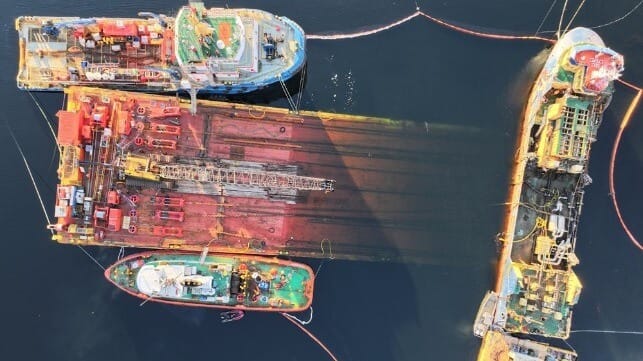
A notable example of how this is working is a wreck-removal in which the Resolve team converted a standard 300x100-foot barge into a semi-submersible. Using a salvor's heart and a spirit of ingenuity, with nothing more than standard maritime and hardware store equipment, the salvage team ballasted the converted semi-submersible barge beneath the wreck, then refloated both the barge and wreck vessel. It was a huge win operationally, but more importantly it illustrated how Resolve's in-house resources of marine towing, spill response and even a damage-control training school enable salvors to confidently think outside conventional maritime norms.
"The maritime industry has entered a new era of complexity," says Adams. "We find ourselves navigating more dangerous and intricate cargoes. Vessels are being powered by alternative fuels that bring unfamiliar risks, and new domains are emerging in the maritime arena like renewable energy, all of which demand a more robust emergency management response posture. In this environment, owners, insurers and regulators expect more than just a technical solution. They require clear communication, full transparency and dependable support."
PCCI – ENGINEERING MANAGEMENT
If salvors feel overlooked at times, then engineering firms that support salvors must feel absolutely invisible. Alexandria, Virginia-based PCCI is an engineering firm that likes to solve marine-based problems, and for over three decades it's been working with the same U.S. Naval Sea Systems Command as Donjon. In fact, PCCI provided the underwater digital imaging and engineering planning that became the strategic catalyst for salvors during the FSK Bridge salvage response. Founded in 1981 with the primary purpose of providing environmental services for the U.S. government, today its services include ocean engineering, marine construction and customization of hyperbaric facilities. Its customer base has expanded well beyond the U.S. Navy and now includes international government agencies, energy producers, mining companies, hospitals and medical facilities. It's an engineering think tank to support marine operations, and that's what it excels at.

that matters most
Get the latest maritime news delivered to your inbox daily.
"Traditional brute-force methods have given way to more sophisticated, multidisciplinary engineering solutions," says Matt Schubert, PCCI's Chief Naval Architect/Engineer. "Larger vessels, stricter environmental regulations and the complexity of modern port infrastructure demand advanced engineering foresight and precision." It's a perspective that should be well-received by maritime stakeholders. The FSK response is a case in point of how salvage operations can be most effective when salvors and engineers work together. Salvors that work with PCCI gain "engineering solutions born out of real-world experience," adds Schubert.
Frequent contributor Pat Zeitler is a Dive Superintendent at Orion Group in Houston.
The opinions expressed herein are the author's and not necessarily those of The Maritime Executive.
