
Rethinking Hull Maintenance: The Problem Goes Deeper Than Fouling
In today's operating environment, that rethinking can't come soon enough.
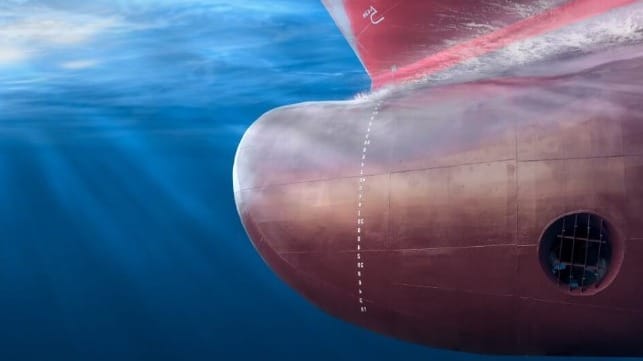
As fuel costs continue to fluctuate across the global shipping industry, operators are being forced to look more closely at every factor impacting vessel efficiency. While routing decisions and operational strategies often receive the most attention, one of the most significant contributors to rising costs is below the waterline.
Hull condition affects everything. Right now the industry's approach to managing it is no longer adequate.
The world is watching the Strait of Hormuz, but in reality location isn't the issue.
Since the effective closure of the Strait earlier this year, approximately 2,000 ships have been stranded in the Gulf, with maritime traffic running at roughly 3% of normal. Vessels are sitting idle for weeks, waiting for conditions that remain unpredictable. Biofouling does not pause when a ship does. It accelerates, especially in warmer waters on stationary hulls.
Port congestion, anchorage holds, mechanical downtime or any condition that reduces vessel movement creates the same accumulation problem. Extended idle time is not uncommon anymore. It is a baseline operating condition and the traditional maintenance model was not designed for it.
What Biofouling Actually Costs
The financial impact of hull fouling is well-documented and consistently underestimated at the fleet level:
- Early-stage fouling creates measurable drag penalties. As fouling progresses to moderate coverage, fuel consumption can increase up to 30%.
- Those losses compound across every vessel, on every voyage, across an entire operating year.
- Bunker fuel costs at current levels mean even incremental drag has a real financial implication.
The problem develops gradually with no visible failures. Just a hull working harder than it should, on every trip, until someone decides it is time for a cleaning.
The Hull Is Also a Security Gap
In the past week, the LPG tanker Arrhenius arrived at the Russian port of Ust-Luga. During a mandatory security inspection, divers and drones discovered two magnetic mines attached to the hull near the engine room. The vessel had not transited a conflict zone. It had experienced a routine port delay in Antwerp of about 36 hours, waiting for a terminal to open. That window was enough.
The mines were found because Russia now requires hull inspections on arrival, a program instituted following a series of previous attacks. Without that program, the Arrhenius would have docked, loaded cargo, and departed with the devices still in place.
This is not an isolated incident. The broader maritime security environment is increasingly defined by what operators cannot see and putting divers in the water to investigate is a risky solution.
- Limpet mines and magnetic devices can be attached during routine anchorage holds at non-hostile ports
- Shadow fleet activity, gray zone maritime tactics, and contraband smuggling have normalized the use of commercial hulls as opportunities for sabotage.
- Standard port delays create the same exposure window as an extended conflict-zone hold.
- Periodic diver inspections leave months of blind spots between assessments
The hull is no longer just a surface to maintain. It is an intelligence gap. And the same conditions that accelerate biofouling such as idle time, anchorage holds, or port congestion, are the same conditions that create exposure to physical threats below the waterline.
Hull Performance as a Continuous Operation with EverClean
It is not enough to clean a hull on a schedule. A credible hull performance program needs to:
- Maintain a consistent cleanliness standard throughout a vessel's operational lifecycle
- Provide ongoing visibility into hull condition between port calls
- Detect anomalies, foreign objects, and developing issues below the waterline in near real time
- Integrate into existing port workflows without requiring significant infrastructure changes or putting divers in the water
EverClean by Greensea IQ was built around exactly that operating model.
Designed as an autonomous hull grooming solution, the system enables operators to proactively maintain a near-dry-dock hull condition directly at port, continuously, while simultaneously providing the kind of hull awareness that periodic diver inspections cannot deliver.
The Economic Case for a Proactive Solution
- A proactive approach can save vessels up to 20% in fuel consumption.
- The math becomes more favorable when factored against current bunker fuel pricing and the growing frequency of disruption events that accelerate fouling
- Routine autonomous inspection as a first line of detection represents risk mitigation that has no equivalent in the reactive model
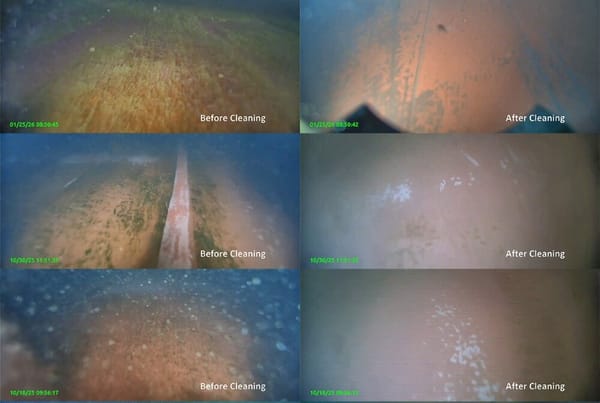
- The image below shows proactive cleaning, paired with inspection capabilities using high-definition cameras in a single operation.
The State of the Industry
The Strait of Hormuz situation will resolve, the Arrhenius incident has been disarmed, but the operating environment that made both problematic is not going away.
Hull performance is not a static maintenance issue. It is an operational factor that directly affects fuel consumption, reliability, and decision-making across a fleet. Operators who treat hull condition as a continuous operational responsibility for both efficiency and for security, are already running a more resilient program than those who do not.
To learn more about EverClean, contact Greensea IQ, the sponsor of this message.
The opinions expressed herein are the author's and not necessarily those of The Maritime Executive.
