
Russia May Put Mobile Fire Groups on its Grain Ships to Counter Drones
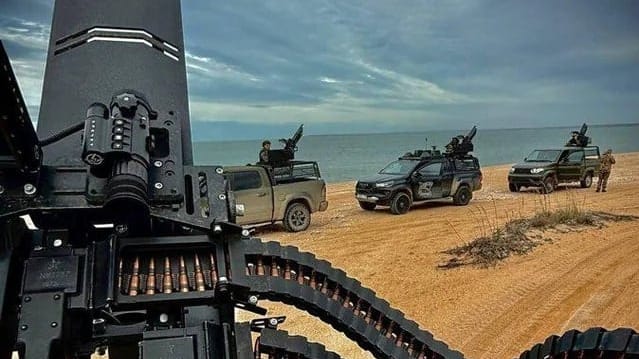
Faced with a serious threat from Ukraine's "middle strike" drone campaign in the Sea of Azov, Russian transport authorities are considering taking a page from the experience of Russian truck convoys on the road to Crimea, which face an identical threat.
On the highways, Russian fuel and ammunition trucks are often accompanied by mobile fire groups - machine gunners in trucks - which are tasked with downing incoming Ukrainian attack drones. The duty is hazardous, as the gunners themselves are a priority target. But the operating model is well-established, used by both sides in the conflict as an inexpensive way to counter slow-moving, low-flying drones; Ukrainian units' effectiveness in shooting down slower prop-driven Shahed drones has reportedly prompted Russia to field faster-moving jet drones, according to ISW. Within Russia, a series of long-range Ukrainian strikes on warehouses and refineries has prompted an acceleration of mobile fire group recruitment for domestic air defense operations.
Both sides have to deploy finite resources well, and each expansion of the target list expands the territory that must be protected. The threat to shipping expands the area at risk out to sea, further stretching available resources of equipment and manpower - a goal in itself, as it thins out the resources available on land.
A Ukrainian FP-1 drone struck the Russian bulk carrier NEW VICTORY in the northeastern Black Sea on July 24. The Belize-flagged vessel was heading toward the Taman Peninsula, according to the latest MarineTraffic data. #Ukraine pic.twitter.com/yoRapUMdVk
— NOELREPORTS ???????? ???????? (@NOELreports) July 28, 2026
According to Bloomberg, Russian authorities are responding to pressure and looking at ways to harden the vessels against inbound drones. The list of options starts with passive defenses, like cables and mesh strung from the deckhouse to catch and detonate drones before they make contact - an arrangement seen across the front lines for the protection of high-value assets and infrastructure.
The next step up would be embarked guard detachments with machine guns, equipped with suitable mounts for temporary shipboard installation. These mobile fire groups would board at the port of departure on the Sea of Azov, provide manually-operated air defenses through the Kerch Strait, and disembark after the passage - removing the weaponry upon departure. The concept has similarities to the private maritime security contractor arrangement used by merchant shipping to combat Somali piracy: the weapons go on the ship and come off the ship without touching a foreign jurisdiction, avoiding the regulatory complications of crossing borders while armed.

that matters most
Get the latest maritime news delivered to your inbox daily.
Personnel close to the Russian deliberations told Bloomberg that military patrol boat escorts and convoy operations could also be used. This approach is a familiar strategy but could have unintended side effects: Ukraine's drone forces prioritize strikes on military patrol vessels, and convoying - rather than dispersing - would concentrate the vessel targets in a smaller area. Ukraine's Unmanned Systems Forces have shown a preference for striking areas of concentration, particularly anchorages, and convoying could create a similar hazard.
Until Russia finds a way to mitigate the threat, its wheat exporters will have a difficult time reaching foreign markets. About one quarter of Russia's grain export capacity passes through the Sea of Azov, and there are few alternative routes to water, according to World Grain.
