
Port Everglades: A Diversified Cargo Gateway Built for Performance
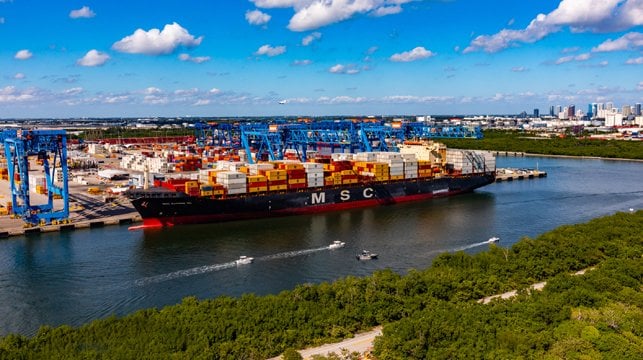
In a maritime industry increasingly defined by reliability, capacity and connectivity, Port Everglades has solidified its position as one of the most diversified and resilient ports in the United States. Located in South Florida -- within one of the nation’s largest consumer markets -- the port offers shipping and cargo terminal operators a powerful combination of strategic geography, responsive infrastructure and a balanced cargo portfolio that spans containerized, dry bulk and breakbulk freight.
For cargo executives evaluating gateways in the Americas, Port Everglades represents a proven logistics platform that consistently delivers operational performance and access to high-value markets across the Caribbean, Latin America and beyond.
A Record Year Demonstrates Strength
Fiscal Year 2025 (Oct. 1, 2024, to Sept. 30, 2025) marked a defining milestone for the port. For the first time in its modern history, Port Everglades simultaneously achieved record volumes in cargo, energy and cruise operations -- a trifecta that highlights the strength of its diversified business model.
On the cargo side, the port handled 1,167,552 TEUs, setting a record and reflecting sustained growth in global trade connections. The milestone underscores the port’s expanding role as a logistics hub linking U.S. markets with key international partners.
Energy throughput also reached new heights, with 131,855,261 barrels of petroleum products moving through the port. This performance reinforced Port Everglades’ standing as Florida’s leading petroleum port, supplying fuel to 12 counties and five international airports.
Meanwhile, cruise activity surged to 4,773,873 guests, a 16 percent year-over-year increase for the third-busiest cruise homeport in the world.
Collectively, the port generates approximately $28.1 billion in annual economic activity, supports 12,272 direct local jobs and contributes to more than 204,000 jobs across Florida.
For cargo stakeholders, these results signal stability: Diversified revenue streams help ensure the port continues investing in infrastructure and services that support freight growth.
Infrastructure Built for Cargo Growth
Port Everglades is backing its growth trajectory with a long-term capital investment strategy designed to expand capacity and improve productivity across its cargo terminals.
The port recently updated its Master/Vision Plan, outlining approximately $3.8 billion in capital investments aimed at strengthening infrastructure for cargo, cruise and energy operations.
A major milestone was the completion of the $471 million Southport Turning Notch Extension, which expanded berth space and enabled the installation of six Super Post-Panamax gantry cranes. These cranes significantly enhance the port’s ability to service larger container vessels and improve overall terminal efficiency.
Additional projects continue to bolster the cargo sector:
• Replacement of aging bulkheads throughout the port for safe navigation of marine vessels
• Structural upgrades to existing Samsung cranes, including enhanced lifting capacity of 65 long tons, electrical and mechanical improvements and new operator cabins
• Expansion of Slip 1 to accommodate Aframax-class vessels through a public-private partnership
Looking further ahead, the port is working with the U.S. Army Corps of Engineers to deepen and widen the harbor channel, a project projected for completion in 2034 that will further improve navigational efficiency for modern vessel fleets.
Private sector investment is also playing a major role. Terminal operators have introduced digital tools and operational improvements such as the Advent eModal appointment platform, real-time yard management systems and trials of electric yard trucks to enhance efficiency and sustainability.
Strategic Gateway to the Americas
Port Everglades’ geographic advantage is one of its strongest differentiators. The port sits at the center of a massive consumer region that includes more than 6 million residents within a 100-mile radius and access to roughly 156 million annual visitors to Florida.
Remarkably, 80 percent of cargo moving through the port happens within 80 miles, reducing inland transportation time and cost for importers.
The port also offers seamless intermodal connectivity through direct access to interstate highways and the near-dock 43-acre intermodal container transfer facility operated by the Florida East Coast Railway.
For international trade, Port Everglades is a dominant player in Western Hemisphere shipping lanes.
The port ranks:
• No. 1 among U.S. ports trading with the Caribbean, handling about 26 percent of the region’s cargo, including more than 266,000 TEUs annually
• No. 2 among U.S. ports trading with Latin America, accounting for roughly 10 percent of that trade, with more than 437,000 TEUs moving between the port and Latin American markets
Major commodities include apparel, motor vehicles and parts, machinery, furniture and perishables such as fruits and vegetables. The port is Florida’s leading gateway for perishables and ranks among the Top 10 U.S. ports in that category, handling more than 147,000 TEUs of refrigerated cargo in Fiscal Year 2025.
Transit times are another competitive advantage. Imports from Central American markets such as Guatemala and Honduras can reach South Florida in as little as three days, supporting time-sensitive supply chains.
Diverse Carrier Network
A strong roster of global and regional carriers further reinforces the port’s logistics ecosystem.
Today, 25 cargo services connect Port Everglades to international markets through shipping providers that include CMA CGM, COSCO Shipping, Crowley, Hapag-Lloyd, Maersk, Mediterranean Shipping Company, Ocean Network Express, ZIM Integrated Shipping Services and regional specialists such as King Ocean Services.
Operational Performance on the Global Stage
Efficiency remains a key differentiator. According to the 2024 Container Port Performance Index, developed by the World Bank and S&P Global Market Intelligence, Port Everglades ranks in the top 20 percent of container ports worldwide among more than 400 evaluated facilities.
Regionally, the port ranks No. 3 in North America and continues to hold the No. 1 position in Florida.
The index evaluates global ports primarily on vessel turnaround times, which is one of the most critical indicators of supply chain efficiency.
At Port Everglades, improvements in berth capacity, modern cranes, gate systems and enhanced truck flow management have helped drive these performance gains.
A Port Designed for the Future
As global supply chains evolve, Port Everglades is not simply keeping pace. It is building the infrastructure, partnerships and operational performance required to remain a leading cargo gateway for decades to come.
Ready to do business with Port Everglades? Visit PortEverglades.net or call 954-468-0170.
This article is sponsored by Port Everglades.
The opinions expressed herein are the author's and not necessarily those of The Maritime Executive.
