
Dali’s Operator Respond to DOJ as $2.25B Maryland Settlement is Finalized
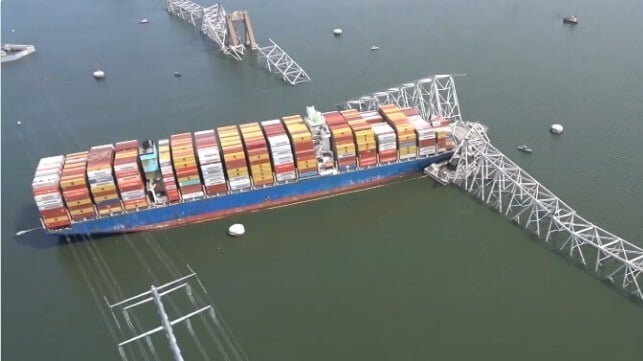
Synergy Marine Group, the operators of the containership Dali that destroyed the bridge in Baltimore in 2024, is responding to news that the United States is pursuing criminal charges, saying it was “surprised and disappointed.” As the criminal charges were being announced against Synergy and a technical supervisor, the State of Maryland announced it had finalized terms of a record $2.24 billion settlement for its claims in the civil case.
“This is a maritime casualty that should be assessed through the full factual, technical and regulatory record, rather than through selective mischaracterizations in a criminal indictment,” says Synergy Marine in its statement. “DOJ is criminalizing a tragic accident.”
The Department of Justice unsealed the criminal indictment on Tuesday with a total of 18 charges. It asserted the vessel’s manager knew of the problems aboard the Dali and failed to notify the U.S. Coast Guard, and continued to operate the vessel. They cited the use of a "flushing pump" to supply fuel to the Dali’s generators, asserting it was not designed to restart and failed to do so after the first blackout, causing the ship to blackout again and hit the bridge.
Principal Deputy Attorney General Adam Gustafson outlined the federal case, asserting it was an “unapproved flushing pump.” He said in his statement that Synergy knew about the improper use of the pump. Further, he cited the two power failures the vessel experienced at the dock in Baltimore, further asserting the company’s employees did not investigate or report the blackouts and later provided false documents and false statements to the NTSB.
Synergy is asserting that the charges in the indictment are “baseless,” saying it will “vigorously defend itself against these inaccurate allegations.” It takes the position that the Dali experienced a power loss due to a “manufacturer’s latent defect,” i.e., the loose wire that the National Transportation Safety Board identified in its report.
“The DOJ’s reference to the vessel’s use of the flushing pump is wholly irrelevant to the cause of the allision and runs contrary to the conclusions reached by the U.S. National Transportation Safety Board following a comprehensive 20-month maritime accident investigation,” asserts Synergy.
Maryland Settlement
While the criminal indictment was just announced, Synergy, along with the vessel’s owner, Grace Ocean, is also facing the start of a trial on the civil claims. The State of Maryland, various state agencies, the city of Baltimore, the families of the six individuals killed when the bridge collapsed, the owners of the cargo on the Dali, and many local businesses have filed civil claims for their economic losses.
The State of Maryland had previously announced a tentative settlement for its portion of the claims, and on Tuesday afternoon, the state’s Attorney General, Anthony Brown, announced the final details. The state and all of its agencies are settling their claims for a total payment of $2.25 billion.
The amount of the settlement is especially significant after Grace Ocean and Synergy Marine filed with the court to limit their joint liability. Citing the Limitation of Liability Act of 1851, the companies said the liability should be limited to the value of the vessel and its cargo, a total of $43.7 million.

that matters most
Get the latest maritime news delivered to your inbox daily.
Maryland reports that it and its agencies have settled all their claims against Grace Ocean and Synergy, while highlighting the settlement does not resolve the state’s claims against the ship’s builder, Hyundai Heavy Industries. The state said it intends to continue to pursue those claims.
The civil case against Grace Ocean and Synery Marine is scheduled to start its trial on June 1. The judge will decide if the companies are entitled to the limitation of their liability, and then the claims from the City of Baltimore and the other businesses and individuals.