
Competing Strategies Emerge for Opening the Hormuz
A resumption of international freedom of movement through the Strait of Hormuz is clearly of vital importance to the maritime community.
Doing so by force has, for the moment, been largely ruled out by almost everyone who might be expected to effect it. Not only would it be a risky and high-casualty operation, but it would run the risk of further widening the conflict.
It is becoming apparent that, having precipitated the closure of the Strait, the U.S. Administration may, however, wind down its war with Iran without seeing the Strait reopened. So other nations are considering their options. Whereas the United States benefits from the free flow of traffic through the Strait, but is not dependent on it, Gulf countries and others in Asia and Europe are critically reliant on ships transiting the Strait – and without which some countries will face national emergencies, as fuel for power generation, agriculture, and water services runs out or becomes impossibly expensive.
There is clearly no consensus yet on how nations of the world should respond to Iran’s aggressive retaliatory actions in the crisis. Different initiatives are being pursued, and it is still difficult to see which will gain the most momentum and forward traction.
Israel probably stands alone in this matter, as usual with probably some covert support from countries in the region, and is not necessarily fully aligned with the United States. Israel has no particular interest in reopening the Strait, as this does not impinge directly on Israeli national security. But irrespective of U.S. wishes, Israel will continue its campaign against Iran until it is confident that Iran no longer poses a short- or medium-term threat to its survival. This may entail inflicting further damage to Iran’s national infrastructure – to a point where Iran may be tempted to accept a ceasefire, which, if it requires a cessation of all military activity, might mean that the threat to the Strait is lifted. Some estimates emerging from the U.S. intelligence community suggest that at this point only half of Iran’s missile and drone inventory has been destroyed; on this basis, Israel might well see a need to prolong its campaign and force a ceasefire, but the goal of reopening the Strait will not have much force as a factor in any such decision.
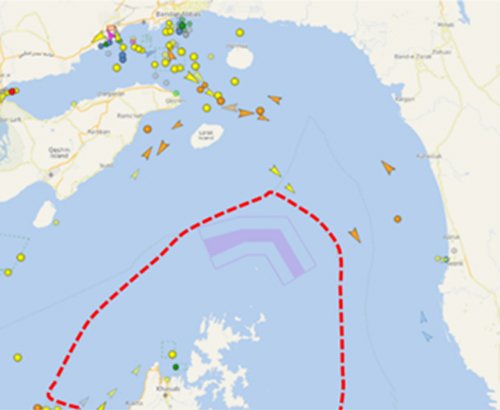
The Straits of Hormuz and the Traffic Separation Scheme empty of ships on April 3, with large numbers of vessels in the Bandar Abbas roads and some tankers sailing north around Larak Island in Iranian waters. Omani territorial waters are within the red dashed line. (VesselFinder/CJRC)
The GCC nations of the Gulf – Bahrain, Kuwait, Oman, Qatar, Saudi Arabia, and the United Arab Emirates – are clearly desperate to get the Strait reopened. Within the GCC, there will be differences of view over whether to call an immediate ceasefire or to support continuance of the war until Iran is forced to concede. There does seem to be agreement, however, that GCC countries should not, for the moment, enter the war. The consensus agreed among the GCC appears to be reflected in the resolution Bahrain has put before the UN Security Council, with drafting assistance from the UK. The resolution has five key points, calling for free, unrestricted use of the Strait, authorization of defensive and deterrent measures to secure passage and support safe passage, and a leading role for the UN Security Council in overseeing and implementing a solution. Acceptance of the resolution without a Chinese or Russian veto is still uncertain, and it may not pass without further amendment.
The parallel initiative led by London, which convened an initial 40-nation virtual conference on the issue on April 2, is set to support the effort in the UN by considering the practical steps to move the UN Security Council resolution further forward.
Oman is part of the GCC compact, but has a nuanced position because the established Traffic Separation Scheme channels in the narrows lie wholly within Omani territorial waters. Oman has long believed that it enjoyed the confidence of Iran, having established trusted partner status during many diplomatic mediations. This relationship has been badly damaged by Iranian drone attacks on Omani port infrastructure in Duqm and Salalah and by attacks on ships in Omani territorial waters, with social media commentators in Oman describing Iran as “treacherous.”
Oman’s contacts with Iran continue, and Omani authorities still appear to believe that the relationship can be resurrected and put to good use, as indicated by a recent Ministry of Foreign Affairs statement on March 29 suggesting that “the competent authorities are still investigating” the “true source and motives” of the drone attacks, avoiding attribution of blame on Iran. Iran is suggesting that it is in dialogue with Oman about establishing a post-war system for regulating traffic in the Strait, which implies that it would seek to charge tolls and impose conditions. But after bilateral discussions, Iran frequently and unilaterally puts out distorted versions of what was agreed upon, and Oman is resolute in seeking to restore unhindered international freedom of access through the Strait, as called for in the resolution put before the UN Security Council on April 3.

that matters most
Get the latest maritime news delivered to your inbox daily.
Whatever may transpire, Oman is likely to have a key role in arrangements finally agreed to reopen the Strait. This is because ships transiting the Strait will need to travel through Omani waters, and any infrastructure needed will probably require a supporting site on Omani soil, for example, the Omani naval base on Goat Island on the northern tip of the Musandam peninsula.
For its part, Iran may well allow a resumption of traffic through the Strait. But it will seek to vet those seeking passage, as it is already doing, and may well charge tolls and impose political conditions. A re-opening on this basis might appear attractive to some nations desperate to resume access in the short term. But any such solution is likely to be only temporary, as Iran would have a mechanism in place to blackmail both shipping lines and particular flags at a whim. This is not going to happen, and in particular would be unacceptable to Gulf nations, who need the free passage as a matter of national survival but who cannot subordinate themselves to Iran. To achieve such suzerainty would realize Iran’s ambitions to be the leading regional power, which has always been Iran’s ambition, and would be the ultimate signal of Iran’s victory in the current conflict.
The opinions expressed herein are the author's and not necessarily those of The Maritime Executive.