


Op-Ed: Where Have All the Daniel Inouyes Gone?
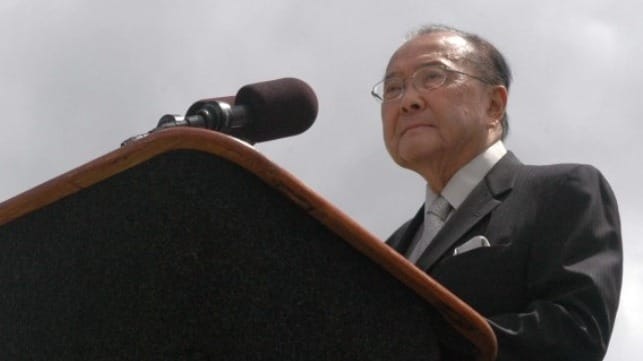
Regardless of your political leanings, it's hard to argue that the late Senator Daniel Inouye's life reads like a work of fiction. A witness to the Japanese attack on Pearl Harbor, he rendered aid and saved lives as the Pacific Fleet burned. Labeled an "enemy alien" by the country he loved, he was battlefield-promoted from sergeant to second lieutenant, and he distinguished himself in combat beyond what most could conceive. Leading the charge on three enemy machine gun nests, he pried an unexploded grenade from his own detached arm (shot off at the elbow) and threw it, eliminating the final position. He continued and led his unit forward, taking down at least one more enemy combatant, and ultimately only left the field after being shot a fifth time.
His courage earned him a Medal of Honor, and not a single man under his command was lost that day. He went on to earn a law degree, become Hawaii's first full congressional representative following statehood, and served Hawaii and the United States for 58 years. For mariners, he brought that same grit and fight to the Senate floor.
Primary architect of the Maritime Security Program (MSP), champion of the Honolulu Harbor container yard reconstruction at Pier 29, and a persistent enforcer of cargo preference provisions under the Jones Act, Senator Inouye never failed to look beyond the islands he represented. His efforts sustained 4,500 shipyard workers, facilitated billions in American shipping, and kept Pacific maritime capability intact at a time when it could easily have been traded away.
When Pearl Harbor Naval Shipyard faced potential closure or consolidation under Base Realignment and Closure Commission recommendations, Inouye went to work again. Rather than accepting the loss of a critical Pacific build and repair hub, he challenged the shipyard to demonstrate measurable improvements in cost control, quality, and safety; the areas where it had fallen short. The maritime industry answered the call, as it tends to do. The culture shift at the yard produced real results: costs came down, quality and safety improved, and legislators were reminded of what American workers could accomplish when given the chance. Behind the scenes, Senator Inouye fought consistently for a robust maritime industrial base, for the enforcement of the Jones Act, and for an industry that too many of his colleagues took for granted.
That industry is again in trouble. On the defense side, we are short on qualified mariners and shore-based support; simultaneously, quality, schedule, and cost challenges persist in naval shipbuilding and ship repair. On the commercial side, American shipbuilding capacity has deteriorated to approximately 0.1% of global output, against China's 51% and South Korea's 28%. This as mariners sit at the union hall and foreign-flag trade continues to flow through American ports.
The 2026 Maritime Action Plan (MAP) identifies the right pillars for success: rebuilding shipbuilding capacity, reforming workforce education and training, protecting the maritime industrial base and the ports sector, and restoring national security and industrial resilience. The administration got the diagnosis right. The problem is not identifying the faults, those we have known for quite some time. The problem now is execution.
This is where we need our next Inouye. As any mariner who has worked at sea knows: if everyone owns a system, nobody does. Two things must happen now to turn the MAP into results.
First, we need a designated leader to carry it out. Without Congressional buy-in and a champion willing to push through resistance from one administration to the next, even the best plan becomes a document rather than a directive. The Department of Transportation should empower MARAD - which is charged with fostering a merchant marine "sufficient to carry the greater portion of its commerce and serve as a naval or military auxiliary" - to own the execution of this plan, not just advise on it.
Second, regulation must follow. Executive orders start engines; regulation keeps them running. EOs are wiped from administration to administration while regulation persists. Senator Inouye understood this. He held Democrats and Republicans alike accountable, ensuring that the maritime industry had a voice and received attention regardless of who occupied the White House. That durable, institutionalized advocacy is what we are missing.

that matters most
Get the latest maritime news delivered to your inbox daily.
On my way to work one morning in Hawaii, I was walking (because I was too poor to afford gas or parking), and I crossed paths with Senator Inouye, not long after he had visited BAE Hawaii Shipyards. He stopped. He listened. He was present and clearly passionate about ensuring that the workers keeping our maritime capability afloat knew that someone in Washington saw them. I was a nobody, and he treated me like I mattered. When news of his passing reached the Hawaii ship repair community, the grief was immediate and visible in the faces of men not given to showing it. My supervisor at the time, a particularly hardened man, put it plainly: “Hawaii and the maritime industry had lost their greatest friend.”
I applaud the current administration for taking aim at a priority that has languished for far too long. But applause gets us nowhere without execution. The map exists. Now we need someone willing to lead the charge, absorb the hits, and keep moving the way a young soldier from Hawaii once did on a hillside in Italy.
The opinions expressed herein are the author's and not necessarily those of The Maritime Executive.
