
Archaeologists Uncover Danish Navy Flagship From the Battle of Copenhagen
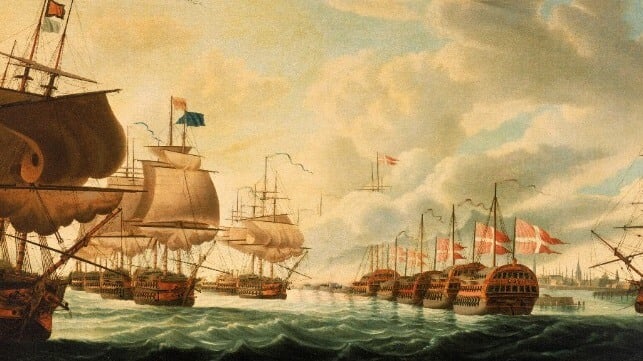
Marine archaeologists have discovered the wreck of a famous Danish warship on the bottom of Copenhagen's harbor, a reminder of the War of the Second Coalition and the 1801 Battle of Copenhagen.
The battle was among the best-known victories of Admiral Horatio Nelson, who was tasked with seizing Copenhagen's harbor and compelling the Crown Prince of Denmark to abandon the new League of Armed Neutrality. This new Russian-Danish-Norwegian-Prussian-Swedish naval alliance threatened to undermine British control of the shipping lanes to and from France; Britain and France were at war, and the Royal Navy needed to maintain a naval blockade of French ports.
A fleet of 12 British ships of the line - backed up by frigates and bomb vessels - sailed from Britain to convince Denmark to revise its alliance with Russia. Admiral Hyde Parker was in command, with then-Vice Admiral Horatio Nelson as his second-in-command. Nelson led the attack on the Danish fleet, which was anchored in a line along the harbor's edge at Copenhagen. In the manner of the time, Nelson arranged his ships in a line and anchored them within about one cable's length of the opposing force, then opened fire with cannon broadsides; the Danish ships, also anchored, returned fire for the next four hours. Each vessel in the stationary melee continued unless disabled or destroyed. Famously, Nelson ignored an order from Parker to withdraw and continued in the fight. The Danish fleet, though numerous, was overwhelmed by the more powerful British force, and the Danes ultimately agreed to a ceasefire. For his role in breaking up the League (among many other victories), Nelson was created Viscount Nelson of the Nile.
During the fighting, the Danish flagship Dannebroge caught fire; after the battle, it exploded and sank, killing more than 50 crewmembers and leaving 19 missing. The wreck rested on the bottom undiscovered for 225 years, surrounded by cannonballs and bar shot. But this year, pre-construction surveys linked to a planned expansion of Copenhagen's waterfront district unearthed the remains of the long-lost ship. Developers will soon begin reclaiming part of the harbor to build a new residential district, to be called Lynetteholm, and the work requires archaeological exploration first.

that matters most
Get the latest maritime news delivered to your inbox daily.
“We are now gaining an archaeological body of sources on the Battle of Copenhagen, and that is something entirely new. It is not something that has previously been excavated or studied," said Otto Uldum, excavation leader at the site for the Danish Viking Ship Museum. “The dimensions of the timbers correspond exactly to the drawings of the ship that survive, and the dendrochronological dating matches the vessel’s year of construction in 1772. So we are stating this with a degree of certainty that borders on absolute."
Uldum believes that it is the first archaeological effort of any kind related to the Battle of Copenhagen. As the site is a war grave, the team is treating its finds with respect, including bones recovered that are believed to belong to crewmembers who went down with the ship. "We are far from finished sorting and analyzing the material, but we are bringing everything up," said Uldum.