
Churn in Horn of Africa Political Alliances
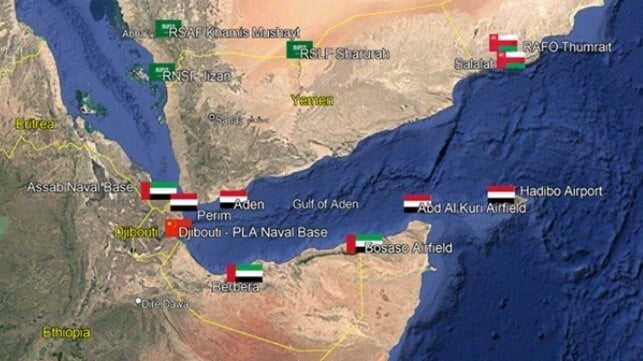
The Horn of Africa, embracing Eritrea with its Red Sea coastline, Djibouti and the component parts of what used to be Somalia, is in a state of flux, buffeted by the changing political situation in the neighborhood. How matters settle will have a direct impact on the safety and flow of merchant traffic through the Suez Canal and the Bab el Mandeb, a trade route using the Maritime Security Transit Corridor (MSTC) which recently carried just under 15% of world trade, and now, with the Hormuz War still a live issue, probably carrying rather more.
There are a number of dynamics at play.
Firstly, any potential interruption of traffic through the Bab el Mandeb has become a far more serious concern since the blockage of sea traffic through the Strait of Hormuz. More than 50% of Saudi oil is now being exported southwards from the East-West pipeline terminal at Yanbu through the Bab el Mandeb, up previously from about 20%. The United Arab Emirates likewise is reduced to exporting crude through the ADCOP pipeline to Fujairah on the Gulf of Oman. General cargo and container traffic is a little more flexible, and traffic through Salalah, Duqm, Sohar, Fujairah and Khor Fakkan reflects the upsurge in shipments to the Gulf States completing with a final land leg. The blockage of the Strait of Hormuz makes the Bab el Mandeb even more important.
The second major development has been the resurgence of the Internationally Recognized Government (IRG) in Yemen at the expense of the separatist Southern Transition Council (STC). Following its failed attempt to move forward with its secessionist position in December, the STC’s primary backer the United Arab Emirates announced its withdrawal from what it had described as its counter-terrorist operation in southern Yemen. Since then the IRG has consolidated its position, and support for the STC has further waned.
The UAE withdrawal has resulted in a number of bases covering the sea lanes in the Red Sea and Gulf of Aden being deactivated. Some mystery surrounds which bases retain a presence, notwithstanding the UAE announcement of its withdrawal, and how some of these bases used to operate. The UAE still retains positions in Eritrea and Somaliland, but probably no longer for example the EL/M-2084 coastal surveillance radar which used to operate from Bosaso. With the UAE no longer quite so present, it can be concluded that surveillance, and consequently the defense of Red Sea and Gulf of Aden sea lanes, has probably been degraded.
Given the growing disparity between military need and capability, it is no surprise that a number of diplomatic moves are afoot to address this issue.
For several months, reports from Washington think-tanks, Trump insiders and Massad Boulos, the State Department’s Advisor on African Affairs himself, have talked up a potential US-Eritrean rapprochement. Though opposed vocally in Congress on account for what has been described as Eritrea’s similarities politically to North Korea, the Eritrean embassy in Washington have said that Massad Boulos and Eritrean Foreign Minister Osman Saleh have had a “cautious but hopeful” dialogue. If anything useful were to emerge from these initial moves, it would be a triumph of pragmatism over political differences, especially as Eritrea still has a confrontational relationship with Ethiopia, with whom the United States enjoys a productive relationship. Eritrean ports nonetheless would be useful for maintaining over-watch over the southern Red Sea.
Recent weeks have seen a resurgence of Somaliland’s efforts to be internationally recognized, after the first such recognition was granted by Israel on December 26, 2025. Somaliland has enjoyed a successful and stable existence post its unilateral declaration of independence in 1991, in many respects one of Africa’s most successful democratic systems. With DP World having upgraded its container port, the harbor and 4,140-meter airfield in Berbera offer advantages over Djibouti’s rather over-crowded basing facilities, and its government is both stable and avowedly pro-Western. The Somaliland government might be willing to trade international recognition for the grant of basing facilities, as it is working towards with landlocked-Ethiopia, which is seeking a port where it can re-establish its navy.
The entry of Somaliland onto the world stage has predictably enraged Somalia, from whom it has seceded. Turkey has established a substantial presence at Warsheikh. Egypt too has strengthened ties with Somalia in Mogadishu, worried about Ethiopia’s bid to regain access to the sea and its control of Nile waters, even though now in operation the Grand Ethiopian Renaissance Dam has merely better regulated seasonal Nile flooding rather than reduced water flow.

that matters most
Get the latest maritime news delivered to your inbox daily.
Eritrea ought to be considered too inflammable to build up a secure long-term relationship with. But Berbera in Somaliland is different, and rather like Diego Garcia is close enough from which to deploy influence in regional hotspots without being too close to be vulnerable. Facilities and basing rights, as has been seen in the Gulf, can be a double-edged sword and proximity does not necessarily translate into tactical dominance.
But rather than substantially pulling back from the region, which has been the policy of successive US administrations, Central Command and Africa Command may be looking for an alternative, less intrusive footprint. Others are interested too. Closer US relationships in the Horn of Africa might help maintain stability and freedom of navigation in the area.
The opinions expressed herein are the author's and not necessarily those of The Maritime Executive.