
MOL Adds Wind Propulsion to In-Service Coal Carrier and LCO2 Carrier Design
Continuing to build on the interest in wind-assisted propulsion, Mitsui O.S.K. Lines (MOL) is highlighting two further advancements for its solid sail “Wind Challenger.” It worked in partnership to develop the commercial designs for the sail and has begun its deployment as part of its overall strategy to reduce GHG emissions.
Developed by MOL and Oshima Shipbuilding, the Wind Challenger is a rigid sail system that can sense wind direction and speed in real time and provides fully automatic control of sail extension, contraction, and rotation.
Having installed the system on two newbuilds, the company has now completed its first retrofit for the hard-sail wind propulsion system onto the Kurotakisan Maru III, an 89,999 dwt coal carrier delivered in 2021. The vessel, which is 235 meters (770 feet), transports coal for Electric Power Development (J-Power). It was the first of the ‘EeneX’ series, which are next-generation coal carriers that the company is building, and which adopted a double-hull structure that eliminates the need to fill cargo holds with ballast water. It is also equipped with an SOx scrubber.
MOL announced plans in May 2024 to retrofit the hard sail to this vessel. At the time, it said it expected to reduce greenhouse gas (GHG) emissions by about five percent on a Japan-Australia voyage and about eight percent on a Japan-North America West Coast voyage, compared to a conventional vessel of the same type.
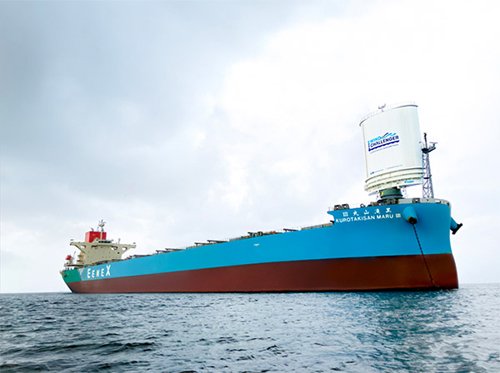
Hard wind sail retrofitted to the coal carrier (MOL)
The first installation was on the 100,000 dwt coal carrier, Shofu Maru, in October 2022. In the next 18 months through April 2024, the ship transported coal on a total of seven round-trip voyages to Japan, mainly from Australia, Indonesia, and North America, with daily fuel consumption reducing by up to 17 percent.
The second installation was on the 64,000 dwt Ultramax bulk carrier Green Winds, which was delivered in July 2024. With the system, the vessel was expected to reduce fuel consumption and GHG emissions by about 7 to 16 percent, depending on the ship route and other conditions.
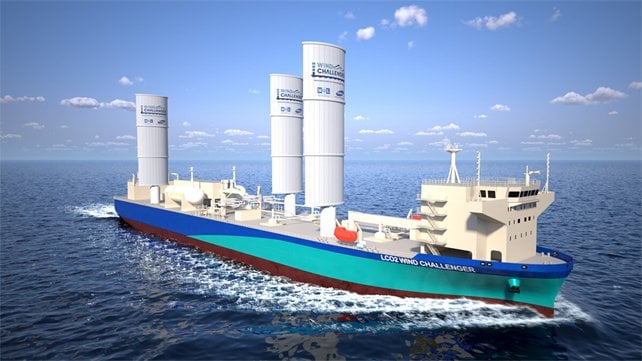
MOL also announced its next concept design for a 40,000 cbm liquefied CO2 carrier intended for cross-border CO2 transport. The design, which was developed in partnership with Samsung Heavy Industries, features three Wind Challenger units.

that matters most
Get the latest maritime news delivered to your inbox daily.
The new LCO2 carrier concept with the Wind Challenge installation obtained Approval in Principle from ClassNK (Nippon Kaiji Kyokai) on April 14. MOL highlights that the vessel design arranges the navigation bridge and accommodation spaces toward the bow to ensure improved visibility required for ship handling while enabling the installation of three Wind Challenger units. Moreover, the vessel design incorporates various safety considerations, including a safety passage between the engine room and accommodation, optimized arrangements of navigation lights, and placement of lifeboats.
MOL, which has set a target of achieving net-zero GHG emissions by 2050, has announced plans to install the wind-assisted propulsion system on 25 vessels by 2030 and 80 vessels by 2035.