


Unmanned Vessel Deploys With Carrier Strike Group for the First Time
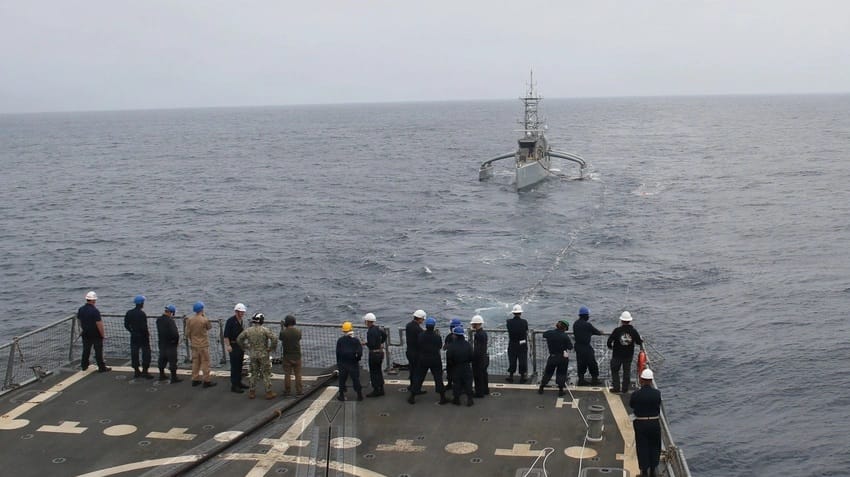
The U.S. Navy has confirmed that a midsize unmanned surface vessel has sailed with the USS Theodore Roosevelt Carrier Strike Group, currently under way in the Pacific. It is the first time that a deployed CSG has been accompanied by an unmanned vessel too large to stow on a ship.
Roosevelt got under way from San Diego on October 8, but preparations for integrating the USV into its escort force have been going on for some time. In September, the service released imagery of the destroyer USS Chafee practicing an astern refueling operation with the prototype USV Seahawk.
Seahawk predates the drone-vessel designs now in production for the Navy's MUSV program. The prototype dates back to 2017, when the Navy awarded Leidos a contract to upgrade its existing Sea Hunter design using lessons learned from early trials. Leidos kept the trimaran hull form, but re-engineered the vessel's systems for minimal human intervention at sea, hoping to achieve truly unmanned, self-navigating operations.
“We didn’t just put an autonomous navigation system onto an existing ship,” said defense executive Dan Brintzinghoffer, Leidos' Vice President for Maritime Solutions at the time of the USV's delivery(now with Austal USA). “Every mechanical and electrical system on Seahawk has unique configurations designed to run for months at a time without maintenance or a crew.”
As delivered in 2021, Seahawk was an unarmed vessel, intended primarily to carry surveillance equipment and a sonar system for tracking submarines. Details of its configuration for the Roosevelt Carrier Strike Group deployment were not released; Acting Secretary of the Navy Hung Cao suggested that it would be a useful addition.

that matters most
Get the latest maritime news delivered to your inbox daily.
"This is a first carrier strike group to ever deploy with a large-size unmanned surface vessel, and this is a force multiplier. Imagine having more guns out there," Cao said at a U.S. Army conference this week.
Cao also noted that the U.S. Navy had used unmanned underwater vehicles (UUVs) to demine the Strait of Hormuz, without exposing its mine countermeasures ships and crews to the risk of Iranian attack. In the early months of the conflict, experienced analysts suggested that the mines could not be removed without first neutralizing Iran's many threats to surface vessels. Cao confirmed that the demining would have been impossible in a contested area without using underwater drones.
