
Ukraine Summons Israel's Ambassador Over Second Shipload of Stolen Grain
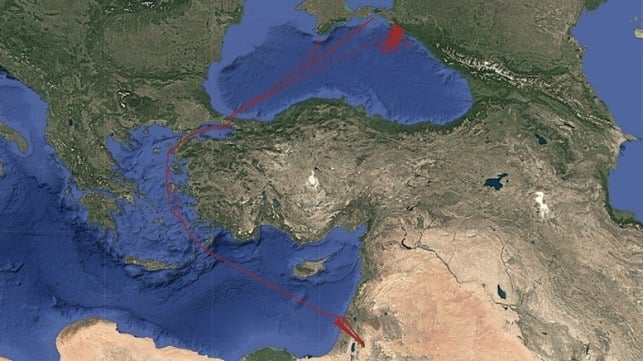
In mid-April, Ukraine's foreign ministry took the Israeli government to task for allowing a ship carrying allegedly stolen grain from Russian-occupied territories to unload at the port of Haifa. On Monday, Ukrainian foreign minister Andrii Sybiha said that he had summoned the Israeli ambassador to present a formal note of protest: a second shipload of allegedly stolen grain has arrived off Haifa, without action by the local authorities - and Kyiv wanted an explanation.
"It is difficult to understand Israel’s lack of appropriate response to Ukraine’s legitimate request regarding the previous vessel that delivered stolen goods to Haifa," said Sybiha. "Now that another such vessel has arrived in Haifa, we once again warn Israel against accepting the stolen grain and harming our relations."
The EU seconded the sentiment, in gentler terms. In a statement to the Times of Israel, an EU spokesperson said that "we condemn all actions that help fund Russia’s illegal war effort and circumvent EU sanctions, and remain ready to target such actions by listing individuals and entities in third countries if necessary."
The vessel has been identified by Israeli media as the Panormitis (IMO 9445201), a Greek-owned bulker that recently anchored off Haifa. Her exact position is unknown: due to the heavy GPS spoofing found in Israeli airspace, Panormitis' AIS system shows (falsely) that the vessel is located in a cluster of ships at Queen Alia International Airport in Amman, Jordan, 80 miles inland.
It is not Panormitis' first call in Haifa. AIS data provided by Pole Star Global shows that the ship spent about four weeks in the northeast (Russian) corner of the Black Sea in February through March, then transited to Haifa. She returned northwards to call again in the same region in April, potentially reaching the Kerch Strait, then transited back to Haifa once again. The vessel operated with AIS turned off for a significant part of her voyage in the Black Sea, a common practice in the region.

that matters most
Get the latest maritime news delivered to your inbox daily.
According to Haaretz, the Russian export system for ex-Ukrainian wheat revolves around ship-to-ship transfers, conducted near the southern entrance to Kerch Strait. Shuttle vessels move grain from Sevastopol and other Russian-occupied loading ports to a designated granary ship - in several cases, the bulker Glendale - which then transloads the grain onto the internationally-trading bulkers that carry it to market. In this account, based on satellite imaging, some of the ships that carry stolen grain abroad never call in a Russian port; they load offshore, and can therefore deny connections to the Russian occupation economy. Suspect voyages of this type between the Kerch Strait and Israel have been identified as far back as 2023, with multiple vessels implicated.
Israeli foreign affairs minister Gideon Sa'ar said in a statement that "evidence substantiating the allegations [about Panormitis] have yet to be provided," and he claimed that Ukraine had not reached out privately before broadcasting the complaint on social media. Sa'ar suggested that the matter would be handled locally as an administrative issue.