
U.S. Central Command Reveals Drone-Boat Presence Inside Iranian Waters
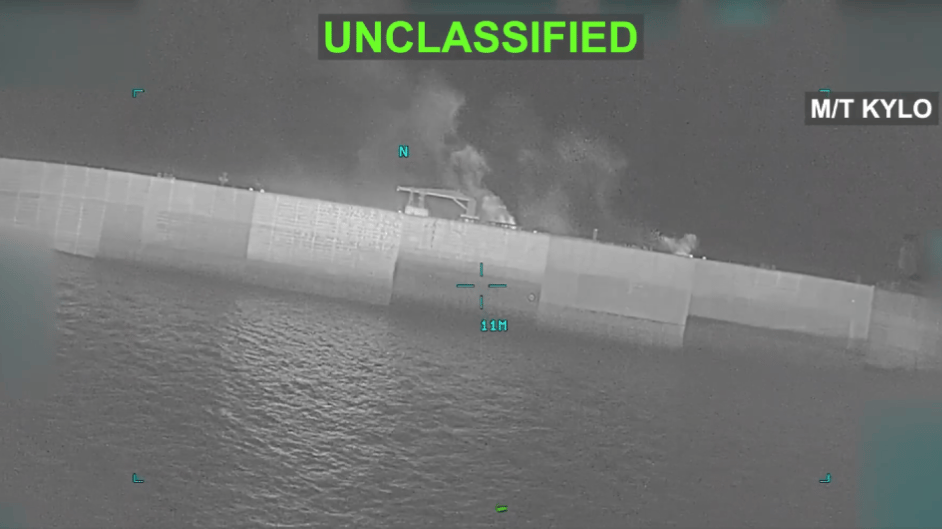
Whether deliberate or an accidental security breach – likely the former – US Central Command has revealed that it has an active physical presence well inside Iranian territorial waters.
In response to an attempted and thwarted Iranian attack on an unnamed US aircraft carrier in the Gulf of Oman employing a ballistic missile, CENTCOM carried out a series of retaliatory attacks on Iranian targets in return. Two tankers were hit in the Gulf of Oman: the Comoros-flagged tanker Kylo (IMO 9189146) in ballast, which sank, and the Iranian-flagged tanker Stark-1 (IMO 9171450) disabled off Jask, having loaded oil at Kooh Mobarak Single Point Mooring (SPM) to the west of Jask a few days earlier. The 275m Stark-1 had been hanging on the Kooh Mobarak SPM for most of August. Within the Gulf, the Iranian-flagged tanker Downy (IMO 9218480) in ballast was disabled off Kharg Island.
The Iranians are unlikely to want to use the Kooh Mobarak SPM again until the conflict is over. There may previously have been a temptation to load tankers there in an attempt to then sail along the Iranian coast, and thence into Pakistani waters and import terminals.

that matters most
Get the latest maritime news delivered to your inbox daily.
The video footage of the Kylo on fire and sinking originally showed close-in video footage of the tanker taken from sea-level, indicating the presence in the water of a US naval sea drone within meters of the hull. Social media footage has shown that the Kylo was close in to the coast and Iranian territorial waters.
The Fifth Fleet unmanned sea drone capability, developed extensively by Task Force 59 since it was established to conduct unmanned surveillance operations in September 2021, is clearly a powerful tool, and also likely to be a deterrent even to the small craft of the IRGC Navy taking to the water. It is a capability which is likely behind the US Navy’s ability both to clear mines in the Strait of Hormuz and also to prevent Iranian craft from laying any more – and hence the resort to laying mines through the expensive and inefficient use of Fajr-5 rockets instead.
