
U.S. Navy Tests Out a System to Refuel USVs at Sea
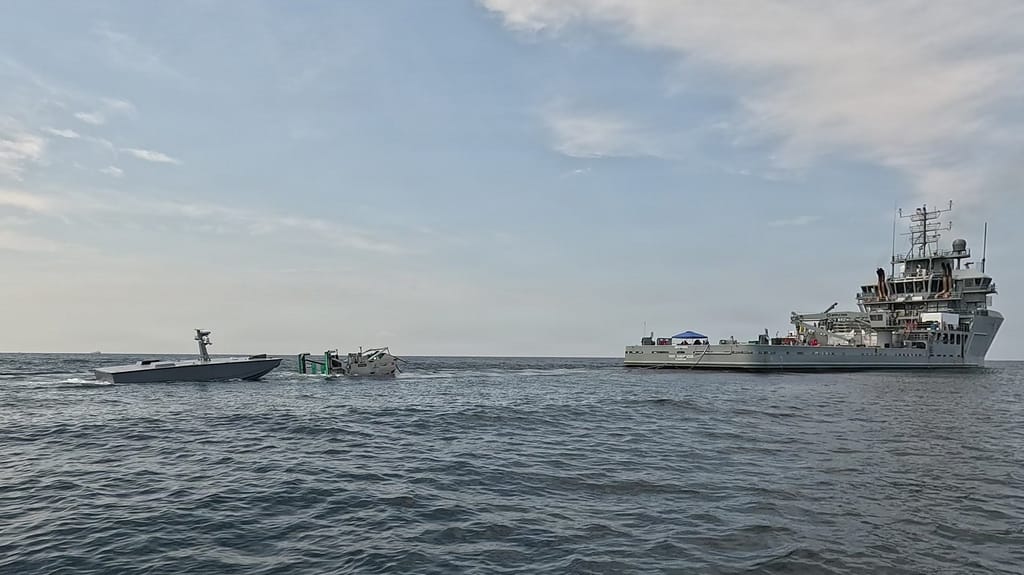
The U.S. Navy is beginning to move in earnest towards deployment of unmanned vessels for "dull, dirty and dangerous" missions on the high seas, from persistent ISR and ASW to high-risk strike roles. The advantages are obvious: unmanned vessels are far less expensive to build and operate, they would fill a hole in the Navy's small combatant fleet, and they can be expended without sustaining casualties. There are substantial technical challenges, though. There is no one on board to conduct maintenance, nor to hook up the cables and fuel lines for underway replenishment. One Navy command is trying to solve the latter issue with a towable "robotic refueling" system, which catches the USV in a dock-like structure and accepts a fuel probe to transfer over a supply of diesel.
The push for this system isn't being driven by surface combatant units, which get most of the attention, but by the Naval Air Warfare Center's Weapons Division, which has nothing to do with day-to-day front line combat - or even warships. The division's Blue Water Instrumentation lab wants to use USVs to collect sensor data during long-range weapons testing over open ocean, putting more sensors on station for longer without increasing the number of manned ships it uses. The big limitation for these small-craft USVs is range.
"[Weapons test] flight profiles can extend thousands of miles beyond fixed-range boundaries and require data-collection assets to be distributed across a vast area,” said Spencer Holloway, director of BWI’s Future Capabilities Office. “But the underlying challenge applies more broadly— every time an unmanned vessel must return to port for fuel, we lose persistence, reduce coverage and redundancy, and interrupt the mission.”
To reduce the need for port calls, BWI brought in Sealartec, maker of a towable docking system for USVs. The training support vessel USNS Vindicator towed Sealartec's device during a trial off Virginia and conducted fuel transfers totaling about 400 gallons. In all, the team conducted about 100 docking cycles to try out the system, with generally favorable results.
BWI and Sealartec took the idea for a trial into practice within seven months - a rapid turnaround for the Navy. Fleet Forces Command has picked up on the idea for general application out in the fleet.

that matters most
Get the latest maritime news delivered to your inbox daily.
“This will allow us to have greater reliance on unmanned vessels instead of manned and we can push the USV into higher threat areas without risking manned vessels and personnel,” Ronald Raymer, branch head for capability, innovation, science and technology integration at U.S. Fleet Forces Command. “It will also allow us to distribute greater capability into an area without having to invest in large expensive manned vessels and the refueling supports that.”
MARTAC, maker of the T38 unmanned surface vessel, supported the trials and said that the lessons-learned would inform future developments. Ultimately, BWI wants to develop a fully autonomous refueling cycle with the vessel driving itself into the dock and all subsequent procedures following automatically. Command-and-control latency during precise maneuvering was one issue identified during testing, Spencer Holloway, director of BWI’s Future Capabilities Office, said in a statement.
