
Two U.S. Deep-Sea Mining Companies Plan $1B Reverse Merger
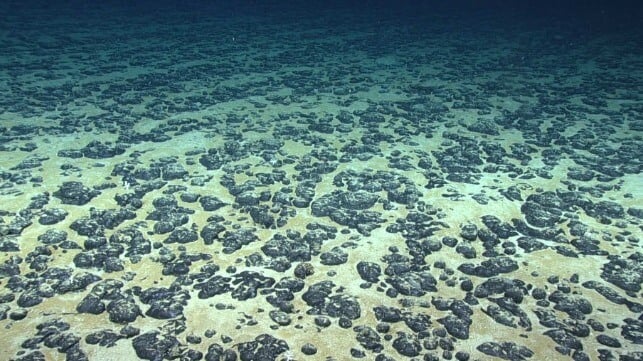
Two players in the nascent U.S.-jurisdiction polymetallic nodule sector have agreed to a reverse merger to combine their holdings and expertise, creating one of the larger operators in the segment.
The merger will bring together the strengths of the American Ocean Minerals Corporation (AOMC) with Odyssey Marine Exploration, and will operate under the AOMC name after completion of the process. The combined entity will have an equity value of about $1 billion and $175 million in cash.
"By combining AOMC’s capital and multi-jurisdiction asset base with Odyssey’s, and with a combined team representing 300 years of deep-sea expertise, we are building a scalable platform to support a more secure and diversified critical minerals supply chain," said Mark Justh, AOMC CEO in a statement.
The two parties have complementary strengths: AOMC is putting together a dual portfolio of exploration rights for polymetallic nodules in the Cook Islands, a jurisdiction favorable to deep-sea mining; and in international waters, where it hopes to operate under U.S. government regulation. Odyssey brings technical expertise and 30 years of experience in deep-sea operations.
AOMC believes that the combined entity will be able to implement "environmentally responsible harvesting technologies" for nodule extraction. It anticipates significant investment in intellectual property and in physical assets, to include technical R&D, construction or retrofitting a fleet of deep sea mining vessels, and building out support infrastructure on shore.

that matters most
Get the latest maritime news delivered to your inbox daily.
Many conservationists and marine biologists question the proposition that nodules can be removed in an environmentally responsible manner, and have called for extensive additional research on ecosystem impact. Past studies have shown decadal-scale damage from trial-run mining passes; once extracted, the nodules themselves only re-form on a geological timetable measured in tens of millions of years. BMW, Volvo Group, Samsung, and Google have all pledged not to source deep sea minerals over concern about ecosystem effects.
International marketability may be more challenging if the operation is conducted on the high seas without International Seabed Authority permitting, according to the ISA - a practice the U.S. government plans to support. UNCLOS requires all ISA member states to not recognize an ISA-unlicensed deep sea mining claim's legitimacy. That means that UNCLOS signatories are technically not allowed to recognize any ownership claim to the mining operation's products, making the ore harder to sell on the international market. A U.S. government buyer - like a defense critical-mineral stockpile program - could potentially provide a single customer for U.S.-nexus deep sea mining products, without incurring exposure to international law.