
Trident Sues Tacoma Fire Dept. for the Loss of the Kodiak Enterprise
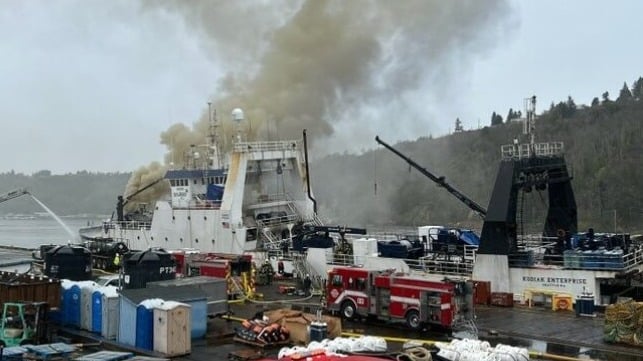
U.S. fishing company Trident Seafoods has filed a rare lawsuit against the city of Tacoma, Washington for alleged mishandling of the fire aboard the fishing vessel Kodiak Enterprise, which was destroyed in a massive blaze three years ago. A lawsuit against an emergency response agency is virtually unheard-of after a marine casualty, but Trident alleges gross negligence on the part of the Tacoma Fire Department.
In the early hours of April 8, 2023, a fire broke out in a compartment towards the bow of the Kodiak Enterprise while the vessel was alongside at the Port of Tacoma. The point of origin was likely in a dry stores space, according to Trident. The crew evacuated onto shore, and Tacoma Fire Department responded to the scene by about 0330 in the morning.
The fire department took command of the response and began its work. Meanwhile, Trident contracted with salvor Resolve Marine for expert marine firefighting services. Resolve has a base located in Tacoma and a strong presence in the Seattle area, and it mobilized a team to the scene beginning at about 0600 that morning. Tacoma Fire retained formal control, and Resolve's personnel acted in an advisory capacity.
A Tacoma Fire battalion chief took over the incident commander role at about 0720 hours, and the fire was substantially under control by 1330 hours, according to Trident. Resolve recommended boundary cooling and isolation (shutting down all ventilation) in order to let the fire burn out in the forward compartments, controlling risk.
Instead, the Tacoma Fire battalion chief insisted upon the opposite strategy, Trident alleges in its suit. Over the objections of Resolve's advisers, the incident commander allegedly ordered Tacoma Fire's responders to bring fans aboard and begin blowing large volumes of air into the space - a strategy called positive pressure ventilation (PPV) - at about 1845 hours.
In a shoreside fire, PPV is typically used after the blaze is knocked down or extinguished in order to clear out smoke and allow fire teams to move into the space, or to decrease the imminent hazards of smoke inhalation and heat for any trapped survivors (not a factor as the space was unoccupied). These use cases make PPV a popular firefighting tool for shoreside fire departments, but the technique is deployed with care: it has the risk of potentially re-igniting smoldering materials, as by the nature of its operation it blows additional oxygen into the fire space. PPV's success depends upon setting up a controlled airflow route between the blower fan at the entryway and a designated exit point for smoke and hot air.
PPV is controversial when applied in marine firefighting, according to the textbook IFSTA Marine Firefighting for Land-Based Firefighters, as ventilation inside a ship is harder to control. "Positive pressure ventilation is ineffective [in shipboard fires], and smoke movement is unpredictable," advised DoD civilian firefighter and consulting fire investigator Nicholas Palumbo in a recent editorial.
When Tacoma Fire's battalion commander ordered his fire teams to use PPV aboard Kodiak Enterprise, Trident asserts, Resolve Marine recommended against it and offered to take over incident command in the morning. The Tacoma Fire battalion commander proceeded anyways, without first arranging for a controlled ventilation pathway for the smoke and hot air to safely exit the space, Trident alleged in its complaint.
Per Trident's timeline, thick black smoke and flame emerged from the ship within a short time after Tacoma Fire commenced PPV in the fire-affected space. At about 2100, roughly 2.25 hours after ventilation began, Tacoma Fire's event chronology noted that the response was "transitioning to defensive." The agency evacuated its fire teams shortly after, and the fire burned through the rest of the ship over the course of the next several days. The Kodiak Enterprise was declared a total loss.
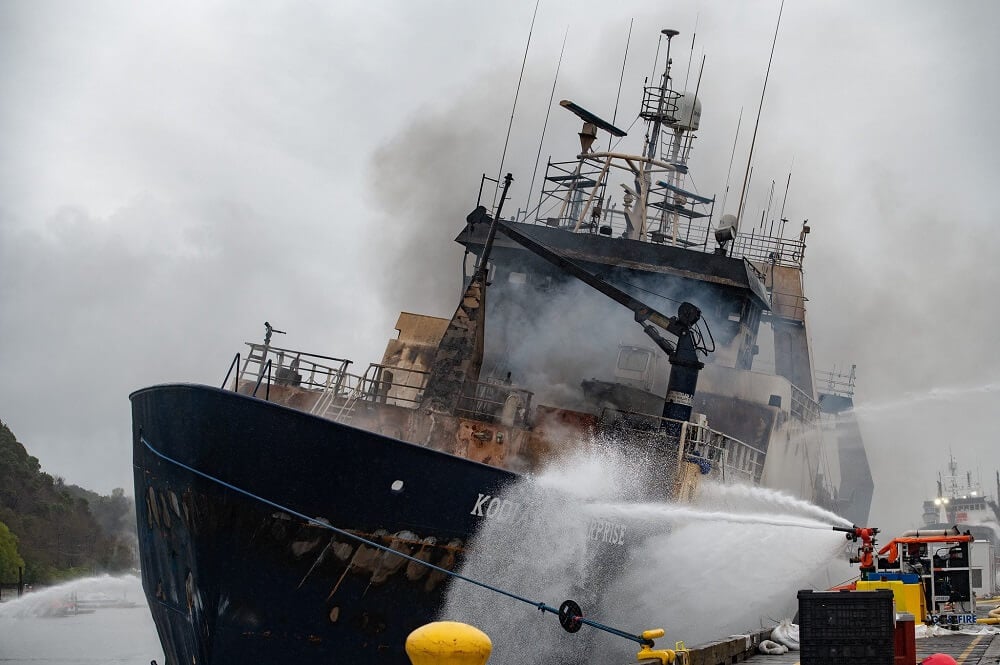
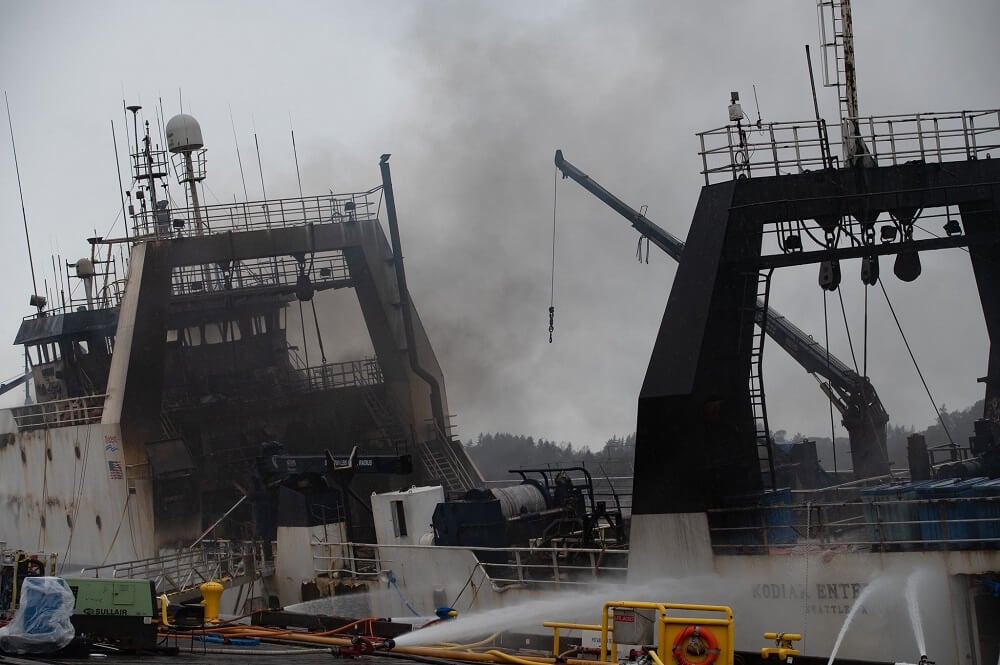
Images courtesy USCG
Trident alleges that the fire would have been contained to the forward compartment if Resolve's advice to isolate it had been followed; the company claims that the rest of the ship would have been unharmed if Tacoma Fire had not initiated positive pressure ventilation.

that matters most
Get the latest maritime news delivered to your inbox daily.
Trident claims that the value of the vessel was $185 million, and that the damages attributable to Tacoma Fire's decision came to at least $100 million.
Tacoma Fire and Resolve Marine have been contacted for comment.