
Severe Weather Disrupts Shipping in the North Atlantic
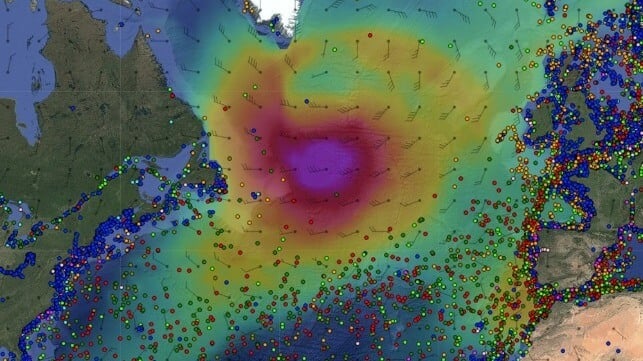
A severe, rapidly-intensifying storm is forcing ships to divert southwards to avoid serious conditions. A massive low of just 938 millibars is churning south of Greenland, bringing winds of up to 80 knots and "phenomenal" seas of up to 54 feet - genuinely difficult weather, even for large merchant ships.
AIS data provided by Pole Star Global suggests that almost all transatlantic shipping has diverted well to the south in order to avoid the worst wave heights, which are located in the southeastern and southwestern quadrants of the storm. Just a handful of ships are within the most affected area, located due east of Newfoundland - notably the 60,000 dwt bulker Nord Allegro, currently making about three knots and headed southeast, away from the storm.
"What makes this storm stand out is the extraordinary pace at which its central pressure is falling. When a large mid-latitude (extratropical) cyclone deepens by more than 24 hPa within 24 hours, it is classified as a bomb cyclone – the result of explosive cyclogenesis, also known as bombogenesis," commented weather consultancy Meteoblue in a statement. "In this case, the pressure is dropping even faster than this threshold, placing the system among the most intense North Atlantic storms observed so far this season."
Disruptive weather
Stormy North Atlantic weather has already caused multiple casualties around the British Isles over the last week. A French-registered trawler, Fastnet, grounded near Dingle, Ireland on Sunday and remains hard aground. The crewmembers were successfully helicoptered off, and salvors are now attempting to access the vessel to assess its condition and begin defueling - but heavy swells are impeding progress. Pollution remains a concern, as the ship could contain up to 10,000 gallons of fuel.
On the other side of the Irish Sea, a 24-meter guard boat from an offshore wind farm is under monitoring after running aground on the shores of North Pembrokeshire, Wales.
In the early hours of December 11, the guard boat Resolute grounded on the rocks on the coast near the town of Aber Hywel. Four crewmembers were on board, and they sent a distress call to request rescue. A helicopter aircrew responded to the scene, but the boat was moving too much in the surf to safely extract the survivors. Instead, the Fishguard RNLI inshore life boat - a small rubber-fendered craft - was tasked with approaching in shallows and waves to retrieve the crew. One person went overboard and into the water during the attempt to transfer to the inshore lifeboat, and the coxswain had to maneuver away from the wreck to retrieve the man-overboard. After the survivor in the water was safely brought aboard, the last crewmember was retrieved from the wrecked guard boat and all were transferred ashore.

that matters most
Get the latest maritime news delivered to your inbox daily.
Plans are under way to defuel the Resolute for pollution prevention purposes. It remains aground, and has reportedly taken on water.
Another minor casualty has disrupted food supplies to the Isles of Scilly, off England's far southeastern tip. The small coastal cargo vessel Gry Maritha sustained damage in heavy weather after departing Penzance on Friday evening, and was unable to offload cargo in St. Mary's. Local sources told BBC that the vessel could not berth at the destination port because of heavy swells in the harbor, and had to return to mainland England without offloading. Instead, air freight operators flew four tonnes of goods across the short distance to St. Mary's in order to ensure adequate supplies for residents.