


Royal Navy Pulls Last Ship From Bahrain, Ending 46-Year Gulf Presence
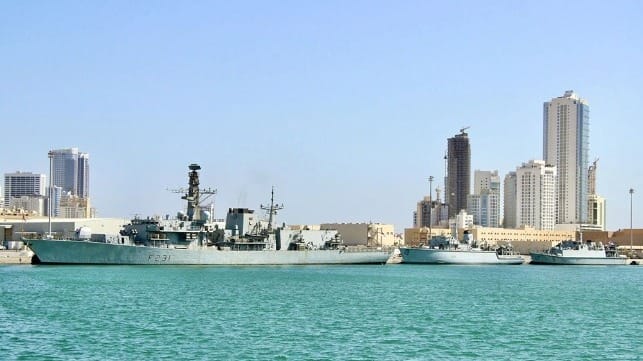
The Daily Telegraph has carried a report that the Royal Navy is intending to withdraw its last ship permanently stationed at HMS Juffair in Bahrain, leaving the naval base with no complement of ships. The report suggested that the Hunt-class minesweeper HMS Middleton (M34) will be withdrawn this year, possibly as early as March.
The permanently-deployed Type 23 frigate HMS Lancaster (F229) was decommissioned at HMS Juffair last month. A senior Royal Navy officer will remain in Bahrain, but will shortly not have any ships under command.
There is no indication of whether or when any Royal Navy ships will return to Bahrain once the acute shortage of frigates in 2026 is alleviated by the first deliveries of the new Type 31 frigates, the first of which will be HMS Venturer due into service in 2027. When Britain withdrew from the Gulf in 1970, it maintained thereafter a visiting presence, but a permanent fleet presence in Bahrain, latterly at HMS Juffair, has been in place since 1980.
The withdrawal of Royal Navy ships comes at a time of particular tension in the Gulf region. The outbreak of violent protests in Iran has for the moment subsided. But the brutal way in which these protests were suppressed, with reports that as many as 16,500 protestors have been killed, has planted the seeds for a revival of protests later this year. None of the underlying causes of the protests has been alleviated, and it is unlikely that the present regime in Iran has the means to make any meaningful improvements to the lives of ordinary Iranians.
HMS Middleton (M34) provided a unique niche minesweeping capability which complemented the US 6th Fleet presence. This would be of particular utility in maintaining freedom of navigation in the Straits of Hormuz, should this be disrupted during a further period of upheaval in Iran.
The withdrawal also comes at a time when the US 6th Fleet based in Bahrain is also low on numbers, and without a carrier support group. A lack of capability may have limited US options when it came to planning military responses after President Trump told Iranians that help was coming. The Nimitz-class USS Abraham Lincoln (CVN-72) and its carrier support group is believed to be on its way to the region.

that matters most
Get the latest maritime news delivered to your inbox daily.
In a deployment already underway, the Royal Navy is deploying a nuclear-powered Astute-class attack submarine HMS Anson (S124) to HMAS Stirling in Western Australia. As part of the UKUSA agreement, this deployment is likely to be of extended duration. HMS Anson left Faslane on January 10 and arrived in Gibraltar on January 16, where she appeared to be loading Tomahawk cruise missiles. En route to Australia she will therefore be a formidable capability, should any need arise in the Middle East or elsewhere.
The departure of HMS Anson from UK waters leaves an uncertain nuclear attack submarine capability available for duties in the North Atlantic, with the remaining boats of the Astute-class at varying states of readiness. There must be confidence however that in accordance with the First Sea Lord’s 100-day program to restore nuclear submarine capability, a boat will be available to track Russian intrusions through the Greenland-Iceland-UK gap and to cover the deployments of nuclear ballistic-missile armed submarines from Faslane.
