
Italy Seizes Bulker Accused of Falsifying Info to Hide Sanction Violations
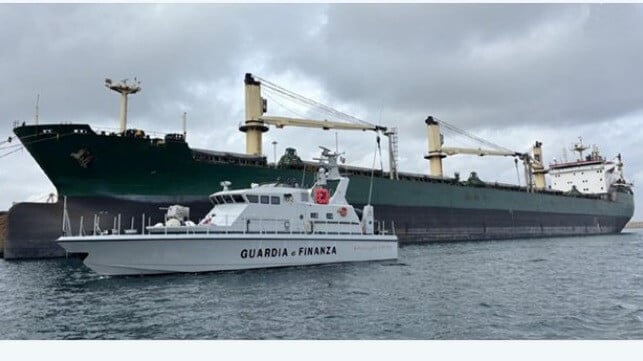
Italy’s Guardia di Finanza, working with the Customs Agency in Brindisi and other agencies, revealed it has seized a cargo ship accused of falsifying records to obscure violations of EU sanctions. The ship is suspected of illegally loading and exporting a cargo of 33,000 tons of ferrous metal from the Russian port of Novorossiysk. The details were released after the vessel was seized, and the shipowner, a Turkish company, and several crewmembers are being investigated.
The Italian authorities report that during an inspection when the ship arrived in the Port of Brindisi, “serious inconsistencies, falsifications, and alterations to the on-board documentation relating to the locations of stops and loading operations of the goods,” were revealed. They also assert that the vessel’s AIS system had been deactivated near the Russian port of Novorossiysk, “presumably with the intent of evading geolocation and hindering the control activities of the competent authorities.”
The Italian agencies did not name the vessel, but it is being widely reported as a Turkish-owned cargo ship, Hizir Reis, which is registered in Tuvalu. The 35,000-dwt ship arrived in Brindisi (according to its AIS signal) on November 21.
#GdiF #Brindisi @AdmGov sequestrata una nave battente bandiera estera con relativo carico di 33 mila tonnellate di materiale ferroso. #NoiconVoi pic.twitter.com/R7qli2CBlr
— Guardia di Finanza (@GDF) January 17, 2026
The Italian authorities report the ship was placed under an “emergency precautionary seizure,” while they investigated the situation. Officers from Guardia di Finanza conducted inspections of the ship’s documentation as well as data from its ECDIS system.
They determined that the ship had carried out prohibited cargo loading operations at Novorossiysk between November 13 and 16. They were able to reconstruct the route and operations carried out by the vessel. They did not say where the vessel was going or the destination of the cargo.
They assert that the captain made “misleading statements” during the inspection. They also assert that attempts were made to “obstruct the facts by alerting documents and turning off the transponder.”

that matters most
Get the latest maritime news delivered to your inbox daily.
A Port State inspection was also conducted on the vessel, which was built in 1999. They reported “structural condition” issues.
Coordinated by the Brindisi Public Prosecutor’s Office, the vessel and its cargo were ordered seized by the Italian courts. The importer, the shipowners, and several crewmembers remain under investigation for circumventing European Union sanctions.