
Vietnam is Winning the Trade Wars
[By Roland Rajah]
Vietnam has again emerged as the apparent winner of Donald Trump’s trade wars, as was the case during his first presidency. Vietnam’s exports have boomed, despite facing US tariffs (now at 20%) and having to compete with surging Chinese exports. Vietnam exported $474 billion worth of goods in 2025, up almost $70 billion on 2024.
As my colleagues and I argued in a recent paper, this export strength could prove relatively durable – driven by Vietnam’s sheer economic competitiveness and, relatedly, the ongoing process of Vietnamese goods replacing Chinese ones in the US market amid rising tensions between them.
Still, question marks continue to swirl as to whether Vietnam is truly benefitting from this apparent export success. For some, it merely reflects a big rise in indirect Chinese exports, either via illegally transhipped goods to evade higher US tariffs on China or through the export of Chinese parts and components which then undergo light assembly before being reexported with little domestic value added by Vietnam itself.
There is some truth to this. Yet the overall signs are that Vietnam is reaping solid economic benefits from its latest export success, even as it becomes more reliant on Chinese imports.
One obvious point is that Vietnam’s strong exports reflect much more than its trade with America. Vietnamese exports to the US and non-US markets rose by roughly equal amounts (about $34 billion) last year.
There is no doubt tariff-dodging transhipments to the United States are occurring. But how important is it? Various estimates exist for the period following the first US–China trade war (see here, here, and here) as well as for 2025. All suggest transhipment is material but only a small part of what is happening.
If there’s not that much transhipment going on, then what explains the recent surge in Vietnam’s imports from China, which rose by more than $40 billion to reach $186 billion last year?
This is, in fact, not that hard to explain. A similar dynamic was evident after the first US–China trade war that started in 2018. As my colleague Ahmed Albayrak and I have shown using trade in value-added data, the big increase seen in Vietnam’s imports from China during those years was not as unusual as many seemed to think. Instead, it could easily be explained by a combination of rising domestic demand in Vietnam, the usual amount of Chinese inputs needed for Vietnam’s booming exports to non-US markets, and, yes, some increase in the role of Chinese inputs going into Vietnam’s exports specifically to the United States. Notably, most of the value in Vietnam’s exports to America still came from non-China sources, most importantly Vietnam itself.
IMF researchers also looked at this in a nice study released mid last year. They too concluded that most of the increase in Vietnam’s exports to the United States during that episode came via genuine trade relocation and domestic value addition.
We don’t yet have updated data to repeat the analysis for 2025. One clear difference this time is that the jump in Chinese imports has been much sharper, rising by almost 30% in a single year. That suggests Chinese imports are indeed playing a much bigger role in enabling Vietnam’s increased exports. But with two important caveats.
First, the sharper increase in Chinese imports partly reflects stronger Vietnamese domestic demand, which grew by 8% in 2025 compared to 5% on average during 2018–22, as the latter period overlapped with the Covid-19 pandemic.
Second, after accounting for stronger domestic demand, the increase in Vietnam’s total imports does not look so unusual for what the country normally needs to feed its export machine. Total imports in 2025 grew by 19%, slightly faster than total exports at 17%. With growth in imports and exports largely tracking each other, that suggests little change in Vietnam’s domestic value-addition role.
However, with imports from China up 30%, imports from other countries have grown more slowly, at only 13%. Hence, Vietnam’s exports are indeed becoming more reliant on Chinese imports, but at the expense of other import sources (notably South Korea) rather than it indicating a dilution in Vietnam’s domestic value-addition role.
Importantly, other signs suggest Vietnam is realising broader benefits that mirror what happened after the first US–China trade war. Studies focusing on that earlier period find Vietnam benefitted through gains in industrialisation, more formal employment and higher wages (especially for women), increased foreign direct investment, and greater economies of scale that enabled higher exports to both the United States and other markets.
The data for 2025 paint a similar picture. Manufacturing GDP grew by 10%. Vietnam added 265,000 new industrial jobs. The share of workers stuck in low productivity agriculture fell. Monthly earnings for wage employees rose 6%. Despite high uncertainty, foreign direct investment (both actual and new greenfield deals) remained strong, boding well for future exports and growth. There is also good evidence of industrial upgrading. Industrial production in consumer electronics grew 21%, outpacing more basic manufacturing in clothing, footwear, and other apparel. And Vietnam is attracting substantial higher tech investments, for instance in semiconductors and electric vehicles.
All this is not solely, or even primarily, due to the US–China trade war in diverting trade and investment. Much of it reflects Vietnam’s homegrown progress and trade integration efforts with the rest of the world. Vietnam’s latest push to turbocharge competitiveness-enhancing reforms adds further upside potential.
A US clampdown on indirect Chinese exports, further tariffs, or a downturn in the world economy could easily derail this positive story. But for now, Vietnam is winning the trade wars.

that matters most
Get the latest maritime news delivered to your inbox daily.
This article appears courtesy of The Lowy Interpreter and may be found in its original form here.
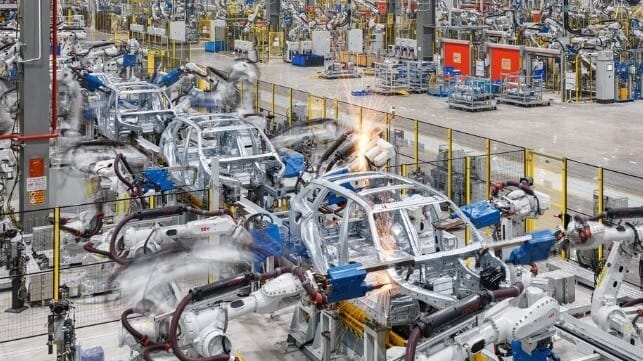
Top image: Electric car plant, Vietnam, 2023 (Taofast / CC BY SA 4.0)
The opinions expressed herein are the author's and not necessarily those of The Maritime Executive.

