
Oman Leverages its Influence With Iran to Resolve Strait of Hormuz Impasse
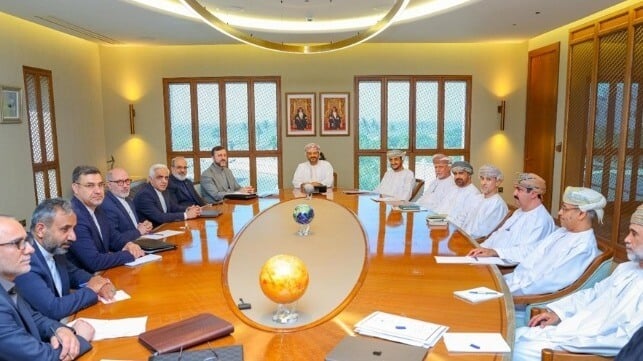
In parallel with ceasefire talks between American and Iranian diplomats in Islamabad and Doha, Oman hosted an Iranian delegation in Muscat on May 24 to discuss the specific question of navigation in the Strait of Hormuz.
Oman has clearly stated its position that it wishes to return to the antebellum situation in the Strait of Hormuz, where the IMO-endorsed Traffic Separation Scheme (TSS) has the force of international law, previously a status recognized by both Iran and Oman. Both channels of the TSS lie entirely in Omani territorial waters, and for decades Oman has administered and overseen the TSS operation as a free service, without tolls or pilotage fees, for the international maritime community.
But Oman has taken an independent line in the peace talks between Iran and its adversaries. It did not join Circular Letter 5028 submitted to the International Maritime Organisation on May 20 by all the GCC states, less Oman, and fronted by the United Arab Emirates. The Circular was unequivocal in its condemnation of Iran for unilaterally taking on powers of sovereign governance, to be administered by its Persian Gulf Strait Authority, and for seeking to divert traffic to an unsafe channel, so as to levy fees and exert controls. Notwithstanding Oman’s non-signature, the Circular in particular cited Iran’s unjustifiable ‘attempt to divert the established Strait of Hormuz TSS that lies entirely within the territorial waters of the Sultanate of Oman’, a scheme internationally-recognized since 1968. Omani diplomats have cordially declined to offer details as to why Oman did not join the démarche.
Oman has barely acknowledged Iranian drone attacks on its infrastructure, let alone take Iran to task for the damage and casualties inflicted both to port facilities and to ships in Omani territorial waters. This restraint has perplexed some other GCC leaders.
At the same time, government delegations have been flying between Tehran and Muscat as negotiations have been taking place elsewhere. It is inconceivable that these singular aircraft movements in otherwise empty Iranian airspace were not notified to the US military authorities in advance, and clearances given.
The most likely explanation for Oman’s apparently incongruous position is that Oman is seeking to distance itself from Iran’s adversaries, so that it can have better influence with Iran bilaterally. Oman prides itself on its diplomatic links with Iran, trust having been built up over decades of interaction. This political capital and understanding is probably the most useful contribution Oman can make to solving the crisis. But it is only of value if deployed discreetly.

that matters most
Get the latest maritime news delivered to your inbox daily.
In this scenario, Oman uses its influence and leverage to persuade Iran to moderate its position over the Strait of Hormuz, and Iran then reflects that new positioning when it next meets American negotiators. Signing up to IMO Circular Letter 5028 would have weakened Oman’s ability to reason with Iran over the matter in the talks in Muscat on May 24, and would run contrary to Omani Foreign Minister Sayyid Badr’s nostrum (long followed by the Sultanate) on diplomacy in a multi-polar world, in which he advocates "talking to anyone for the good of everyone." d
As negotiations between Iran and the United States continue, it is to be expected that Oman will sit close to Iran, acting as a friend, but discreetly nudging and persuading Iran to take conciliatory steps towards ending the war – without claiming any credit, and probably earning some disfavor for doing so, but for the good of everyone.