
NYK Plans Long-Term Preservation of Japan’s Last Surviving Ocean Liner
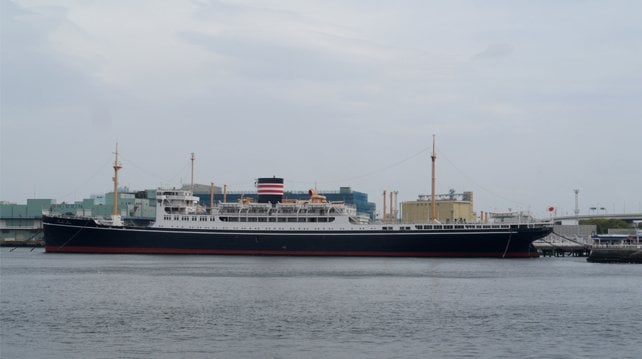
Planning is underway for the long-term preservation of the 95-year-old former ocean liner Hikawa Maru, which is now on permanent display in Yokohama. Considered a nationally important cultural property, the vessel was the largest Japanese passenger ship to survive World War II and today is celebrated as a key part of NYK and Japan’s maritime heritage.
The company reports that an expert committee specialized in ship preservation and architecture will meet for the first time on January 8, 2026. The committee’s goal is to establish technical and conservation policies for repairs, while determining the best practices for the future upkeep of the vessel. They will also explore exhibition strategies to help revitalize the Yokohama waterfront.
“This long-term preservation project aims not only to ensure the ship’s structural soundness but also to enhance public engagement with the ship’s rich historical legacy,” reports NYK.
Since 2024, NYK reports it has been conducting surveys on the hull of the Hikawa Maru to assess its safety and structural integrity in preparation for large-scale repairs. The project aims to preserve its historic shipbuilding and design heritage while ensuring safety through expertise from Japan and abroad.
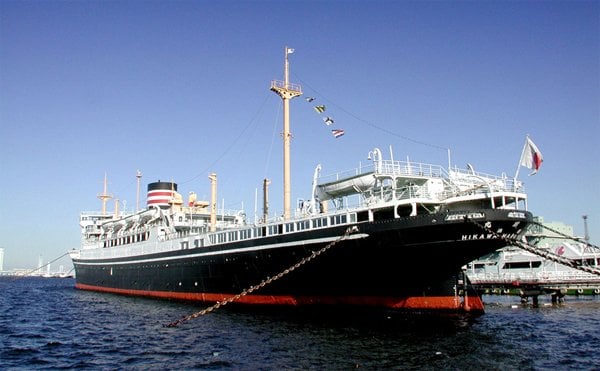
Surveys are determining the condition of the 95-year-old vessel (NYK)
Nippon Yusen Kabushiki Kaisha (NYK), established in 1885, today operates more than 800 ships worldwide, ranging from dry bulk to energy and car carriers, as well as being one of the three founding partners of Ocean Network Express (ONE). While it has a small cruise ship division, Asuka Cruise, the company has a long heritage in passenger shipping, which is celebrated in a maritime museum in Yokohama (currently closed for renovations) and by preserving its liner, Hikawa Maru.
Built by the Yokohama Dry Dock Company (now part of Mitsubishi Heavy Industries) and having entered service in May 1930 as the first of three sister ships, Hikawa Maru was not the largest, nor most prestigious, of the Japanese passenger fleet. At 11,600 gross tons, she was a passenger-cargo vessel specifically designed for the service between Japan and Seattle, along with her sisters Hiye Maru and Heian Maru. There were each 163 meters (535 feet) in length with a maximum speed of 18 knots and as built carried 76 passengers in first class, 69 in tourist class, and 183 in third or steerage.
Over the next 11 years, before its service was suspended in July 1941, NYK reports Hikawa Maru completed 73 crossings of the Pacific carrying about 10,000 passengers. Among the notables that sailed aboard the ship was silent movie star and producer Charlie Chaplin, and in 1937, the vessel carried members of the Japanese royal family home from Victoria, Canada, after attending the coronation ceremonies of the UK’s King George VI.
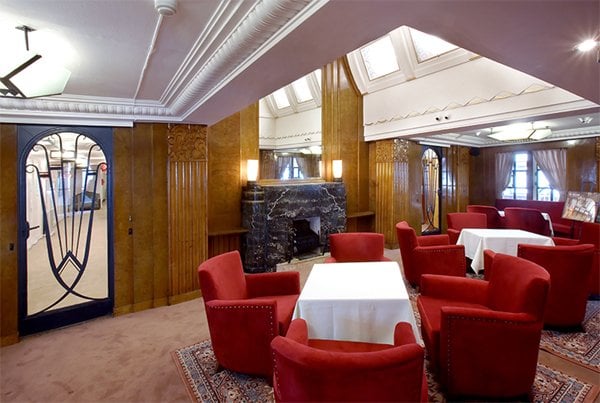
First Class lounge (NYK)
During World War II, she operated as a hospital ship, making 24 trips transporting over 30,000 wounded soldiers back to Japan. NYK reports that on three occasions she struck mines, but avoided catastrophic damage. Both her sister ships and much of NYK’s passenger fleet, however, were destroyed. The company lost a total of 185 ships during World War II, with only 37 surviving. Faced with strict post-war rules, for a time, Hikawa Maru was considered an American war prize, and when returned in 1947 was only permitted to sail a domestic service. In 1949, she was permitted to haul rice from Burma (Myanmar) and resumed her Pacific passenger-cargo service in March 1951.
Through the 1950s, the ship made seven annual voyages between Japan, Seattle, and Vancouver. She had completed a total of 254 voyages on the Pacific and carried more than 25,000 passengers when NYK decommissioned her in 1960.
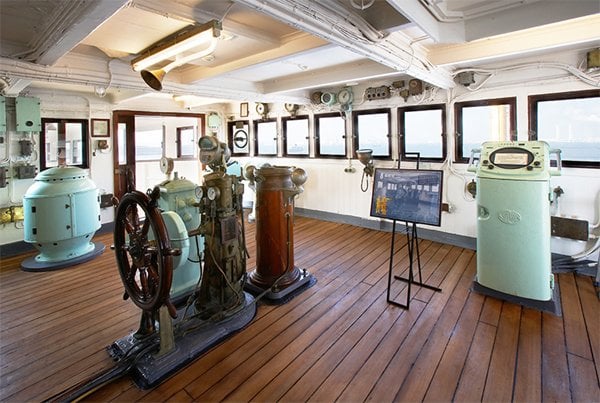
Preserved bridge of the former liner (NYK)
She was likely to have been scrapped when the city fathers of Yokohama requested that NYK moor the ship as part of the efforts to revitalize the port. She was opened as a museum ship, classroom, and youth hostel starting in 1961. Hikawa Maru was closed in 2006 for a large-scale restoration project and reopened two years later as a museum managed by NYK. Japan’s Ministry of Education, Culture, Sports, Science and Technology designated her as an Important Cultural Property in 2016.
Visitors to the ship see various exhibits and can tour spaces including the bridge, captain’s office, the first class lounge, a deluxe cabin, a third class cabin, and the engine room. Exterior deck spaces are also accessible. The company says it authentically showcases the shipbuilding technology and interior decoration of the time, and as such, remains an important icon of the past.

that matters most
Get the latest maritime news delivered to your inbox daily.
Top photo of Hikawa Maru in 2018 by Zairon (CC BY-SA 4.0)