
UAE Withdrawal Underway from Red Sea and Gulf of Aden Positions
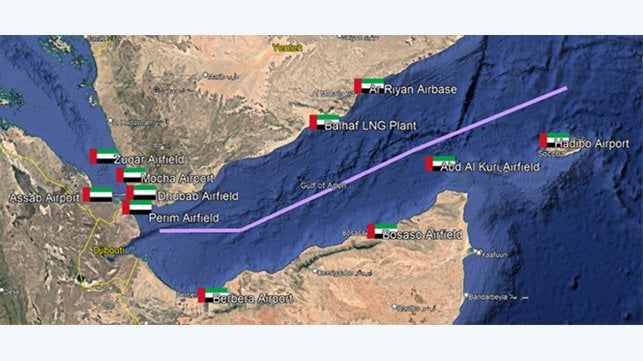
The deployment of Emirati forces in locations to the north and south of the Maritime Security Transit Corridor (MSTC) in the Gulf of Aden, and in similar positions dominating sea routes through the southern Red Sea, is currently in the middle of a significant upheaval. The process is ongoing, and it remains to be seen what Emirati footprint remains in the area once the withdrawal is announced as complete.
This development comes after two advances in which allies and proxies of the United Arab Emirates made two dramatic moves to increase their dominance in the area. In the first, forces of the UAE-supported Southern Transition Council (STC) occupied positions in the Hadramawt and Mahra provinces of eastern Yemen, displacing forces aligned with Yemen’s International Recognized Government (IRG) and supported by the Saudis. As a coup de main, this was never likely to work long-term; locals in these areas enjoy their semi-autonomy and are difficult to dominate contrary to tribal wishes. Opposition from the IRG, the Saudis and the Omanis, muted and diplomatic at first, grew, as it appeared that the Emiratis had over-reached themselves in their ambitions.
Opposition to the UAE move was consolidated on the day after Christmas, when Israel granted diplomatic recognition to Somaliland, the first country to do so since Somaliland’s unilateral declaration of independence in 1991. The UAE was not directly associated with this move, but regional sentiment assumed that it was, given the UAE’s military presence in Somaliland, its support for the breakaway Somaliland government and Benjamin Netanyahu’s statement that the move was in ‘the spirit’ of the Abraham Accords, to which the UAE is a party.
The convergence of opposition to both these moves generated a hardening of regional push-back to the Emirati attempts to consolidate the position of the STC, which many assumed was a precursor to the STC making a unilateral attempt to reestablish Southern Arabia as an independent sovereign state. On December 30, the IRG formally withdrew its mandate for the Emirati military presence in Yemen, demanding that UAE forces withdraw within 24 hours; this precipitated what appears to have been the very well-organized UAE withdrawal operation.
Emirati C-17, C-130 and CN-235M transport aircraft have since been observed at most of the airfields where a UAE presence has been noted, with aircraft flying multiple return trips to the UAE. Military airlift has probably been supplemented by the civil IL-76 heavy lift aircraft frequently chartered by the Emiratis. An Emirati-chartered ship, the Ro-Ro cargo ship MV Greenland (IMO 8222111) returned to the port of Mukalla to re-load military vehicles which had been targeted by a Saudi airstrike in the meantime. The Greenland is managed by the Salem Al Makrani Cargo Company, based in Dubai.
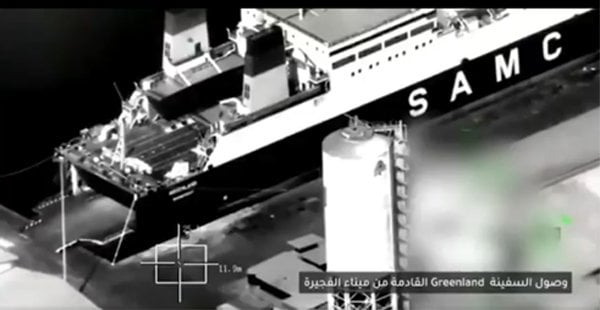
MV Greenland docked in Mukalla port, imaged by a Saudi surveillance drone (KSA Ministry of Defence)
At this point, it is not clear if any Emirati military assets remain in Yemen. It is not apparent if the Emirati withdrawal extends to the humanitarian organizations which have been used to bolster support for those favored by the Emiratis in its Aid to the Civil Community effort. Nor is it clear if STC-affiliated military organizations, such as Major General Tareq Saleh’s National Resistance Forces in the coastal and offshore area around Mocha, or the Southern Giants Brigade, whose forces had moved in to the Hadramawt and Mahra, will continue to receive Emirati sponsorship. If they do not, then the military efficiency and effectiveness of these organizations may well tail off, to the detriment of the fight against the Houthis. They may also be in the market for alternative sponsors, which in turn could prompt a realignment of the coalition within the IRG – or possibly even with the Houthis.
While the Emirati withdrawal has proceeded, but its full extent remains unclear, Yemeni forces loyal to the STC are still in the field, and are now being encouraged by Saudi airstrikes to withdraw. The situation remains in flux.

that matters most
Get the latest maritime news delivered to your inbox daily.
The Emiratis had invested heavily in the network of airfields overlooking the southern Red Sea and Gulf of Aden. These outposts however were rarely if ever used as bases for Emirati strike assets, which suggests their primary purpose was to conduct surveillance and to gather intelligence, using only a lightweight footprint on or near these bases. If that was indeed the purpose of these bases – to host and support an intelligence collection effort - then it is difficult to see what immediate advantage this has brought the maritime community. Notwithstanding the presence of naval forces as escorts, civilian shipping remained vulnerable to Houthi attacks until a ceasefire was declared politically, mediated and delivered as usual by the Omanis in the wake of Israeli and US airstrikes.
Not directly pertinent to the maritime community, a retrenchment of Emirati force deployments in the area may also impact Emirati support for General Khalifa Haftar’s forces in Eastern Libya and the Regional Support Forces fighting in Sudan’s civil war. Emirati air bridge support for both these factions has been flown through the network of Red Sea and Gulf of Aden air bases.